 Collections
  Magazine
  Exhibitions
  ITA version












Even the most creative idea needs actions to become real. The act of writing is one of these actions. First, there is intuition, urgency, or necessity, and then there are novels, stories, essays, and all the infinite types of artistic forms that involve the use of written words. This is how the Stesure series is born, published in Italian by Franco Cesati, and curated by the author and researcher Alice Avallone and the writer and story editor Leonardo Staglianò. Stesure branches out around the enigmatic act of writing, which, as the curators say, has fascinated humanity since immemorial times.
From narrative to the digital world, from journalism to public speaking, the series aims to be a tool for those who read and write, helping them understand the various facets of storytelling, starting from the creative process.
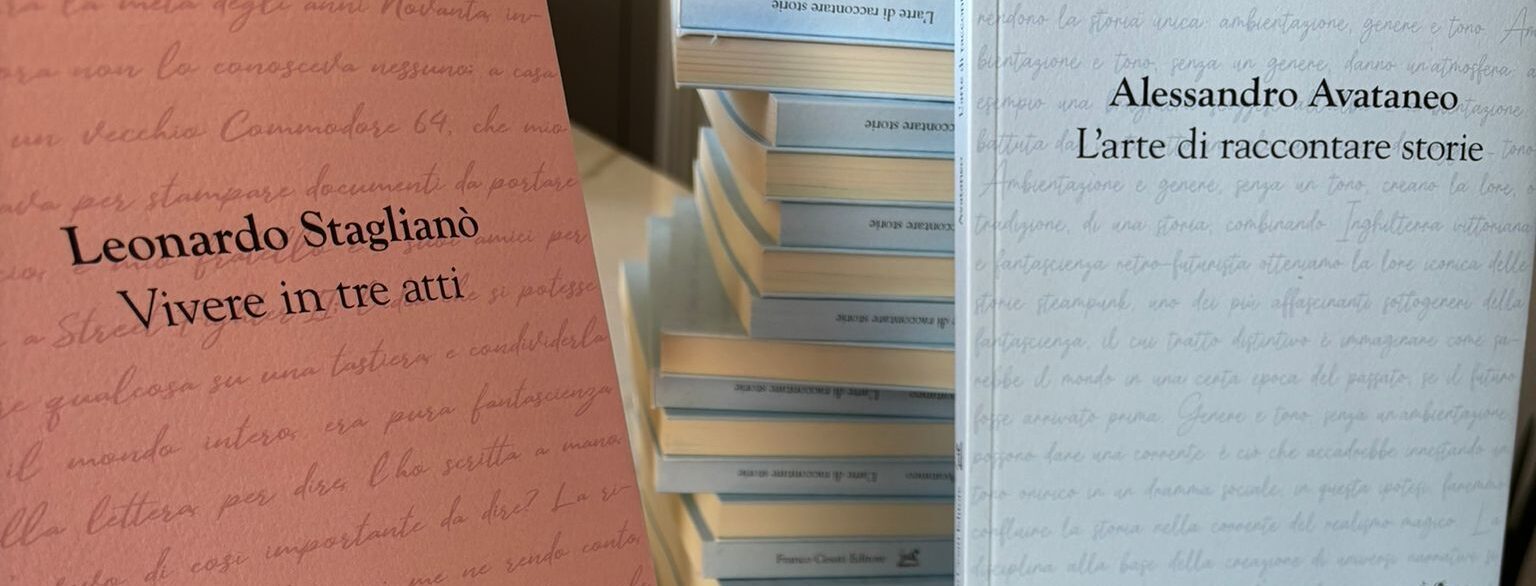
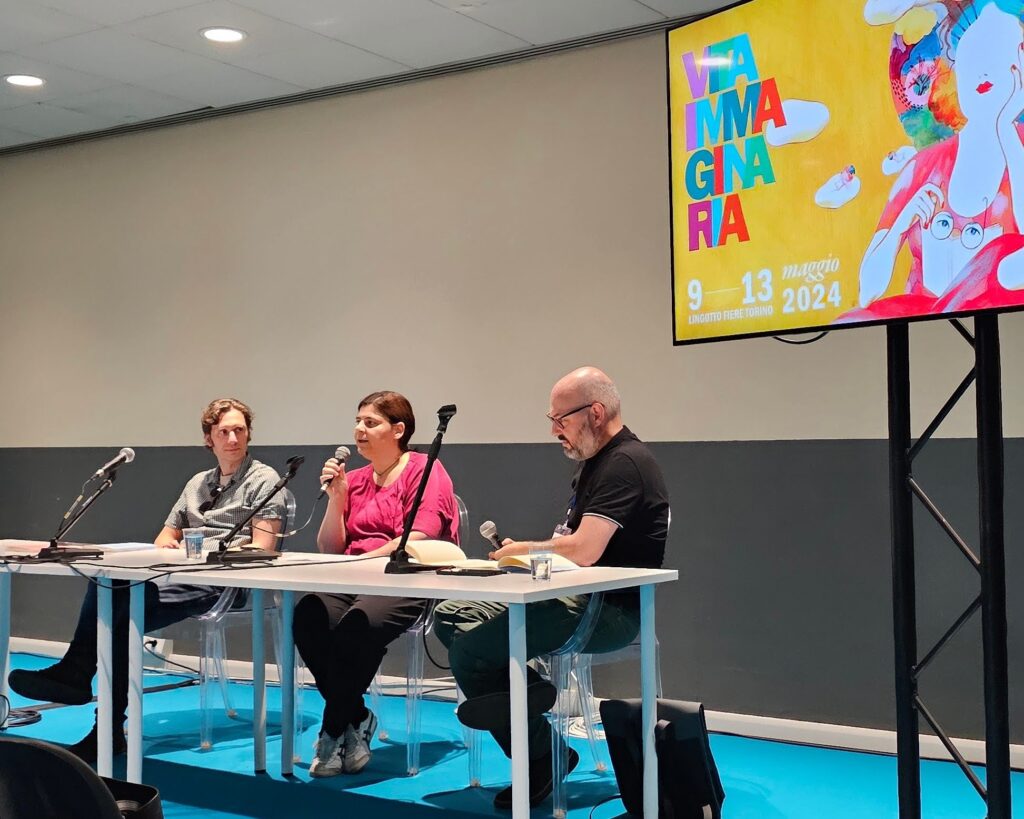
On the occasion of the 36th Turin International Book Fair, Stesure meets the public for the first time. It presents its first two titles: The Art of Telling Stories (L’arte di raccontare storie) by Alessandro Avataneo and A Life in Three Acts (Vivere in tre atti) by Leonardo Staglianò.
The Art of Telling Stories by Alessandro Avataneo
If the series aims to explore words, in his book Avataneo decides to share with the public an equation: the equation of all stories. Searching for universal criteria and correlations may seem provocative; instead, the author relates the elements present in narratives — having identified them in every form — in an experiment that, almost with a scientific spirit, continually tests his equation.
Around this research develops a multifaceted essay-memoir that guides readers to explore different worlds (painting, literature, cinema, visual and performing arts), analyzing classics, niche works, and popular franchises.
The result is a map capable of guiding people to understand the profound mechanisms of storytelling, which, as Avataneo writes, means reclaiming the unique adventure of which we are protagonists: our own life.
When we pick up a book from the shelf, or press the play button, when the curtain opens or darkness falls in the movie theater, there, that is the moment when we rub the lamp and release the genie of the story
From The Art of Telling Stories by Alessandro Avataneo
A Life in Three Acts by Leonardo Staglianò
Like Avataneo, Staglianò also sees his thesis in numbers—specifically, in one number: three. To understand its significance, the author takes readers back to ancient Greece in the 4th century BCE to meet Aristotle. The philosopher discovered that Homer and the great tragedians told their stories by dividing them into three parts. Aristotle defined this narrative technique as dramaturgy, which still demonstrates its validity today despite the passage of time and the new term of three-act structure.
In addition to bridging the gap between storytellers of the past and present, Staglianò asserts that this book poses an existential question: what if life itself were in three acts? One, two, three – within the pages of the essay-memoir, readers find themselves measuring tertiary time like a metronome through analyses of odd pairings: Oedipus Rex and The Sopranos, Back to the Future and Philoctetes, The Iliad and Stranger Things. The risk, or natural curiosity, is to also experiment with one’s own story.
You cannot detach art from life: each needs the other to be understood and find its own form. Aristotle was only one part of the story; the other, I eventually realized, was me.
From A Life in Three Acts by Leonardo Staglianò
Life presents many inciting incidents, but people tend to be conservative when it comes down to it. But why is it so difficult to change? This is the reflection that Avataneo shares with Staglianò at the end of their presentation at the 2024 Book Fair: “It’s difficult because we are accustomed to having reference points that comfort us; change is a risk. So, how do we proceed? We buy a novel or go to the movies to see a character on screen doing that job instead of us. Aristotle calls this catharsis.”