 Collections
  Magazine
  Exhibitions
  ITA version













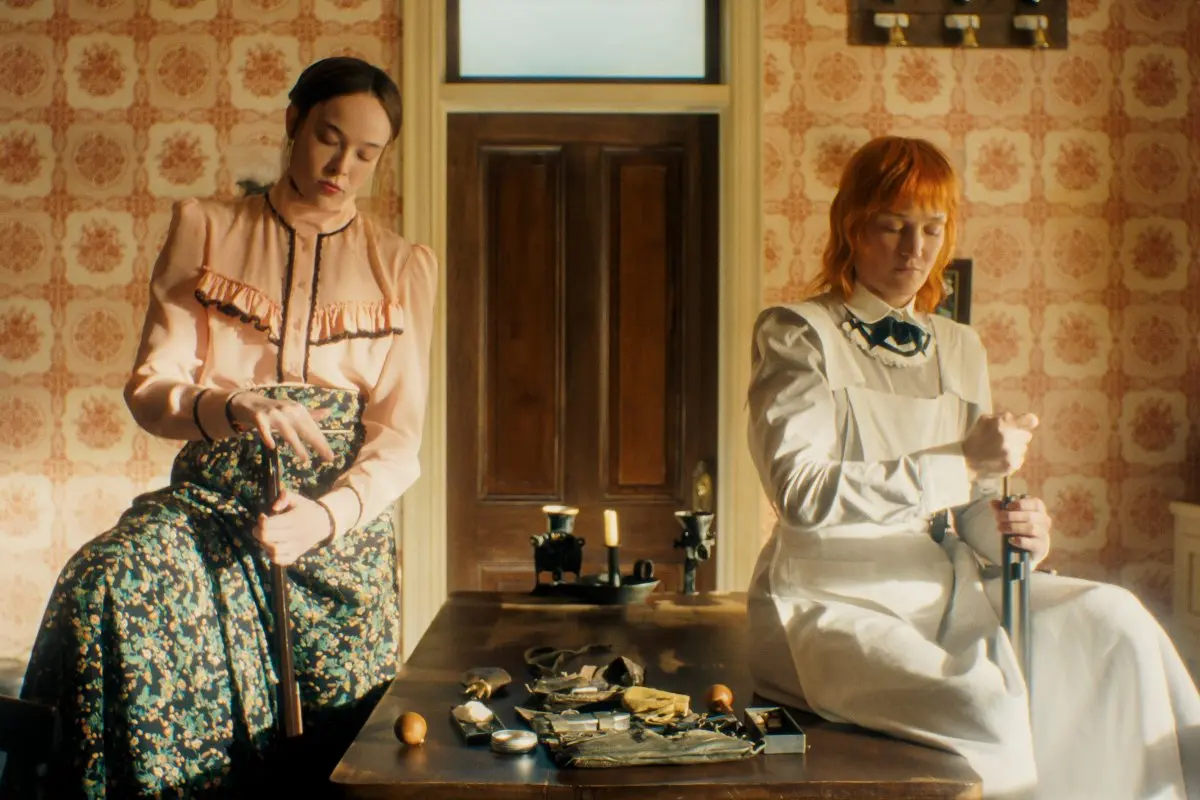
The fourth season of Ryan Murphy and Ian Brennan’s anthology series seemed different from its predecessors. And it is, though perhaps not in the way one might have hoped. After Jeffrey Dahmer, the Menendez brothers and Ed Gein, Monster puts a woman at the center of its story for the first time and, more importantly, a very different kind of “monster”: Lizzie Borden was never legally found guilty.
Accused of murdering her father Andrew (Charlie Hunnam) and stepmother Abby (Rebecca Hall) in 1892, Lizzie was tried and acquitted. And no one was ever convicted of the crimes. Suspicion has followed her ever since, but definitive proof of her guilt has never been found.
Netflix’s Monster, however, decides that Lizzie did kill them; and not only Andrew and Abby. Together with her lover Maggie (Vicky Krieps), she also killed Bertha Manchester (Linda Reiter), a friend of her stepmother. This is, of course, a perfectly legitimate choice for a work of fiction. It becomes more questionable when a series has always presented itself as being rooted in real events and, above all, when some inventions are used to construct a very specific narrative around Lizzie.
Because Monster: The Lizzie Borden Story wants to turn Lizzie, the murderer, into a symbol of female emancipation. That, too, is a legitimate approach. The problem is how it goes about it.

Can a Woman Be Both Victim and Perpetrator?
Ella Beatty’s Lizzie lives in a world in which being a woman means being constantly repressed, both socially and economically. Not to mention sexually. This is one of the season’s central ideas and, in itself, an entirely legitimate lens through which to examine her story. Historically speaking, the restrictions imposed on women at the time were very real.
The problem is how the script sustains its argument.
Almost everyone surrounding Lizzie is gradually transformed into either a morally repulsive figure or a ridiculous one. Her father is an alcoholic; her stepmother is very abusive; her sister is absent and incapable of understanding what is happening around her; her uncle is an opportunist; her elderly neighbor is a torturer; Nance O’Neill (Jessica Barden, also known in The End of the f***ing World), Lizzie’s actress friend, is arrogant and manipulative.
The men representing the institutions fare even worse. The police are incompetent, the jurors shallow, the lawyers seemingly incapable of doing their jobs even when all the necessary evidence appears to be sitting right in front of them. At one point, an officer rushes to the scene of murders while eating cotton candy.
The problem is that it often seems unable to criticize patriarchy without turning almost everyone around Lizzie into a caricature.
And so the most interesting question the season could have asked (can a woman be both a victim and a perpetrator?) is gradually replaced by a much simpler one: how awful does the world around Lizzie have to become before we can see her just as a victim even while she is killing people?
Series such as Sharp Objects have portrayed women who are abused, yet also capable of inflicting pain themselves, without using trauma as a certificate of innocence. The Act depicted the horror of the abuse suffered by Gypsy Rose Blanchard without erasing her responsibility for her actions. And Yellowjackets, despite operating in an entirely different genre, allows its protagonists to be victims and perpetrators of crimes together.
A woman doesn’t need to be morally absolved for a story to acknowledge what has been done to her. Perhaps allowing her to be even monstrous is precisely what finally allows her to exist as a fully realized character.
The Problem with Monster’s Selective Feminism
The contradiction becomes even more apparent when we look at the other women in the series.
If Monster wants to explore what it meant to be a woman in the late nineteenth century, why does its compassion seem to be so selective? Abby Borden is a woman living within the very same social system as Lizzie, yet the series shows remarkably little curiosity about her experience. It is not particularly interested in understanding her: it needs the audience not to feel too bad when she is butchered. The Hollywood Reporter made a similar criticism, noting the striking lack of compassion for Abby within a season said to frame itself around women’s experience.
The interludes devoted to other notorious female killers make this mechanism even more explicit.
Several episodes jump through time to show other murderers from different historical periods: Elizabeth Báthory and Aileen Wuornos. They are criminals whose lives and crimes are very different from Lizzie Borden’s, yet Monster attempts to unite them through a single explanation: they are all abuse victims who turned their suffering into violence. The Hollywood Reporter similarly questioned the decision to connect Báthory, Borden and Wuornos through an overly broad conception of what it means to be a woman.
Exploring a murderer’s trauma does not necessarily mean justifying her. On the contrary, it could begin a far more complex discussion. Yet the series often seems determined to reach a very elementary conclusion: behind a monstrous woman (or man) we must first look for the world that made them that way.
The result is paradoxical. In its attempt to humanize these figures, Monster exaggerates them so much that it risks making them less human.
Aileen Wuornos (played by Sarah Paulson), in particular, occasionally becomes almost a caricature. Her appearance should create an emotional bridge between women marked by different forms of violence and trauma. Instead, the performance and the writing are pushed toward such relentless grotesquerie that empathy can easily give way to ridicule.
When Provocation Replaces Complexity
This may partly be a question of style, but Monster sometimes seems deliberately written at maximum volume simply to shock. In doing so, it repeatedly risks resembling someone who has just discovered something provocative and cannot stop using it.
More blood, more sex, more vomit. More bodily fluids, more mutilated bodies. And more deliberately absurd situations.
In The Guardian, Lucy Mangan described the season as feeling as though it had been written by “adolescent boys”, criticizing precisely the juvenile fascination with sex, menstruation, violence and the female body.
The grotesque can be used to describe disturbingly and satirically a political context. But when everything is pushed toward the extreme, eventually nothing feels extreme anymore.
Even the supporting characters obey this logic. It’s not enough for the police to be shaped by sexism, they have to become almost farcical. It is not enough for the jurors to be influenced by Lizzie’s social image; they have to appear superficial. It is not enough for a family to be dysfunctional; it has to become a catalog of abuses.
Paradoxically, it would have been far more disturbing to show intelligent people and functioning institutions still reaching questionable conclusions precisely because they were steeped in the prejudices of their era. Monster instead prefers to make almost everyone look like an idiot.
And that weakens Lizzie’s manipulation as well. She hardly seems like a brilliant manipulator if the system she is deceiving is not particularly formidable to begin with.
Monster and the Dignity of the Dead
Another issue which became particularly apparent in The Ed Gein Story was its relationship with the victims. Some reviewers criticized the third season for appearing more interested in shock value than in preserving the dignity of the dead.
The same thing happens in The Lizzie Borden Story.
Lizzie Borden took an ax,
Gave her mother forty whacks.
When she saw what she had done,
Gave her father forty-one.
The famous rhyme says that Lizzie gave Abby forty blows and Andrew forty-one. In reality, they were struck 19 and 11 times respectively. The writers know this discrepancy, yet they still choose the rhyme’s imagery, using it to render the bodies practically unrecognizable.
Nor does the series hold back when showing the bodies of Lizzie’s parents cut open during the autopsy. And since its version of Andrew Borden is closely associated with the funeral trade, what better excuse could there be to gain access to a few more corpses to display throughout the season with absolutely no reason?
This has a historical basis, but the chronology is off. Andrew had actually worked in the undertaking business, including as a partner in a company selling caskets. By the time of his death, however, his professional life was tied to property and banking, while the show therefore takes a real but earlier part of his life and moves it further into the future.
When a story deals with people who actually existed, consciously choosing their bloodier version means deciding that legend has greater entertainment value than reality. All because the dead are the most valuable props.
The Act, once again, showed that another approach is possible. Understanding Gypsy’s desire to escape did not require turning her mother Dee Dee’s death into a celebration. Two truths can coexist. Something terrible had been done to Gypsy and, at the same time, something terrible was done to Dee Dee.
Monster seems to have far less faith in the audience’s ability to hold two ideas at once.
Lizzie Borden and the Dove Symbolism
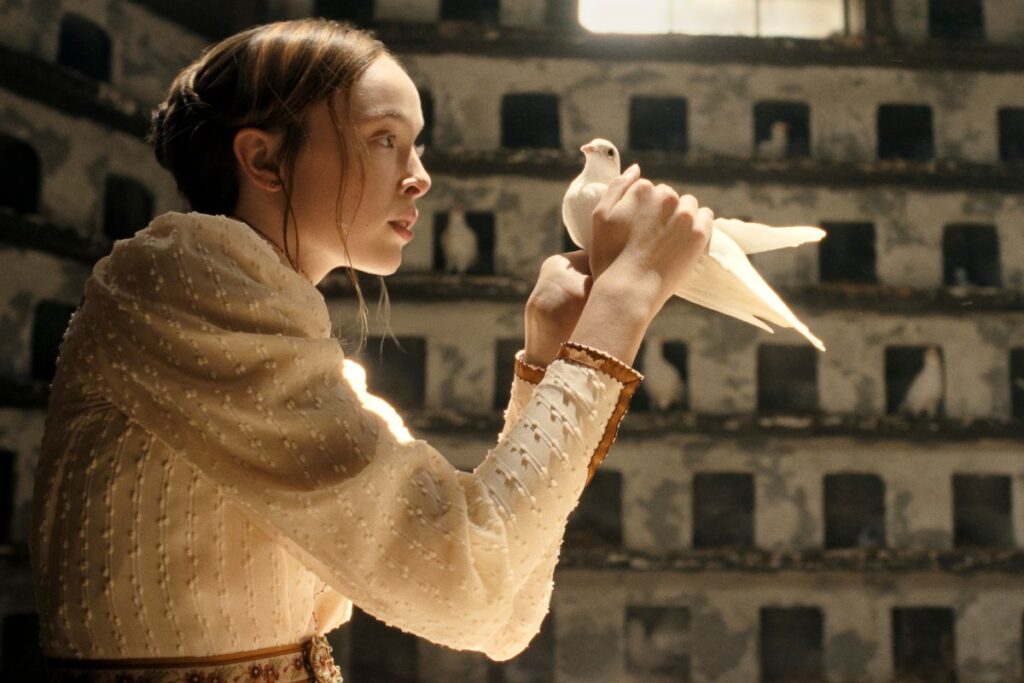
One of Lizzie’s hobbies in the series is raising doves, the animal that represents purity par excellence. The violence inflicted on them symbolically becomes the violence inflicted on Lizzie herself. When they are destroyed, something inside her is destroyed with them.
The symbolism could hardly be more obvious, and the series seems to want the audience to see Lizzie herself as one of those doves. But she’s not.
The historical Lizzie still can be, because we will never know exactly what happened, but the Lizzie created by the series cannot: this Lizzie kills. And yet the series continues to surround her with the imagery of purity, perhaps because Monster seems afraid of the most interesting possibility of all: that a woman can be a victim without being innocent. That she can be oppressed and terrible. That she can deserve understanding without deserving absolution. That patriarchy can have harmed her without necessarily providing the definitive explanation for everything she goes on to do.
When Feminism Erases Moral Complexity
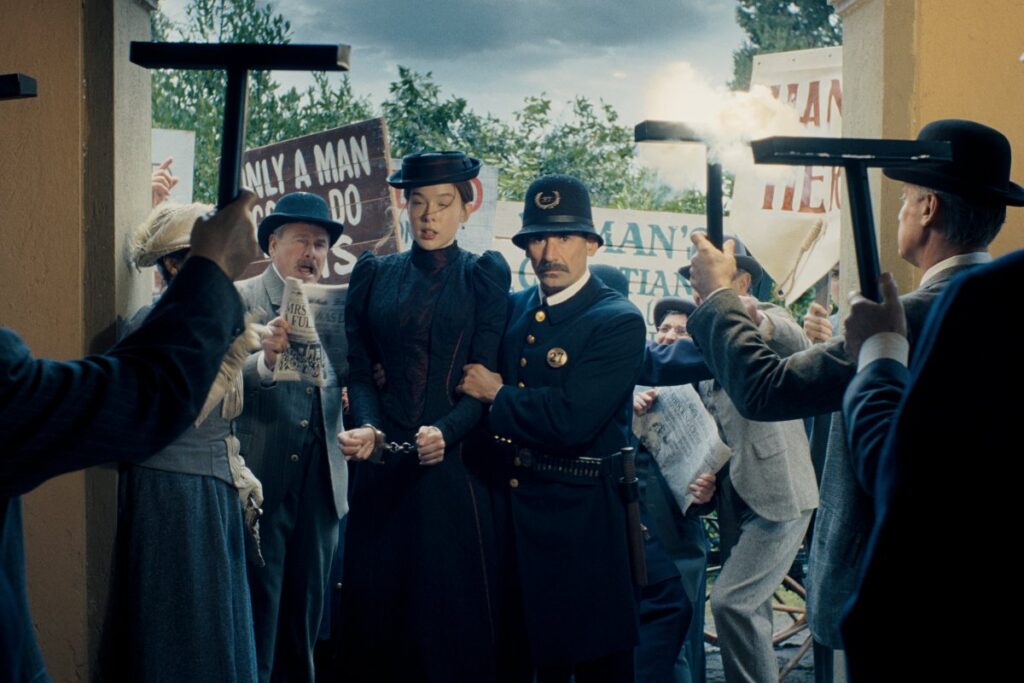
At the end, Ryan Murphy and Ian Brennan declare the “feminist” intent, even turning Lizzie and Maggie into model suffragettes demanding the right to vote (when in reality Lizzie was ostracized by the entire town), making explicit what had previously been merely implied. They remove any doubt about the intentions behind the move, attempting to fully rehabilitate her. Paradoxically, granting a female character the same right to contradiction and even monstrosity that storytelling has always granted men would have produced a far more genuinely feminist argument.
Monster seems then to prefer a simpler Gothic fairy tale with a cheesy finale, above all.
And yet, despite everything, after a season populated by murderers, abusers, sadists, opportunists, manipulators, incompetents and caricatures, the only creatures to whom the series manages to grant unquestionable innocence are the doves.