 Collections
  Magazine
  Exhibitions
  ITA version













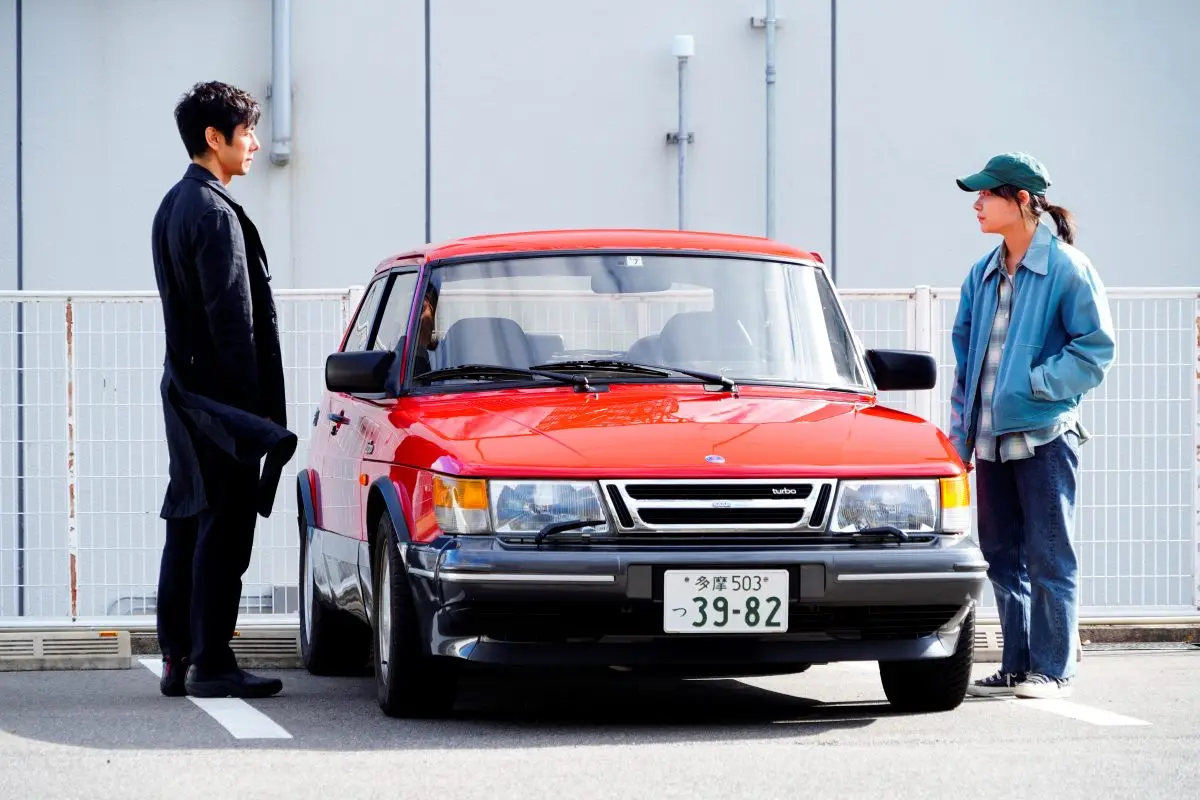
Drive My Car | Ryûsuke Hamaguchi’s Road Movie on Grief and Silence


If one categorises Ryûsuke Hamaguchi’s Drive My Car using traditional cinematic genres, it would fall under the road movie genre. However, like many contemporary films, it defies such definitions by blending genres in a subtle yet distinct manner. Inspired by Haruki Murakami’s eponymous short story, Drive My Car is a psychological drama structured as a journey. Movement through space mirrors an internal voyage through grief, memory, and the unspoken. The red Saab serves as a confessional, a stage, and a cocoon—a place where silence carries as much weight as speech, and emotional transformation takes precedence over narrative momentum.
Additionally, the film features a rich metatheatrical layer. The rehearsals of Anton Chekhov’s Uncle Vanya (1899) are not just background; they are a parallel language that echoes and deepens the characters’ private struggles. Art and life blur into one another, revealing what lies beneath the surface of performance, both onstage and in daily life.

- Prologue: The Impossibility of Knowing
- The Car as a Space of Intimacy
- Misaki: A Mirror in Motion
- An Anti-Cathartic Film
Prologue: The Impossibility of Knowing
Oto (Reika Kirishima) is a television screenwriter, and Yusuke (Hidetoshi Nishijima) is a theatrical actor and director. Their love life is so fulfilling that Oto often comes up with story ideas right after they make love. [Spoilers ahead!] One day, however, Yusuke unexpectedly returns home and finds Oto with another man, possibly the young actor she introduced him to earlier. His reaction is composed and almost voyeuristic. He says nothing. But when he witnesses the scene, Yusuke confronts one of the harshest truths of human experience: the other — our lover and reality itself — remains fundamentally unknowable.
This rupture sets the tone for the rest of the film. Later that evening, Oto tells Yusuke that she wants to talk. He avoids the conversation. When he finally returns home, it’s too late. Oto has died from a cerebral haemorrhage. Her sudden death leaves Yusuke with double the grief: not only for the person he lost but also for the unanswered questions and unspoken words that will forever haunt him.
The Car as a Space of Intimacy
This emotional stasis sets the film’s rhythm. The only place where Yusuke’s inner world is partially visible is in his red Saab. Behind the wheel, he listens to cassettes of Oto reciting lines from Uncle Vanya. He rehearses with quiet precision, clinging to her recorded voice like a lifeline. The vehicle becomes more than a means of transportation; it becomes a space of ritual, memory, and control. Hamaguchi draws a subtle yet powerful parallel between Yusuke’s drama and the text he prepares to stage. All this suggests that art quietly infiltrates life rather than merely reflecting it.
As the film’s title suggests, car scenes are key to understanding its themes and Hamaguchi’s formal choices. Yusuke’s trauma, reenacted throughout his journeys, mirrors the emotional entrapment of the characters in Uncle Vanya, a play about people who fail to connect. Yusuke’s rigid composure hides his deep fear of being undone by grief. Through long takes and stillness, aided by editor Azusa Yamazaki, Hamaguchi allows emotions to surface gently, without imposition. Eiko Ishibashi’s restrained soundtrack complements this approach, creating a meditative atmosphere. Rather than highlighting Yusuke’s turmoil directly, it allows his pain to take shape slowly.
Misaki: A Mirror in Motion
When Yusuke accepts a residency to direct Uncle Vanya at a theatre festival in Hiroshima, the organisers inform him of a restriction. Due to health insurance regulations, he can no longer drive himself. This seemingly minor detail fractures his daily ritual. He must now share the red Saab, once his private, enclosed world. He had rehearsed, reflected, and kept others at a careful distance in that space. The presence of a driver, especially one as silent and self-contained as Misaki (Tôko Miura), threatens that fragile solitude. Instead, it becomes the condition for its transformation.
Misaki’s role is not just functional. She is not just a supporting character in Yusuke’s story; she is a structural double. Through repetition, shared silence, and simple presence, their interaction creates a space where trauma is revealed rather than confessed. The car, no longer a metaphor for the self, becomes relational — a place where grief shifts from a private burden to a shared experience. Hamaguchi films them with near-monastic care; the camera lingers on profiles, tracing glances, breath, and stillness. He avoids resolution or breakthroughs; tension slowly dissolves as inner walls wear down in silence. Misaki becomes a catalyst not through insight but through witnessing. She listens without judging and drives without intruding, enabling a quiet, wordless healing that speech alone could not achieve.
An Anti-Cathartic Film
What can we do? We must live our lives. Yes, we shall live, Uncle Vanya. We shall live through the long procession of days before us, and through the long evenings; we shall patiently bear the trials that fate imposes on us…
Anton Chekhov, Uncle Vanya
Rather than offering answers or closure, Drive My Car explores the space between pain and understanding. Yusuke and Misaki do not escape from grief; they cultivate the courage to face it daily through their shared experiences. The rehearsals of Uncle Vanya quietly echo this ongoing process, serving as a subtle companion to their emotions rather than a parallel story. The film’s strength lies in its patience, honoring the slow and often incomplete process of living with loss. It allows silence and presence to open possibilities beyond words. Hamaguchi invites us to rethink healing as a courageous, ongoing act, not an endpoint. This act bears what cannot be fully known or expressed.
Distributed by Bitters End, Drive My Car premiered at the 2021 Cannes Film Festival, where it competed for the Palme d’Or. The film won the award for Best Screenplay, making Ryûsuke Hamaguchi and Takamasa Oe the first Japanese writers to receive this honour. The film also won the FIPRESCI Prize and the Ecumenical Jury Prize. At the 94th Academy Awards, Drive My Car became the first Japanese film to be nominated for Best Picture, in addition to Best Director and Best Adapted Screenplay. It won the Oscar for Best International Feature Film.
Tag