 Collections
  Magazine
  Exhibitions
  ITA version













Corpse Bride Turns 20 | Inside Tim Burton’s Victorian Fantasy of Eros and Thanatos


Runtime
Wandering alone into the woods can be a risky endeavor. You might get lost or meet a wolf. You might even end up married to a corpse bride with no idea how it happened. Inspired by a Jewish-Russian folktale, the 2005 stop-motion animated dark fantasy film Corpse Bride, directed by Tim Burton and Mike Johnson, tells the immortal legend of a love story between the living and the dead. This gothic fairy tale, written by John August, Caroline Thompson, and Pamela Pettler, is based on characters created by Burton and Carlos Grangel.
Twenty years after its debut at the 62nd Venice International Film Festival, Corpse Bride continues to influence pop culture and inspire the imaginations of multiple generations, from Halloween costumes to wedding themes. The film, distributed by Warner Bros. Pictures, received an Oscar nomination for Best Animated Feature. Its style, music, and cinematography seem crafted to leave a lasting impression on audiences, and its success also stems from its timeless themes. The power of pure feelings, their survival even across the threshold of the afterlife, and the courage to face death itself: Corpse Bride takes the ancient topos of Eros and Thanatos and brings them into an everlasting fantasy set in the Victorian era, yet evergreen in the human soul.

- What if Death Has Already Separated Us?
- Tim Burton’s Gothic Vision: Love, Death, and All Things ‘Burtonesque’
- Bringing Life to Puppets in a Ghost World
- Till Death Do Us Part and Beyond: A Timeless Love Story
- The Night of the Living Corpse Brides
What if Death Has Already Separated Us?
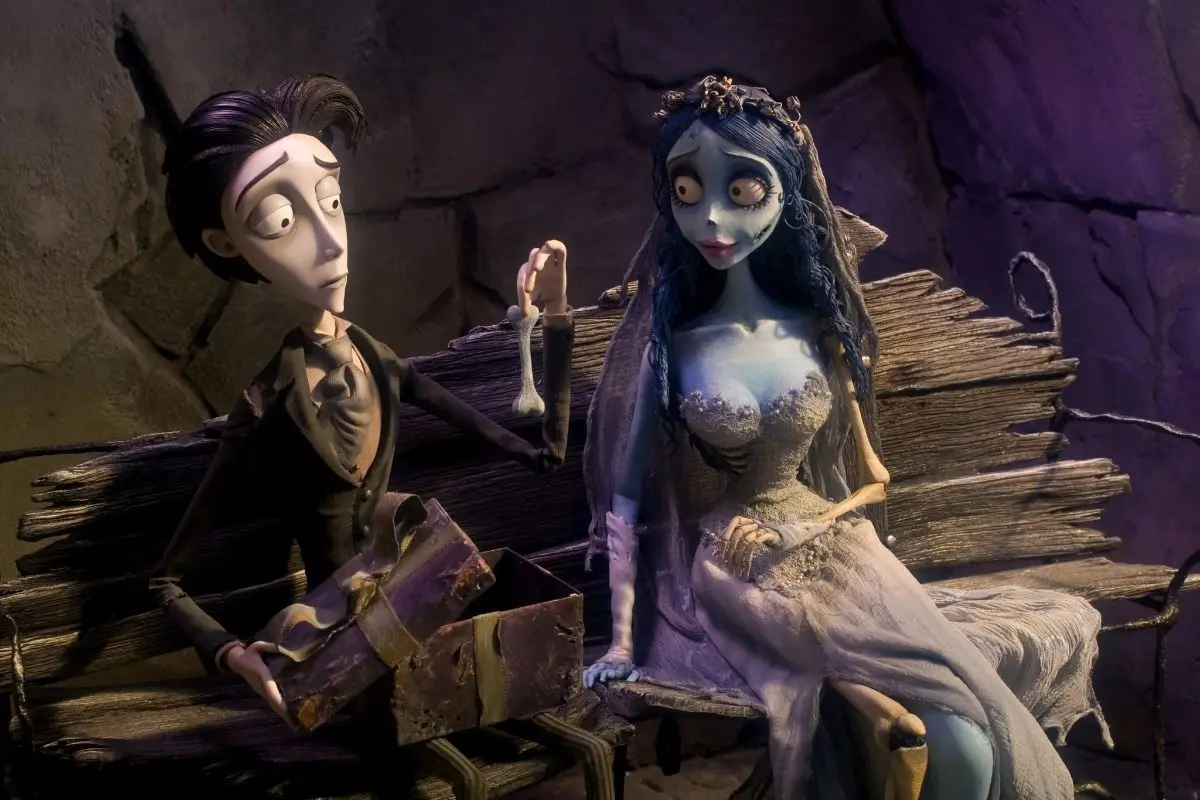
Victoria Everglot (voiced by Emily Watson) is the last heir of a fallen noble family. In hopes of restoring their fortune, her parents promise her hand to Victor Van Dort (voiced by Johnny Depp). Despite this being an arranged marriage, the two young people fall in love at first sight. However, during the rehearsal, Victor gets so nervous that he forgets his lines and messes everything up. The Everglots then decide to postpone the wedding.
Dejected, Victor wanders into the woods, trying to memorize his vows. Suddenly, he recites the exact words and puts the ring on a dry branch. Or, at least, what he believed was a dry branch. From the earth emerges a corpse bride with Victor’s ring on her finger. She is certain that they are now married. She takes him to the Land of the Dead, where he learns her story through a jazz song. Her name is Emily, and Helena Bonham Carter voices her. She was seduced by a man who promised to marry her but stole her jewels and killed her instead. Since then, Emily has been trapped in limbo, unable to find peace until she finds a husband.
The story touches Victor, even though he’s still in love with Victoria. Moreover, a technicality in the law threatens Emily’s long-awaited marriage. “Till death do us part,” goes the vow. Therefore, their union is legally impossible as long as Victor is alive.

Tim Burton’s Gothic Vision: Love, Death, and All Things ‘Burtonesque’
Tim Burton’s first foray into stop-motion animation dates back to 1982, when he directed Vincent, a short film that explores life and death. The director revisited this technique in 1993 with The Nightmare Before Christmas, which he produced and Henry Selick directed. Corpse Bride is Burton’s first stop-motion feature. It was also Johnny Depp’s first animated film, and it doubled his long-time collaboration with Burton. At that time, the director and actor were working on Charlie and the Chocolate Factory during the day and Corpse Bride at night. They carried this simultaneity over to both sets, incorporating it into the creative process.
As an expert animator, co-director Mike Johnson worked closely with Burton, preparing each scene for his approval. Although Burton had nearly total control over the emotional tone and goals, they shared the preparation and footage. However, Johnson left the overall artistic concept to Burton, who made Corpse Bride his personal fantasy.
Developing such a personal project allowed Burton to fully explore his most cherished themes, such as macabre love and the fine line between life and death. His style is so distinctive that, as Tacita Quinn pointed out on CNN, he deserves the new adjective “Burtonesque.” This single word encapsulates style, atmosphere, and recurring elements, creating an unmistakable brand for the artist. This poetic allure permeates the director’s filmography, from its visual and thematic elements. It covers any kind of story with a gothic, yet not horror-like; macabre, yet tender; “Burtonesque” mist. As Roger Ebert noted, this effect stems from meticulous work on shades and details. The director pays more attention to the edges than to the focus.
As he does in all of his pictures, Burton fills the frame with small grace touches and droll details. He seems to have a natural affinity for the Gothic. […] He likes moonlight and dreary places, trees forming ominous shapes in the gloom, eyes peering uneasily into the incredible and love struggling to prevail in worlds of complex menace.
Here comes the corpse… by Roger Ebert
From The Nightmare Before Christmas to Frankenweenie, and as in Sweeney Todd and the most recent Wednesday, any Burton film shows the unmistakable signature of a Master of Macabre. A stamp that finds its full expression in the tender, grim, and though romantic, love triangle of Corpse Bride.

Bringing Life to Puppets in a Ghost World
Although stop-motion is one of the oldest animation techniques, the film also boasts many innovations. It is the first stop-motion feature film made with a fixed camera, as well as the first film shot with a digital single-lens reflex camera. Additionally, to make the characters more expressive, the animators used the “gear and paddle” technique for the first time. This complex gear system in the puppets’ heads, connected to external paddles, reproduces facial gestures that look much more realistic than traditional head swapping.
This enhanced expressivity brings lively characters to life, showing them much more vitality in the afterlife than in their former existence. The cinematography by Pete Kozachik conveys the separation between the living and the dead through different shades. A dark, black-and-white scale of gray with only hints of green covers the world of the living, draining it of real life. In contrast, the afterworld is a vibrant, bright dimension where electric shades of blue, green, and violet permeate every dark corner.
As with many animated cult classics, the score plays a key role; in fact, the characters sing as in musicals. Danny Elfman, who has collaborated with Burton for a long time, composed the soundtrack with John August‘s help. Elfman also voices the skeleton jazzman Bonejangles, who sings Emily’s story to Victor. Like the colors, the music is much more vibrant in the afterworld. In Corpse Bride, every element challenges the common perception of existence. Life after death is revealed to be a festive time painted with vivid emotions — the real beginning of life.

Till Death Do Us Part and Beyond: A Timeless Love Story
In 1800, the Romantic poet Novalis published the collection Hymnen an die Nacht, which revolves around the loss of his fiancée. He found relief only in the graveyard at night, the one place and time that allowed the lovers’ souls to meet. More than a century later, Powell and Pressburger directed the cult classic comedy A Matter of Life and Death, whose protagonist is a soldier who escapes his final trial thanks to the love of a brave woman.
The myth of a love so powerful that it allows one to cross the border into the afterlife is much older, though. Orpheus‘s attempt to save Eurydice from Hades has inspired oral tales and theater pieces from ancient Greece to the present day. Yet Corpse Bride goes against the grain: not a hero fighting to bring his lover back to life, but instead allowing him to join the afterlife. Although Emily adores Victor, she knows he isn’t the man who caused her torment. He lied to her to return to the living world, deceiving her as her first love had. However, unlike him, Victor lied not out of self-interest but to return to his loved one. Such pure love survives death, and the two souls exist as one. Emily knows this in the end.
Her situation is very different, too. Joining the afterlife represents her healing. The matter she needs to settle isn’t dependent on death; it was merely a consequence of the betrayal she couldn’t forgive. As philosopher Jean-Paul Sartre wrote, “Hell is other people”: She was damned in life due to a human choice. Even worse, it was a choice made by someone she believed loved her. Only by understanding her real ghost from the past can Emily find authentic peace in death.
The Night of the Living Corpse Brides
From a pop culture perspective, the macabre love story easily inspired Halloween costumes. Emily’s gothic, ethereal beauty, which wasn’t even defeated by death, became a fascinating, nostalgic character to embody on the scariest night of the year. Among witches, vampires, and ghosts, she stands out with her unique allure. Year after year, more and more women paint their faces turquoise, wear blue wigs, and put on pale Victorian dresses to become the most memorable undead bride. Sometimes, they also have a Victor by their side as an accessory of sorts. Even though they don’t have a happy ending together in the film, they have become a symbol of endless, unbeatable love.
In conclusion, in a colorful and always-happy dimension, as most cult animated films are, Corpse Bride stands out from the crowd. The “Burtonesque” style transforms a tragic legend into a dark fairytale about the timeless theme of Eros and Thanatos. It is a brand-new cult classic and mass phenomenon in the form of a Victorian parable about justice, revenge, and how love enables survival after death. Sometimes, it’s a dream to embody a symbol of immortal love, even if just for one festive night.
Tag