 Collections
  Magazine
  Exhibitions
  ITA version












In San Gimignano, a Tuscan town known for its medieval towers, the exhibition Anima Etrusca / Etruscan Soul. The Fortune of the Etruschi Project celebrates the influence of Etruscan art on contemporary culture.
CL Leonardo Morfini (FMS Archive)
Less celebrated than the Greeks, less documented than the Romans, the Etruscans have long occupied a smaller place in our history books. Yet, in the subtle and mysterious traces these people left behind lies an enigmatic charm. The Etruscan culture continues to resonate in our time.
Courtesy Fondazione Musei Senesi
Until January 11, 2026, in the halls of the splendid Complesso di Santa Chiara, Etruscan bronzes, urns, and vases engage in dialogue with contemporary artworks, design objects, clothing, and jewellery.
The Etruschi Project | The Beginning of a Rediscovery
1985 marks a crucial moment in rediscovering a people whose history scholars had until then confined to academic study. With the Etruschi Project, the Region of Tuscany began an innovative path, shaping the history of archaeological outreach.
The initiative—comprising exhibitions, conferences, and publications—offered a new and dynamic interpretation of the Etruscan world, combining scientific rigor with contemporary sensibility. Thanks to The Year of the Etruscans in 1985, the culture of this seemingly distant civilization stepped beyond the traditional spaces of archaeology to once again engage in dialogue with the present—becoming a living part of our collective imagination.
Anima Etrusca in San Gimignano, forty years after the Etruschi Project, seeks to relive those moments.
The exhibition is curated by Anna Mazzanti and Giulio Paolucci, and organised by Fondazione Musei Senesi, the Municipality of San Gimignano, and the Civic Museums and Opera Laboratori. The event is part of the calendar celebrating the project’s fortieth anniversary, promoted by the Region of Tuscany.
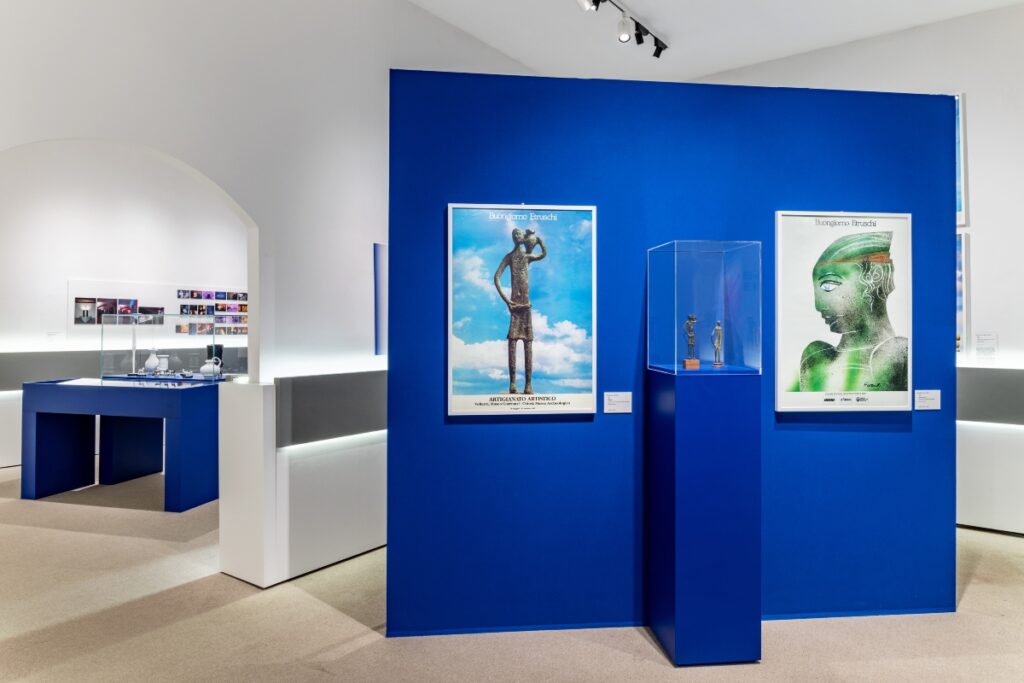
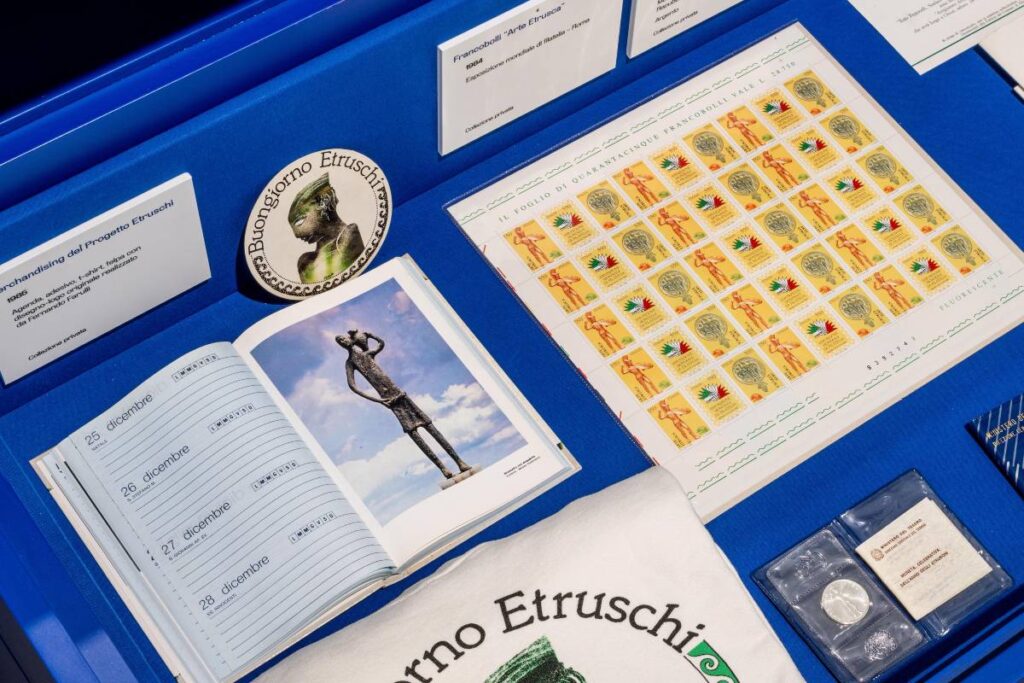
Upon entering the exhibition halls, the journey begins by retracing the events of 1985. Documents from the time, posters, advertising campaigns, and floor plans reveal the forward-thinking choices made for the Year of the Etruscans. It was a true cultural revolution: modern communication strategies and engaging slogans swept away the dust that had long covered Etruscan art.
Courtesy Fondazione Musei Senesi
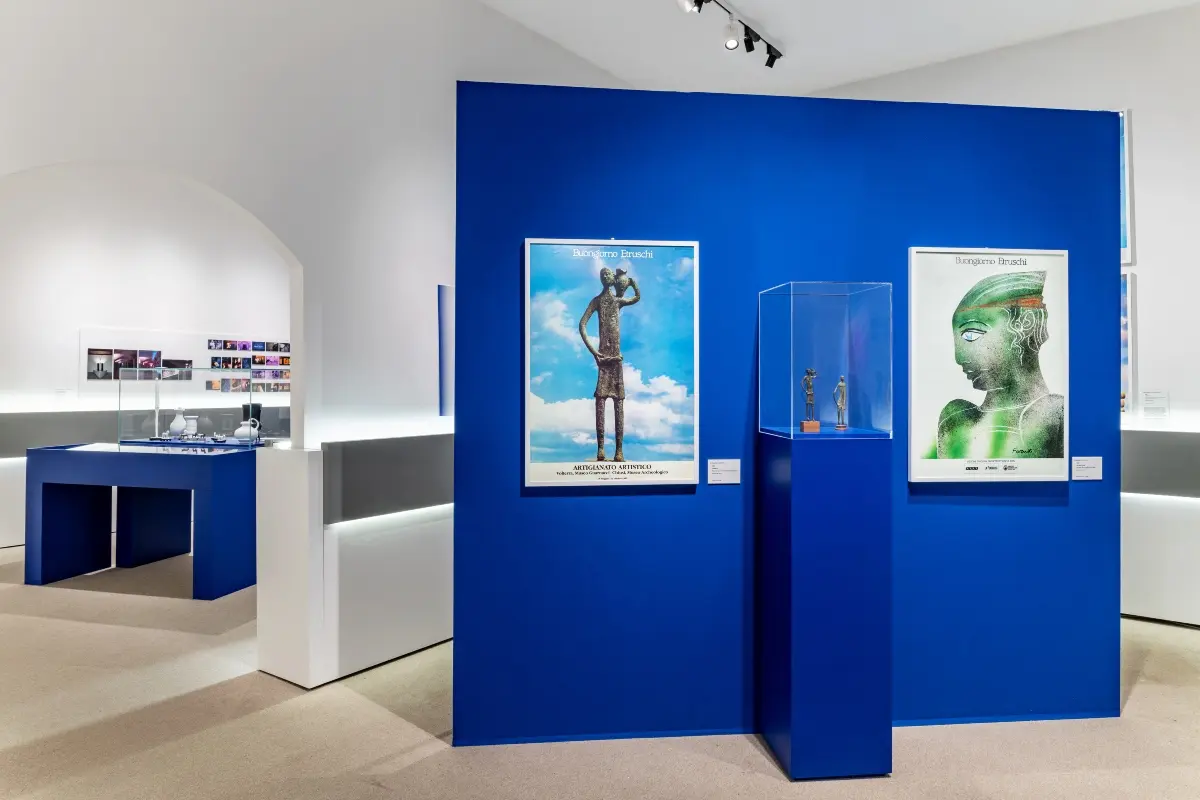
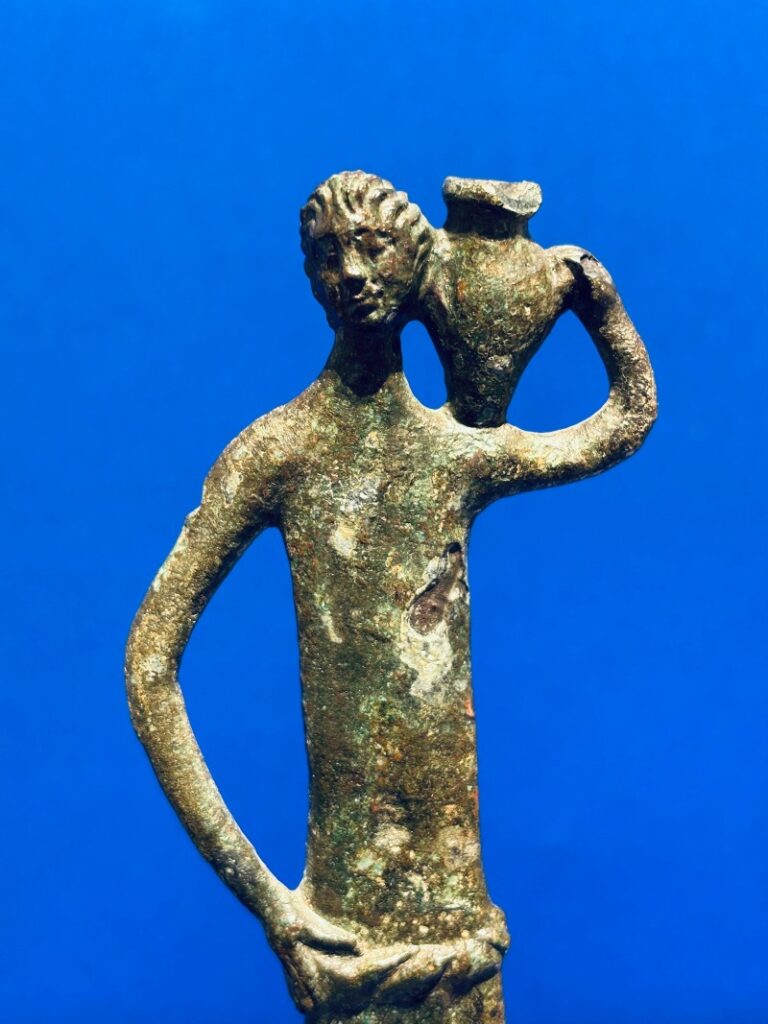
Good Morning, Etruscans reads the promotional poster for the Etruschi Project, created by Fernando Farulli for the Region of Tuscany. Designers created event merchandise featuring Farulli’s logo, inspired by an Etruscan bronze figurine, on notebooks, stickers, T-shirts, and sweatshirts.
Etruscans and Contemporary Art | From Michelangelo Pistoletto to Arnaldo Pomodoro
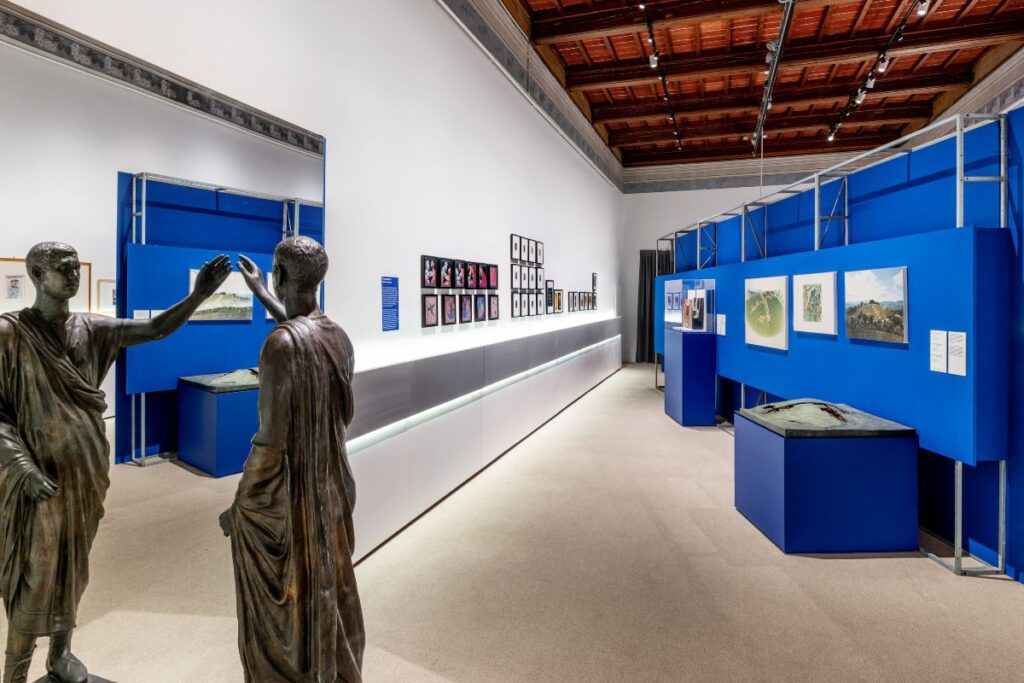
The exhibition dedicates a section to the dialogue between Etruscan art and contemporary art. Welcoming visitors is L’Etrusco by Michelangelo Pistoletto. Born in Biella in 1933, Pistoletto is considered one of the leading figures of Arte Povera. This Italian movement of the 1960s used ‘poor’ materials—simple, everyday objects—to reflect on art’s meaning in contemporary society.
CL Leonardo Morfini (FMS Archive)
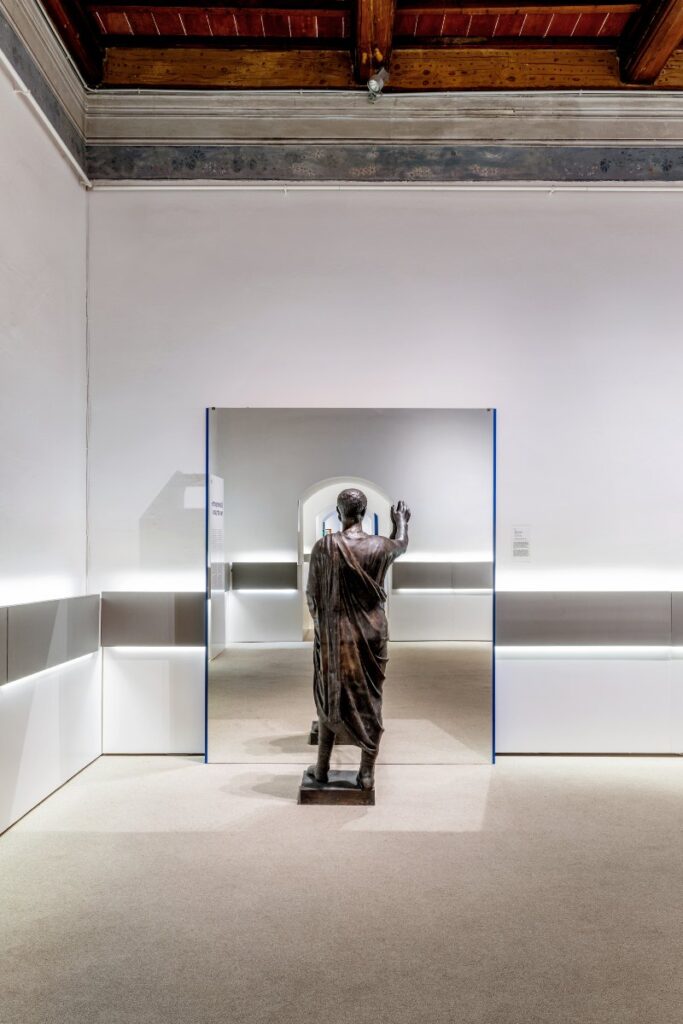
Pistoletto’s works often reflect on the relationship between art and life, reality and representation. The artist is best known for his Mirror Paintings, in which he uses reflective surfaces that draw the viewer into the artwork, making them part of the image. L’Etrusco belongs precisely to this series. Created in 1976, it is a reproduction of the Etruscan statue The Orator (L’Arringatore, Florence, National Archaeological Museum) placed in front of a mirror.
CL Leonardo Morfini (FMS Archive)
Standing before it, we see ourselves reflected alongside Aulus Metellus, depicted in the act of addressing the people. Past and present coexist within the same mirror, in a direct dialogue. The Orator, with his raised arm, points the way forward, becoming a metaphor for the need to look beyond the limits of modernity.
Arnaldo Pomodoro | A Dialogue with the Etruscan Necropolises
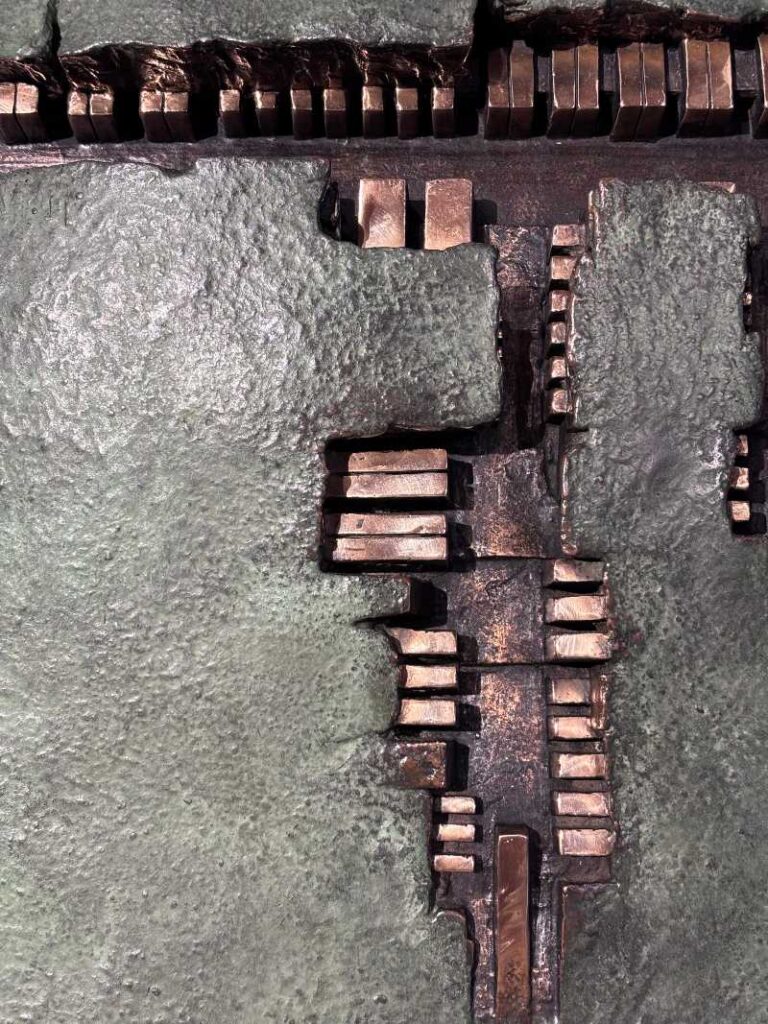
Michelangelo Pistoletto is not the only artist to have engaged with Etruscan art. The ancient Etruscan necropolises carved into the earth inspired another leading figure of contemporary art: Arnaldo Pomodoro. When, in 1973, he entered a competition to design the new cemetery of Urbino, he conceived a solution that directly recalled Etruscan tombs. The site was on a hillside, and an above-ground structure would have disrupted the beauty of the Urbino landscape. Thus, the artist envisioned creating furrow-like paths in the slope, within which the burial niches would be placed. The idea proved successful but, unfortunately, was never brought to completion.
CL Leonardo Morfini (FMS Archive)
On display, the project for the Urbino cemetery highlights the brilliance of Pomodoro’s vision. By respecting the gentle contours of the hillside, the artist designed a cross-shaped path that establishes a dialogue between death and life, earth and sky—a sculpture within the landscape.
Courtesy Fondazione Musei Senesi
Etruscan Art and Modern Design | A Winning Dialogue
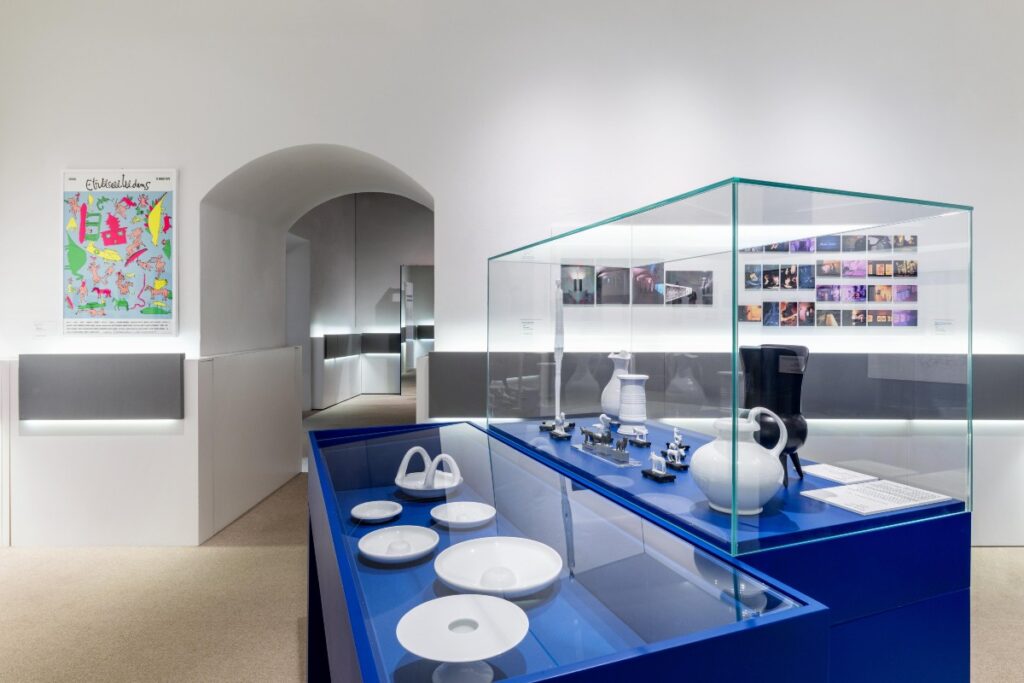
One of the most evocative rooms in the exhibition is dedicated to the dialogue between modern design and Etruscan art. Notable are reproductions of Etruscan pottery and bronzes by the Florentine manufacturer Ginori. A benchmark in porcelain craftsmanship, it is known for its use of a brilliantly luminous white unlike any other.
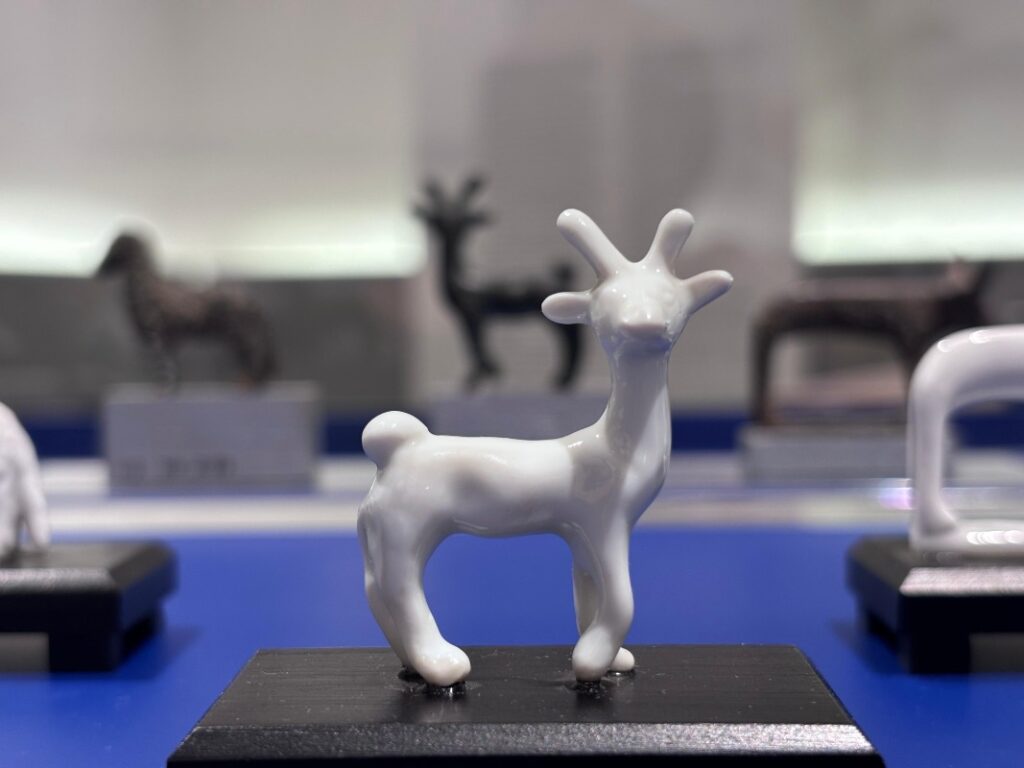
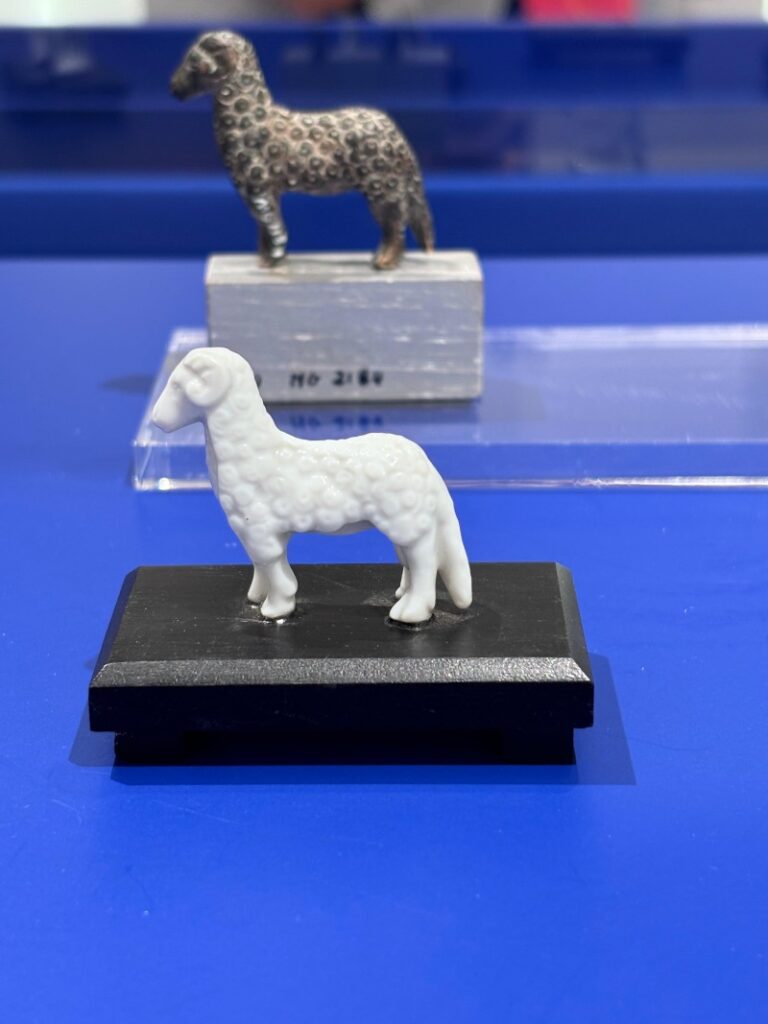
On the occasion of the Etruschi Project in 1985, Ginori was granted permission to make casts of Etruscan works and recreate them in porcelain. Various types of pottery and refined bronze statuettes depicting animals thus took on a new form. From the dark tones of bronze to Ginori’s brilliant white: a rebirth for Etruscan art, illuminated by a new light.
CL Leonardo Morfini (FMS Archive)
Gio Ponti, one of the most important Italian architects and designers of the twentieth century, engaged with the Etruscan past. He envisioned reinterpreting the bucchero technique, a type of light, black, glossy pottery used by the Etruscans for tableware. The Etruscan buccheri became objects of modern design, showing the timeless elegance of lines and forms conceived over two thousand years ago.
Clothing, Jewellery, Perfumes | Fashion with an Etruscan Soul
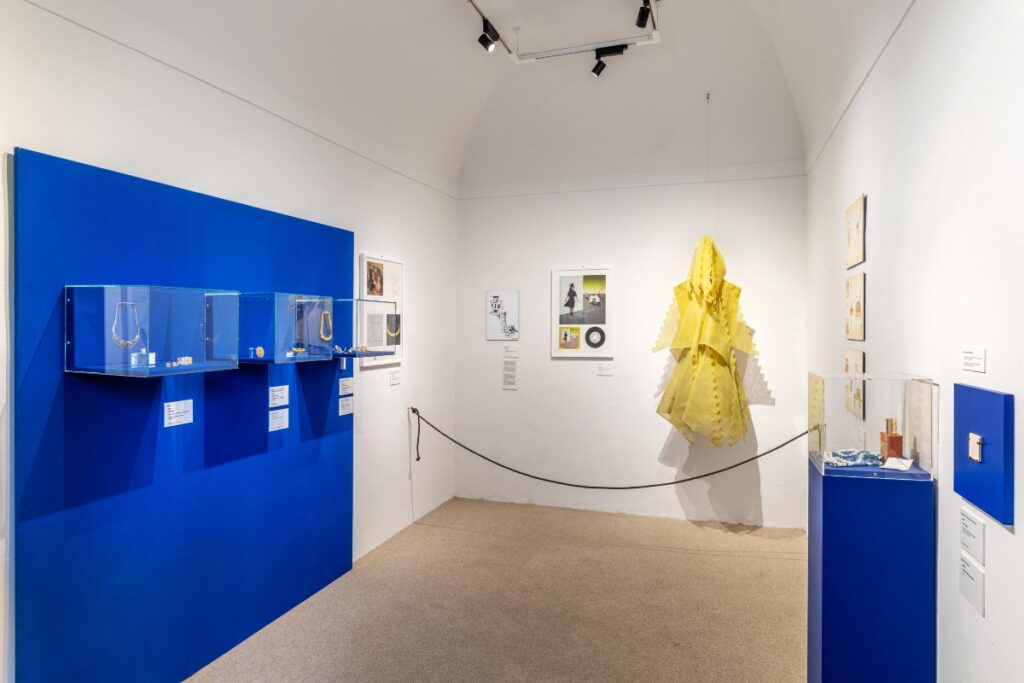
Among the exhibition’s sections, one stands out for showing how the world of fashion was captivated by the Etruscan aesthetic around the time of the Year of the Etruscans. An immediately eye-catching dress with a headpiece, defined by its squared silhouette. It is the work of Italian designer Cinzia Ruggeri, known for her experimental and ironic approach to fashion, design, and contemporary art.
CL Leonardo Morfini (FMS Archive)
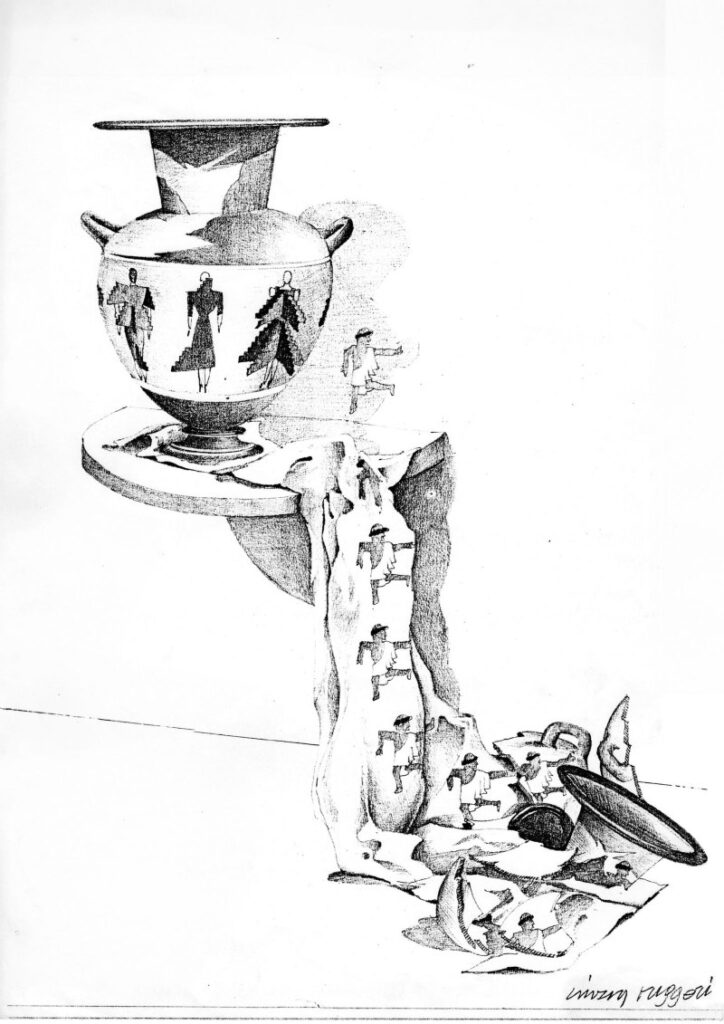
Several garments she designed conceal Etruscan inspiration. Ruggeri envisioned bringing the decorative motifs of Etruscan vases to life. Little figures in squared tunics thus “emerge” from their ceramic prison, coming to life.
Courtesy Fondazione Musei Senesi
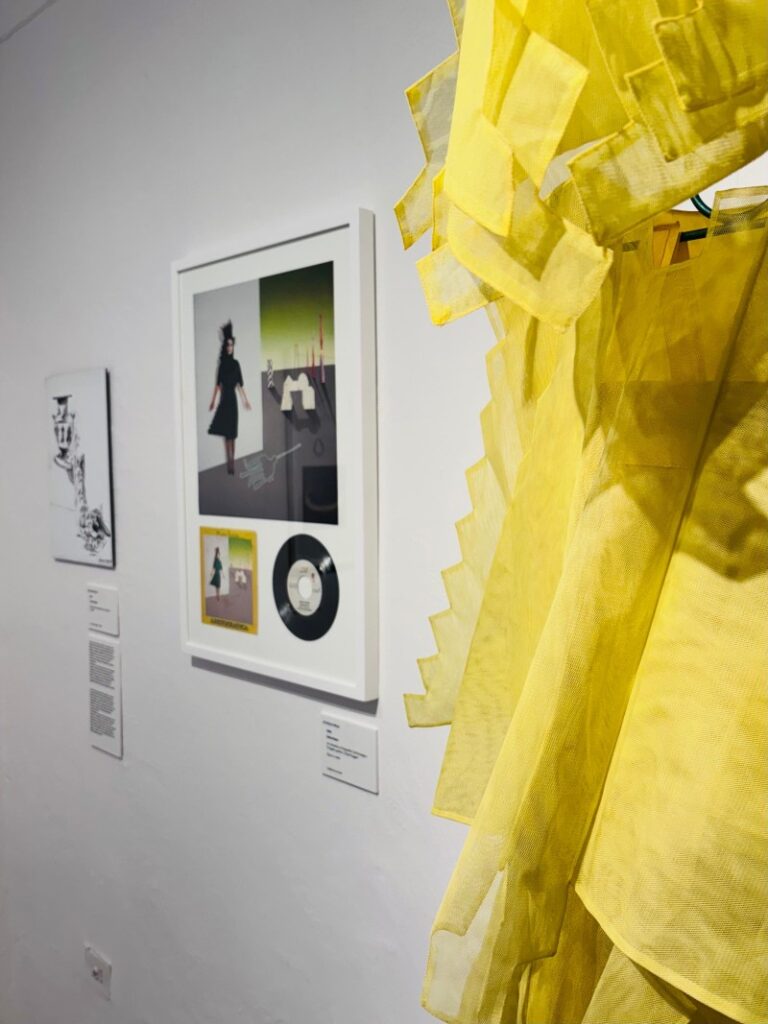
Behind, vinyl by Aristocratica.
Courtesy Fondazione Musei Senesi.
From this idea were born some of the designer’s most iconic dresses, such as the one featured in the exhibition, Homage to Escher (private collection), and Homage to Levi Strauss (London, Victoria and Albert Museum). Antonella Ruggiero of Matia Bazar even wore the latter for the cover of the vinyl Aristocratica.
Courtesy Fondazione Musei Senesi
Courtesy Fondazione Musei Senesi
Courtesy Fondazione Musei Senesi
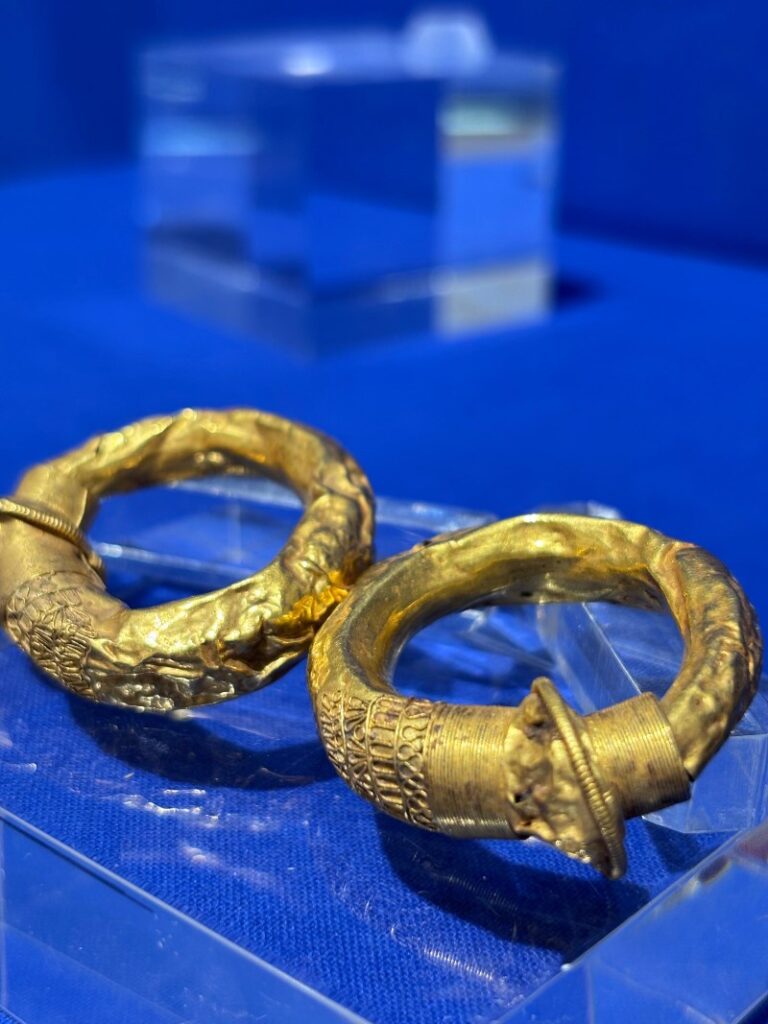
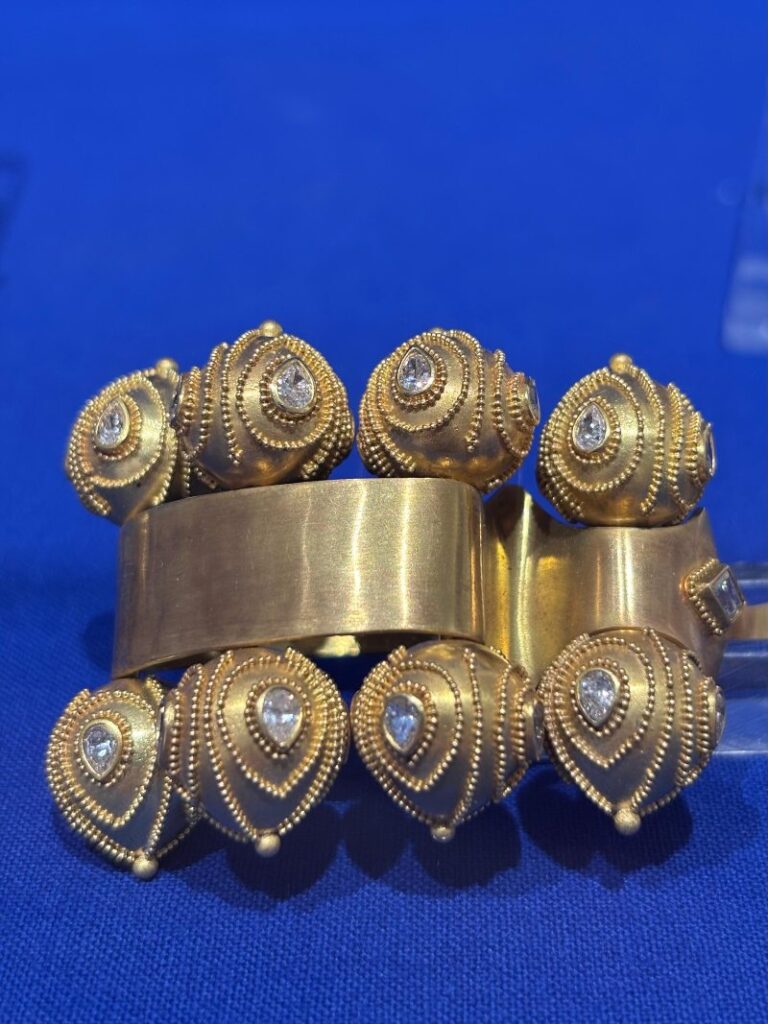
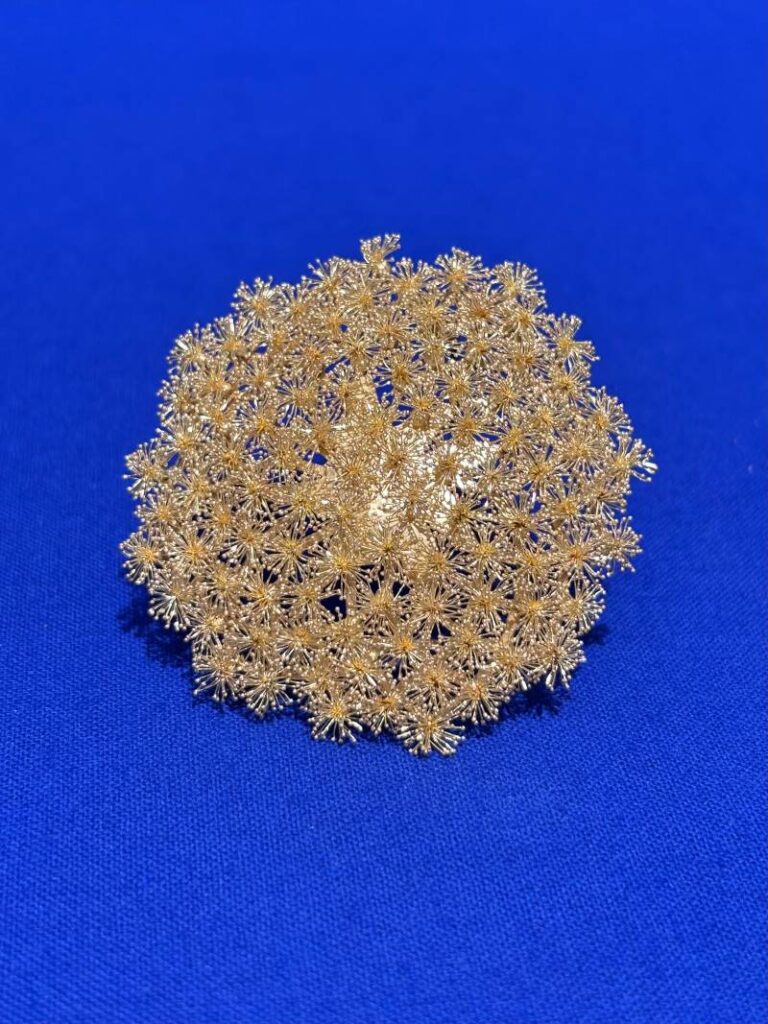
Etruscan goldsmithing techniques such as filigree and granulation also come back to life in jewellery inspired by pieces found in ancient necropolises. Hairpins, brooches, tubular earrings, and necklaces with engraved plates shine in the exhibition’s display cases.
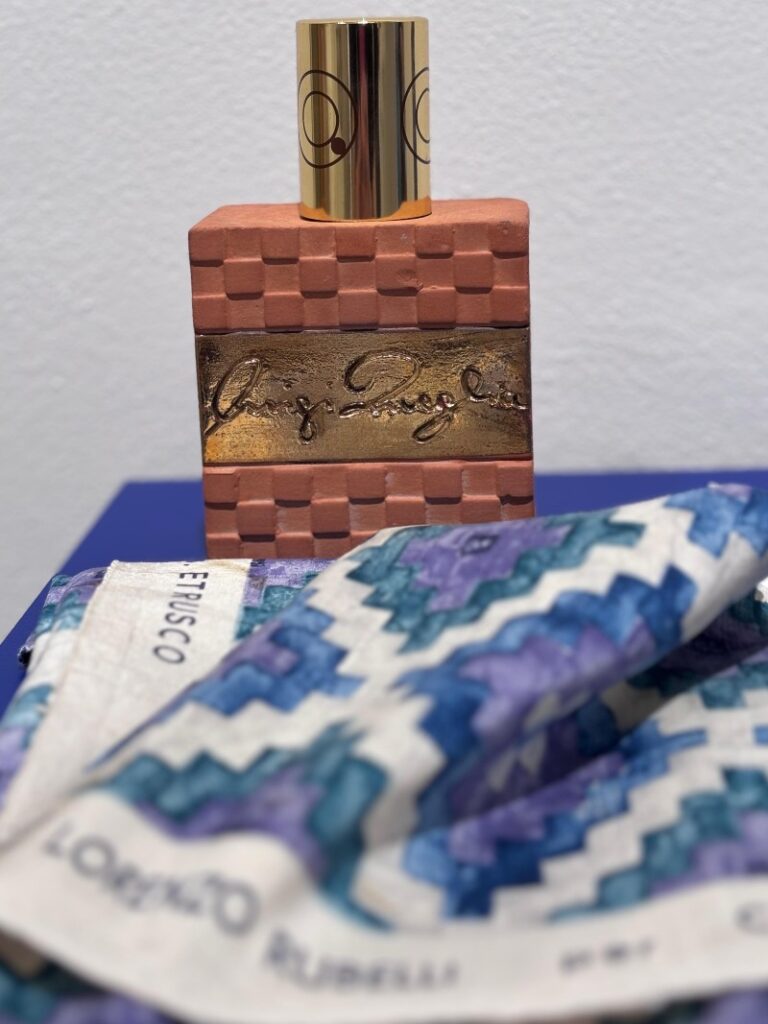
Finally, an Eau de Parfum pour Homme demonstrates how even the perfume industry has fallen under the Etruscan spell. The fragrance, created by artist and goldsmith Luigi Quaglia on the occasion of the Year of the Etruscans, is meant as a celebration of that ancient civilization and their homeland: Tuscany. Magnolia notes blended with exotic woods are enclosed in a terracotta bottle, a rough, warm material typical of the region.
Anima Etrusca | The Etruscans Resemble Us
The exhibition Anima Etrusca / Etruscan Soul. The Fortune of the Etruschi Project is, ultimately, a bridge between eras. A journey that connects the Etruscan age with our own time, passing through 1985—the year when the Etruschi Project took shape. An open dialogue between the ancient and the modern, between memory and reinterpretation.
CL Leonardo Morfini (FMS Archive)
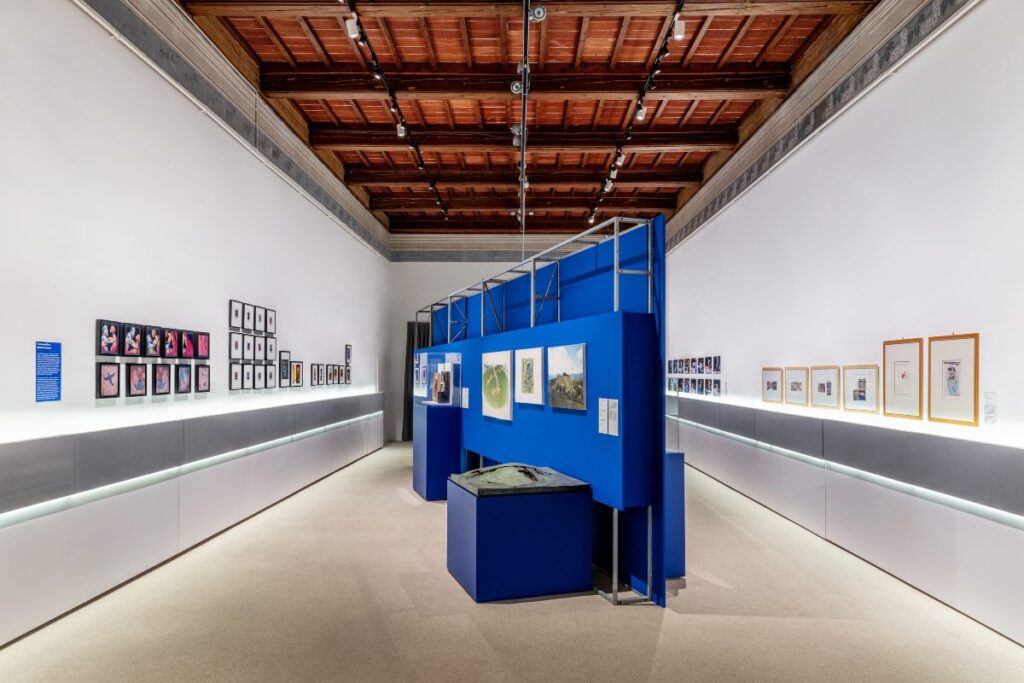
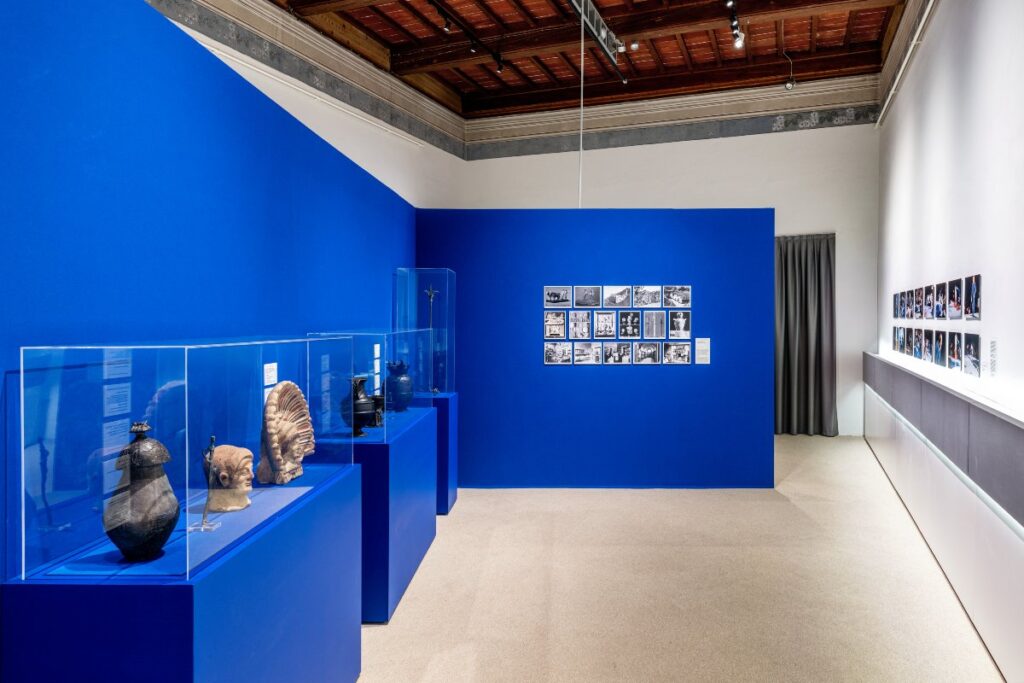
Blue, the dominant colour of the exhibition rooms, seems to evoke the depth of time and the mystery of the Etruscans—finally unveiled. It is a colour that speaks of spirituality and silence, but also of elegance and contemporaneity. A visual and symbolic threshold, capable of uniting the sacred aura of the Etruscan deities with the aesthetic sensibility of the present.
In the end, the Etruscans resemble us. In their art—interweaving the sacred and the everyday, life and mystery—we rediscover the same restless beauty that animates our own time. As we move through the exhibition space, the past is not merely remembered, but relived. The echo of the Etruscans resonates within the contemporary world.