 Collections
  Magazine
  Exhibitions
  ITA version













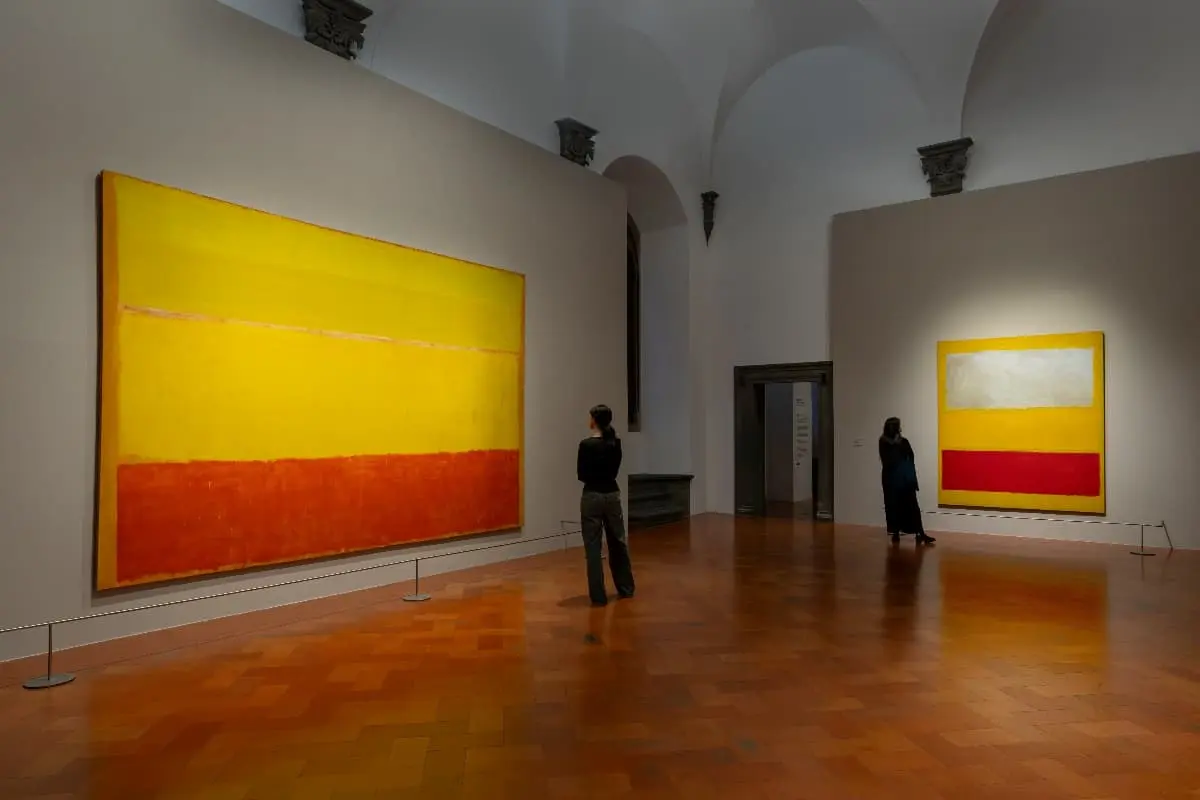
There are a few places in the world better than Florence to give meaning to the admiration of Mark Rothko‘s artwork. The American artist first traveled to Tuscany’s Renaissance birthplace in 1950. According to his son, Christopher, the artist was reluctant to travel, except for Italy. He went there three times, spending a long time at archaeological sites, churches, convents, and museums, to have a direct experience of artworks he had studied from afar. Michelangelo‘s architecture and Beato Angelico‘s frescoes, in Florence, had a disruptive impact on his art. The exhibition Rothko in Florence (in Palazzo Strozzi until August 23) showcases the link in the most spectacular way.
Rothko in Florence: exhibition overview and key artworks
The Rothko exhibition in Florence, promoted by the Palazzo Strozzi Foundation and curated by the artist’s son, Christopher Rothko, and Elena Geuna, showcases more than 70 artworks lent by the most prestigious collections worldwide. Besides private collections, the public can admire side-by-side works from the Museum of Modern Art (MoMA) and the Metropolitan Museum of Art in New York, the Tate Gallery in London, the Center Georges Pompidou in Paris, and the National Gallery of Art in Washington, D.C.
The retrospective at Palazzo Strozzi covers much of Rothko’s production in chronological order, from his first figurative and surrealist explorations, dating back to the 1930s and 1940s, to the birth of the so-called Multiforms and the color field paintings that inaugurated a new viewing experience in the 1950s and 1960s.
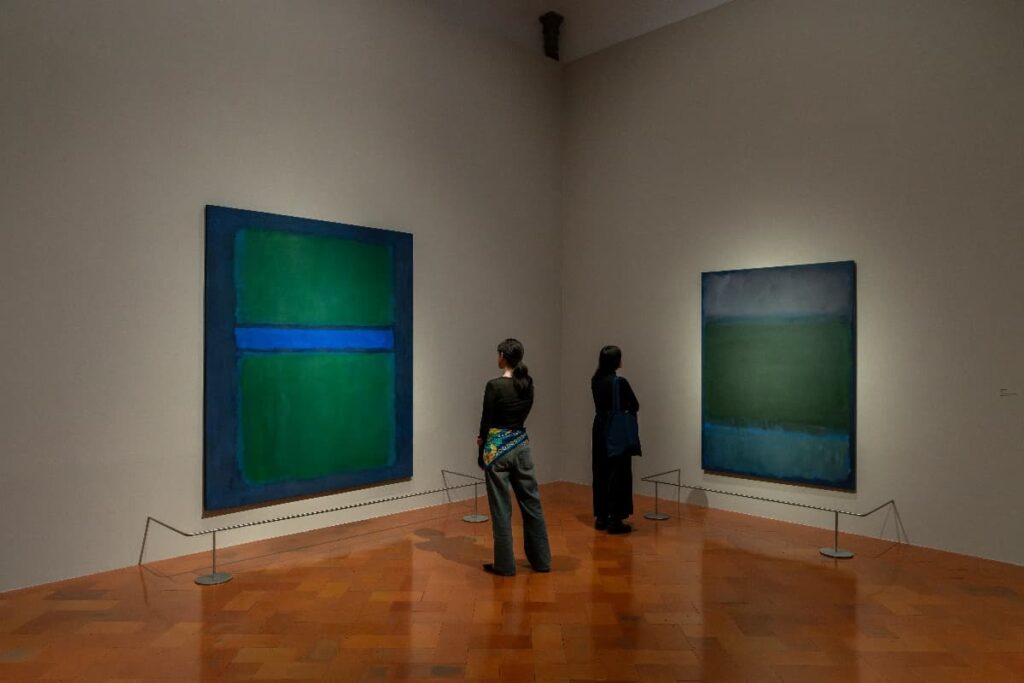
“When he started painting, my father had very little artistic instruction – his son Christopher says – He began as a figurative painter, making many model studies in pen and ink. He gradually grew into watercolor and oil painting, mostly of urban scenes in New York”. There are a few paintings from those years in Florence, including one of the many studies Rothko painted in the New York subway. His subsequent phases are all documented, from the mythic figures of the 1940s to his transition to abstract and expressionist art, until his renowned color field paintings.
San Marco: Rothko and Beato Angelico in dialogue with the sacred
Besides the main Rothko exhibition at Palazzo Strozzi, the real standout experience is the two secondary venues showcasing his art. The first one is the Convent of San Marco, in Florence, with the astonishing frescoes by Beato Angelico. On this occasion, the public can experience four of Rothko’s paintings alongside the frescoes in four of the monks’ cells that reportedly inspired them.
Beato Angelico’s work, dating back to the first half of the 15th century, profoundly affected Mark Rothko during his visits to Florence. He spent many hours admiring the delicate frescoes that adorn dozens of the monks’ cells, depicting several episodes in the life of Jesus Christ, particularly his martyrdom. He was moved by the nature of this painting, conceived for a single viewer’s contemplation. Each of them is the one decoration of a stark, cramped room, sometimes with a narrow window just to let some light in – never to enjoy the landscape outside.
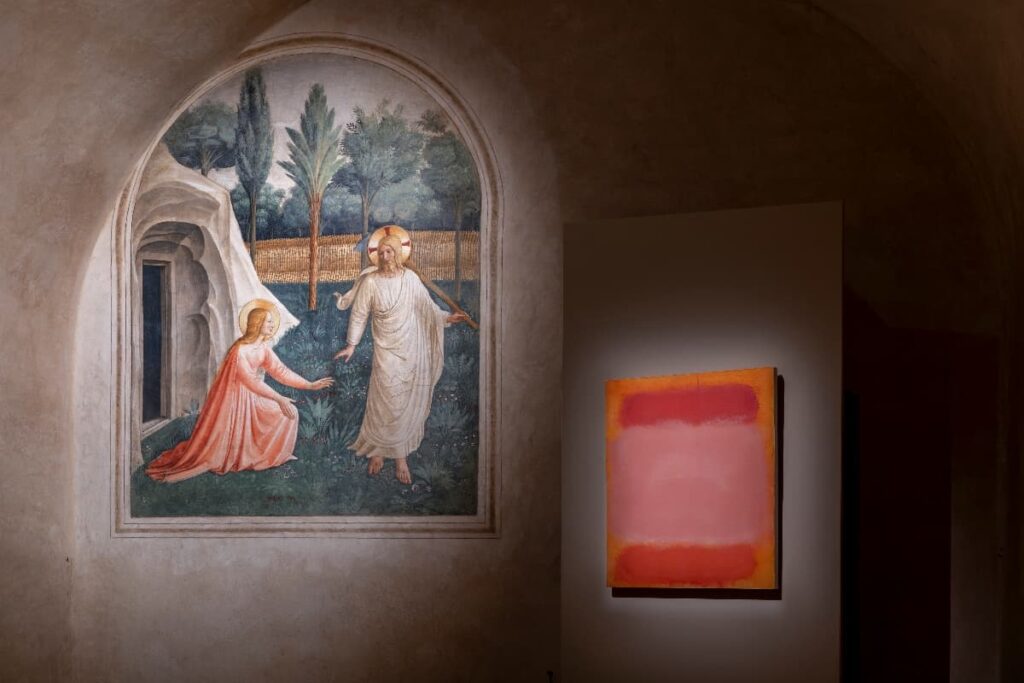
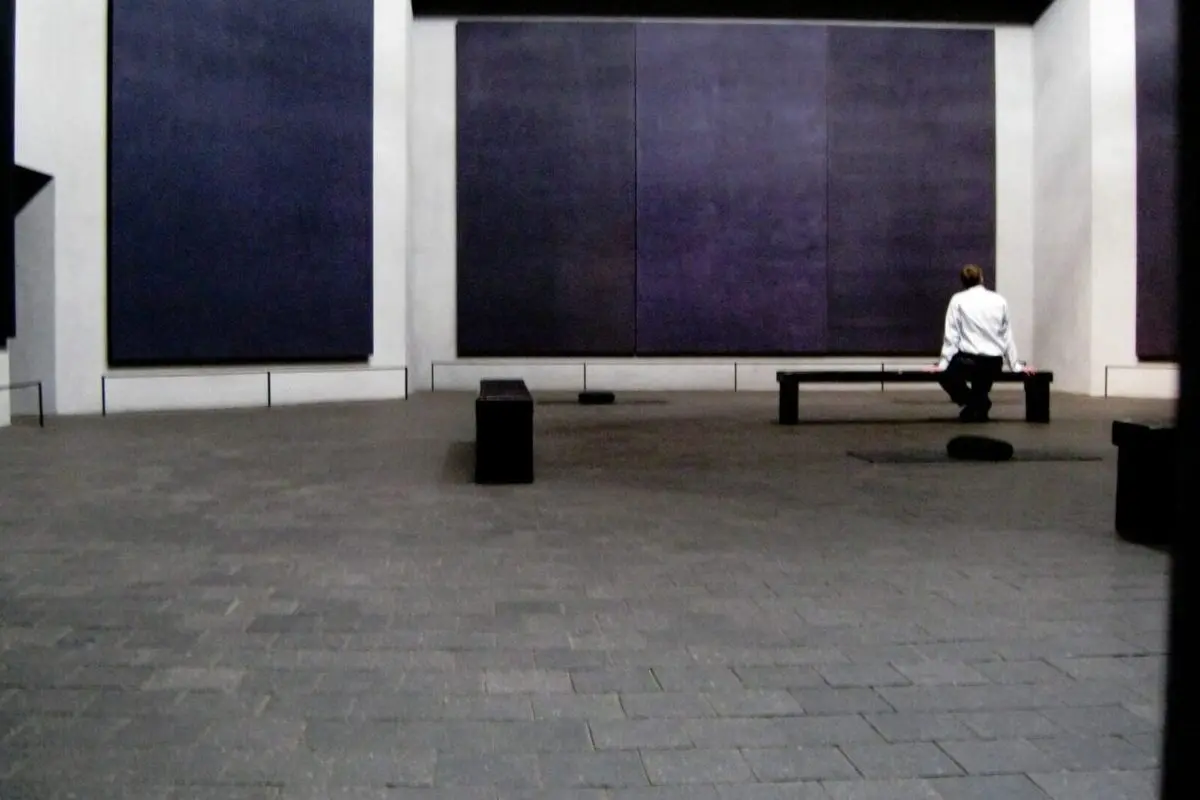
The use of light and the relationship with the space deeply influenced Rothko’s work from the 1950s to the 1960s, as well as the tension towards the sacred. All of these themes reach their peak at the Rothko Chapel in Houston, Texas.
It is remarkable to see side-by-side artworks from five centuries apart that can evoke the same emotions in the viewer.
Color field paintings and the role of emotion
My art is not abstract, it lives and breathes
Mark Rothko
Emotions are at the core of Mark Rorhko’s work, by his own admission. The artist was always cryptic about both the philosophy behind his work and the techniques he used to lay down the layers of color in his paintings. He escaped definitions and often denied critics’ interpretations of his work. Moreover, Rothko had a conflictual relationship with the commercial success of his art.
However, we can have a few certainties about his process. By gradually abandoning every figurative form and returning to a time before the Renaissance’s invention of perspective, he sought to convey basic human emotions in his art. “I’m interested only in expressing basic human emotions: tragedy, ecstasy, doom… The people who weep before my pictures are having the same religious experience I had when I painted them,” he said in an interview with Selden Rodman in the mid-1950s (Conversations with Artists, 1957).
Moreover, Rothko was unusually specific about how the public should experience his work. He said his paintings were to be showcased:
- in dim or controlled light
- to be experienced at a close distance (about 45 centimeters)
- at a low hanging height.
That is why the best way to enjoy the exhibition at Palazzo Strozzi is contemplation. Painting after painting, viewers immerse themselves in a spiritual experience born of color, to the point of almost feeling a physical, almost gravitational pull between painting and viewer.
“My father looked to engage the viewer, not just visually but their whole selves, and he wanted to have his work speak directly to your emotional life,” his son Christopher explains.
The Laurentian Library: Michelangelo’s architecture and the Seagram Murals
The other space that had an uncommon impact on Rothko’s perception and art interpretation was the Laurentian Library in Florence. There, until August 23, the public can admire two of his studies for the Seagram Murals, painted in 1958 and 1959.
The project to decorate the Four Seasons restaurant in the modern, brand-new Seagram Building in Manhattan, designed by Mies van der Rohe, was dropped by Rothko in late 1959. His artistic vision had become irreconcilable with that of the commissioner, architect Philip Johnson, who wanted to decorate the room with huge, colorful murals. Rothko, instead, had conceived the cycle of paintings as a testament to his artistic conception. The studies for the murals, most of which are gathered in the Rothko Room at the Tate Gallery in London, show how deeply architecture influenced the master’s work. Particularly, Michelangelo’s vestibule at the Laurentian Library in Florence, which he designed and supervised the construction of between 1523 and 1534.
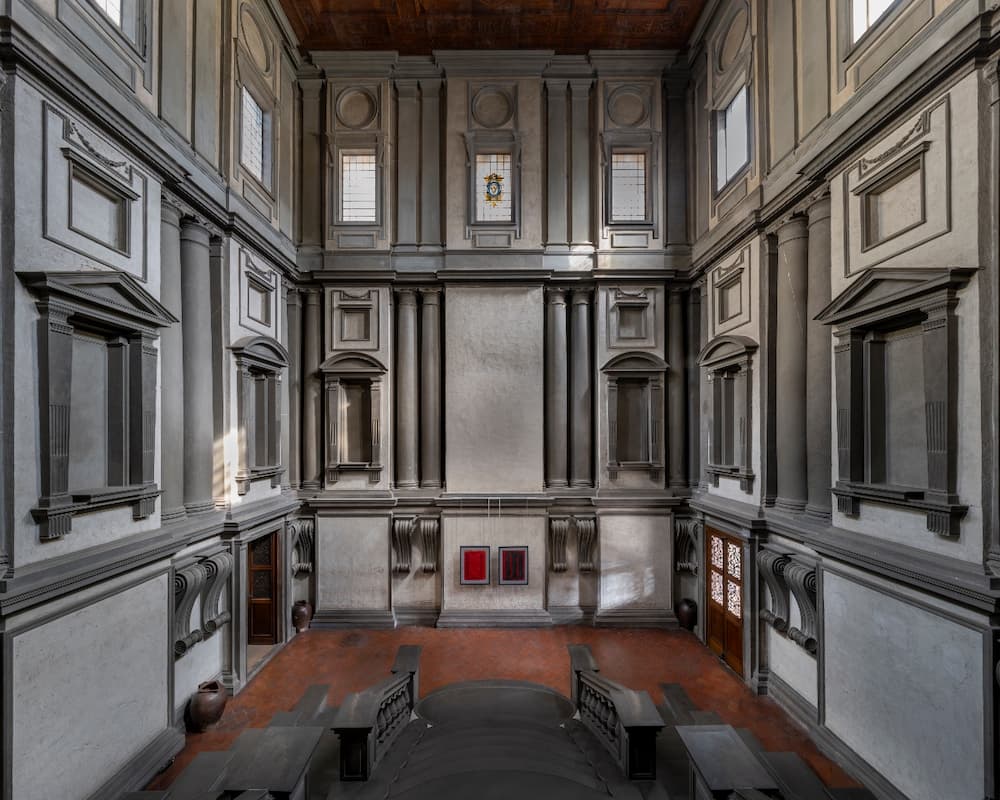
With its closed or fake windows and its range of greys, Michelangelo created a solemn, imposing room that gave the impression of a prison. “It achieved exactly what I am trying to do in painting – Rothko said to Rodman in the mid-1950s – It makes the viewer feel that he is trapped in a room where all the doors and windows are bricked up.”
In the Exhibition Rothko in Florence, we can witness the impact of the library on one of his early works, Interior (1936), and on many of his subsequent works. There are so many artworks that give the impression of light that cannot filter through a window, or traces and hints of columns, such as the ones he also saw in 1959 when he visited Pompei and Paestum.
Despite their bidimensionality, Rothko’s paintings convey a strong sense of volume, presence, and embience – the one only great architecture can convey.
Why Rothko in Florence is a unique viewing experience
Rothko in Florence is an event more than a retrospective. Alone, it is more than enough reason to plan a trip to the Tuscan city before the exhibition closes in August. Given its three locations, visitors should plan their trip in advance, especially since the Laurentian Library has limited timetables.
Tickets, opening hours, and how to visit
Palazzo Strozzi – Main Rothko exhibition
From 14 March 2026 to 23 August 2026
Daily 10.00-20.00
Thursdays until 23.00
Ticket required – Bookings on Palazzo Strozzi’s website
Open ticket (you can access at all times): € 20.00
Ticket for a specific day and time: € 15.00
Visitors who have a ticket for the Laurentian Library and/or the San Marco Museum: € 12.00
San Marco Museum – Satellite exhibition in dialogue with Beato Angelico frescoes
From Tuesday to Sunday, from 8:30 to 13:50 (last admission at 12:45).
Closed on Monday.
Tickets: € 11.00; reduced fee of € 2.00 for EU citizens aged 18-25. Free under the age of 18.
Bookings on the San Marco Museum website
Laurentian Library – Satellite exhibition in dialogue with Michelangelo’s architecture
Opening Hours Monday to Friday: 10:00 AM – 1:30 PM (last admission at 1:00 PM, closed on Saturdays, Sundays, and holidays).
Tickets € 7.00 on Vivaticket:
Reduced ticket € 5.00 upon presentation of an admission ticket to the Palazzo Strozzi exhibition.