 Collections
  Magazine
  Exhibitions
  ITA version













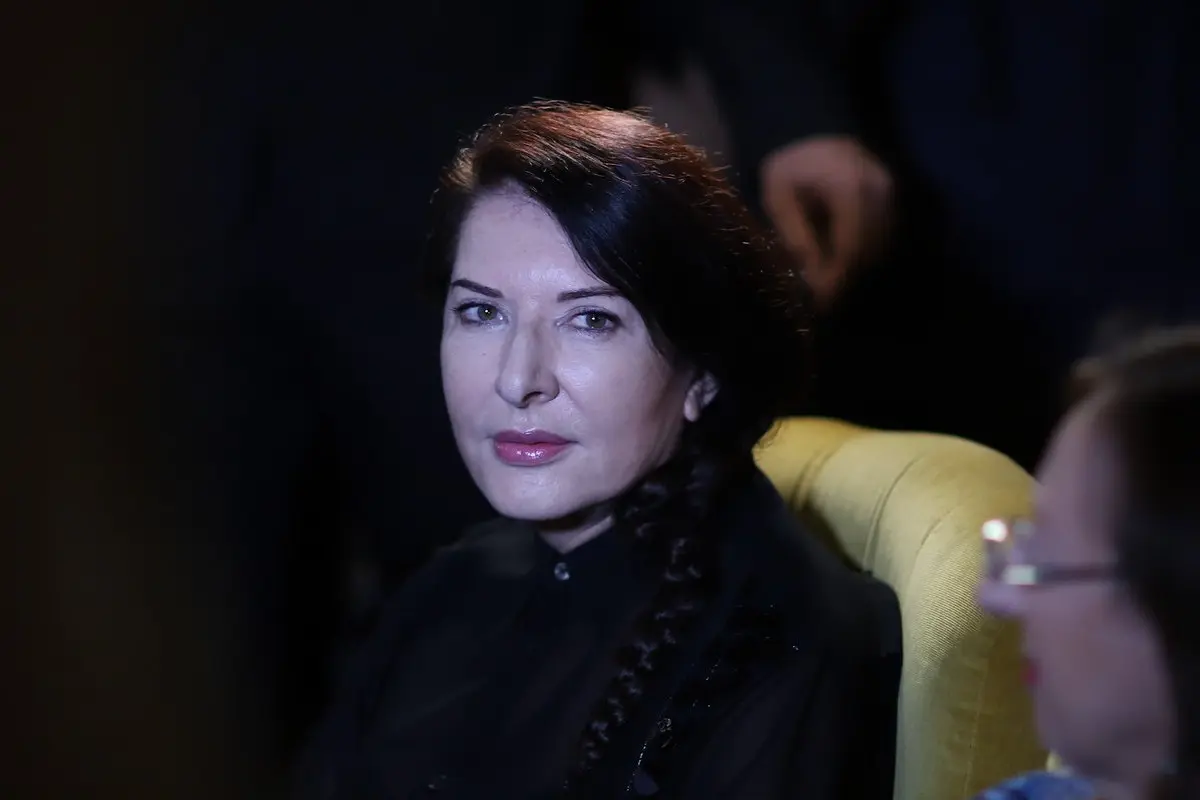
On May 6, 2026, the exhibition Transforming Energy, dedicated to the Serbian artist Marina Abramović, opens at the Gallerie dell’Accademia in Venice. In this temple of Venetian painting – a place where Titian, Giorgione, and Bellini reign supreme – contemporary art makes its mark. Marina Abramović is, in fact, the first living woman artist to be honored with an exhibition at the Gallerie dell’Accademia.
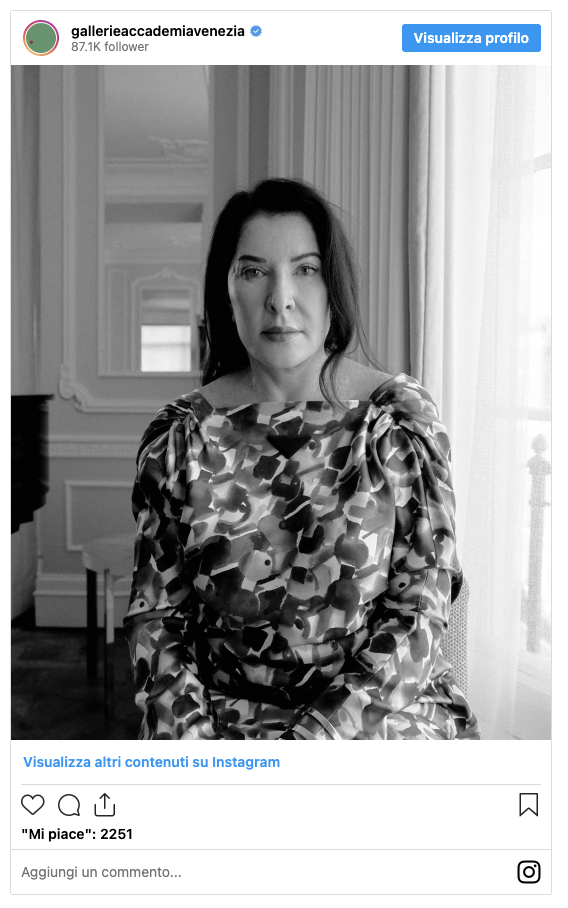
Transforming Energy: Marina Abramović in Venice at the Gallerie dell’Accademia
The exhibition Transforming Energy, which runs through October 19, 2026, coincides with the artist’s 80th birthday and is part of the Venice Biennale. For the first time, Abramović’s performance art engages with Venetian Renaissance masterpieces, occupying both the museum’s historic halls and temporary spaces. At the heart of the exhibition is the theme of energy and transformation. Hence, the title is Transforming Energy.
A particularly significant moment is the dialogue between the tableau vivant Pietà, created by Abramović and her partner Ulay in 1983, and Titian’s famous Pietà, in a direct comparison that reinterprets the themes of pain and redemption through a contemporary sensibility. In this interweaving of eras, the exhibition invites visitors to an immersive experience, opening the door to a profound reflection on the power of art as an energy capable of generating inner change.
But why did the Accademia choose Marina Abramović? There is certainly a connection between the artist and the city. As Abramović herself has said: “I was 14 when my mother took me to the Venice Biennale for the first time. We traveled by train from Belgrade, and when I stepped out of the station and saw Venice for the first time, I started to cry. It was so incredibly beautiful. Since then, returning to Venice has become a tradition. Now, as I prepare to celebrate my 80th birthday, I’m returning for an even more meaningful reason: to be the first female artist to present an exhibition that spans the entire exhibition route of the Gallerie dell’Accademia.”
The Venice Biennale: a Flagship Event on the International Scene
Whether acclaimed or controversial, the Venice Biennale is an event that always sparks intense debate. Founded in 1895, it is one of the oldest and most prestigious international events dedicated to contemporary art. Walking through its pavilions, the public can view works presented by artists from various countries—works that may not always be understood by everyone, and are sometimes harshly criticized, even though, more often, they aim to anticipate the most significant trends in the art world.
Many of the most representative artists of our century and the last have, after all, participated in the Biennale: Pablo Picasso, Paul Klee, Jackson Pollock, Andy Warhol, Anish Kapoor, and Marina Abramović herself, to name just a few.
Performance Art Origins: From Avant-Garde to Marina Abramović
To fully grasp the significance of Marina Abramović’s work, we must take a step back and trace the origins of performance art. This form of expression has its roots in the historical avant-garde movements of the early 20th century. Already, the Futurists, with their “Futurist evenings,” and the Dadaists, through provocative and anti-artistic actions, had begun to challenge the traditional idea of the artwork as a static object. The artist’s body was at the center of something happening in an unrepeatable here and now. Audience participation was encouraged and became an integral part of the artistic action.
It was, however, between the 1960s and 1970s that Performance Art established itself as an autonomous language. In a context marked by profound social and political changes, numerous artists began to reject the traditional artistic object – the painting, the sculpture – to focus on experience. The work is no longer something to be preserved, but something that happens. The body becomes the primary medium: vulnerable, exposed, and often pushed to the limit.
It is in this fertile ground that Marina Abramović’s work takes root. Beginning in the 1970s, the artist developed radical practices that explore physical endurance, the relationship with the audience, and the spiritual dimension. Her performances, often extreme, probe the limits of the body and the mind. In this sense, Abramović not only takes her place in the history of performance art but also plays a decisive role in redefining it, steering it toward a more conscious, almost ritualistic dimension.
The Body as Scream: Marina Abramović’s Early Performances
The body Abramović uses in her performances is one that acts, endures, and reacts. A body that becomes, in every sense, a “cry.” Emblematic of this is the Rhythm series (1973–1974), in which the artist tests her own physical and psychological limits. In Rhythm 0 (1974, Naples, Studio Morra), Abramović offered herself completely passively to the audience, placing various objects at their disposal, including feathers, roses, but also blades and a loaded gun. The experiment lasted six hours, during which some attempted to protect Abramović while others, with fewer scruples, cut the artist with knives. Rhythm 0 thus became a dramatic exploration of human nature, latent violence, and the fine line between individual responsibility and collective dynamics.
Yugoslavia and Memory: The Political Roots of Abramović’s Work
But this radicalism also has its roots in a personal and cultural dimension. Having grown up in socialist Yugoslavia, amid military discipline and strict family values, Abramović brings to her art a memory shaped by control and resistance. Her performances can also be interpreted as a way of coming to terms with that context: the body becomes an archive of experiences, a place where individual and collective histories intertwine.
Her language could only be expressed through performance. Indeed, traditional art is challenged and criticized. In Art Must Be Beautiful (1975, Florence, art/tapes/22 gallery), Abramović obsessively combs her hair, almost to the point of hurting herself, repeating like a ‘mantra’ that art must be beautiful and that the artist must also be beautiful. The gesture exposes the aesthetic stereotypes, conventions, and expectations of the art system.
Marina Abramović and Ulay: Love and Performance
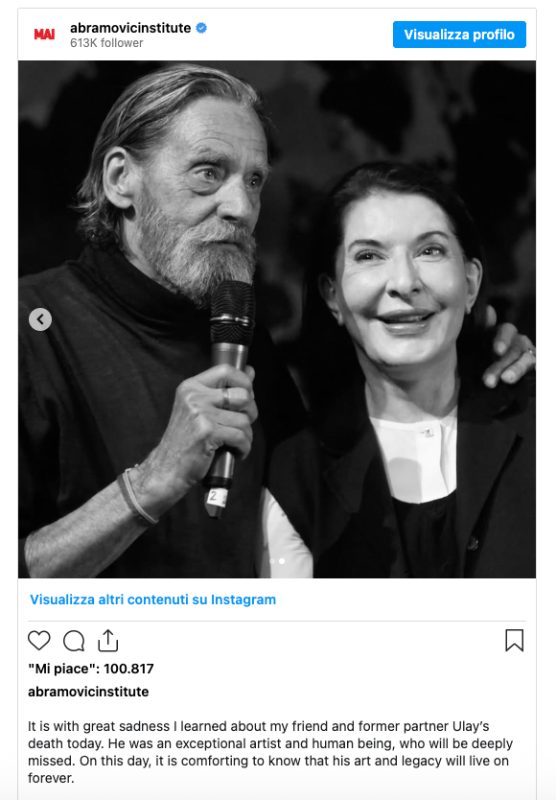
The year 1976 marked a turning point in Abramović’s career. She met Ulay (the pseudonym of Frank Uwe Laysiepen), a German artist and photographer, with whom she began an intense romantic relationship. Their relationship soon evolved into a partnership that was both personal and artistic.
Their work was based on the idea of duality. The masculine is contrasted with the feminine. Presence with absence, and identity with fusion.
Among their most famous performances is Imponderabilia (1977, Bologna, Gallery of Modern Art). Abramović and Ulay stood naked at the museum entrance, forcing the public to walk between them. People were implicitly called upon to choose which way to turn. A seemingly simple decision, but one that was actually fraught with implications: intimacy, embarrassment, desire, and social convention. The title itself, Imponderabilia, refers to that which cannot be measured: emotional reactions, invisible tensions, and psychological dynamics.
The Lovers: The Great Wall Walk and the End of a Relationship
The bond between Abramović and Ulay gradually faded over time until it turned into distance. After years of sharing their lives and work, their separation took on an equally performative and symbolic form: The Lovers: The Great Wall Walk (1988, Great Wall of China). The two artists set out from opposite ends of the Great Wall and walked for about three months to meet in the center, where they said their final goodbyes. An epic and theatrical gesture that transforms the end of a relationship into a work of art, suspended between myth, ritual, and reality.
Their story has entered the collective imagination, helping to make their figures and their partnership iconic. It is no coincidence that articles dedicated to them can be found even in glossy magazines that have nothing to do with the art world. But beyond the romantic narrative, what remains is the power of a project that redefined the very concept of relationship in art: no longer merely represented, but lived, traversed, and pushed to the limit.
Balkan Baroque at the Venice Biennale: War and Ritual
Marina Abramović’s work, however, is not limited to the physical and relational dimensions; it also powerfully opens up to a political reflection deeply intertwined with the history of her homeland. The dissolution of Yugoslavia and the Balkan wars of the 1990s left an indelible mark on her practice, transforming performance into a space for processing trauma.
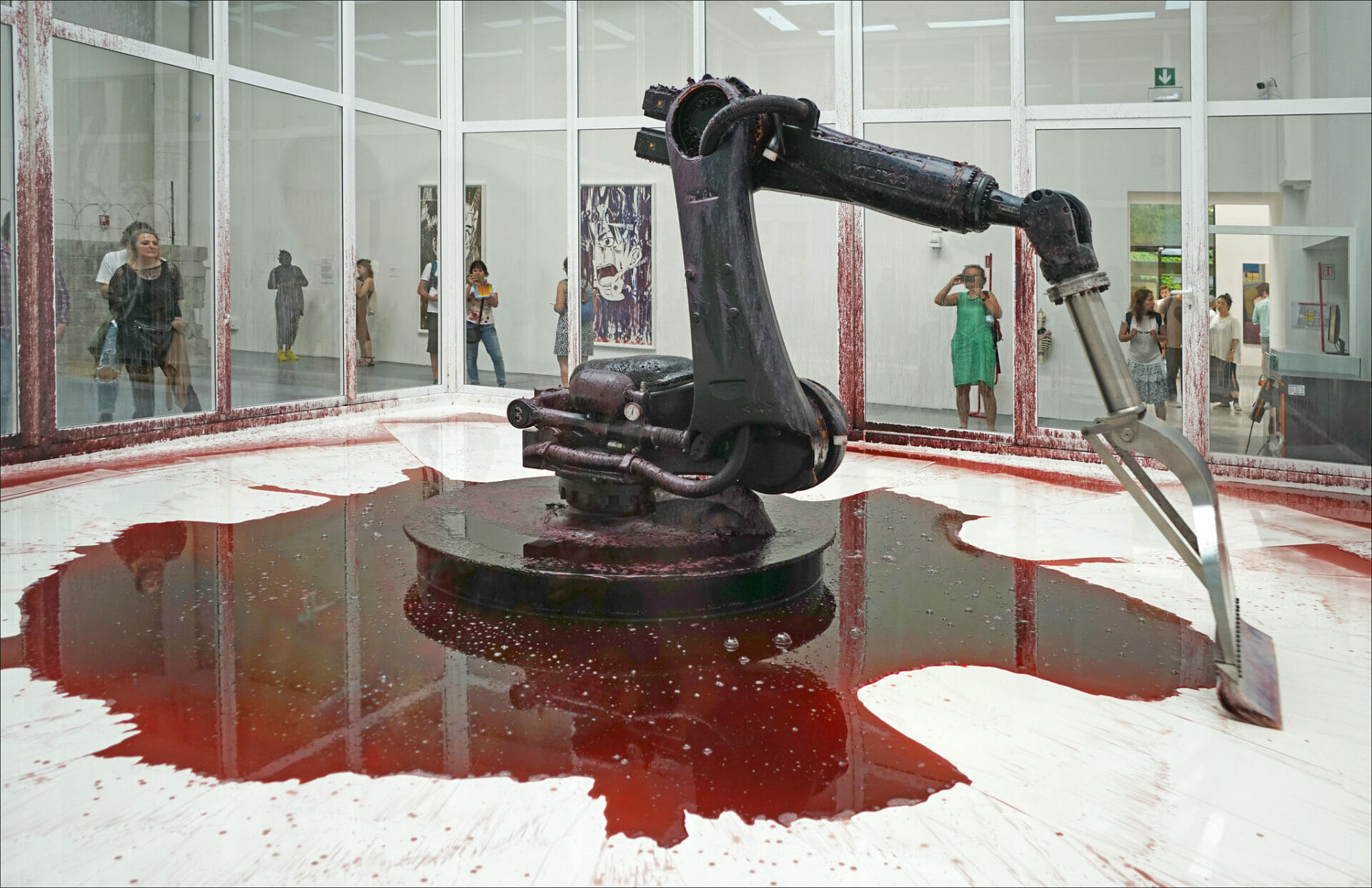
Emblematic in this regard is Balkan Baroque: presented in 1997 at the Venice Biennale, it earned the artist the Golden Lion. For days, sitting on a pile of bloodied animal bones, Abramović washes them one by one, in a gesture as obsessive as it is futile. The action becomes a powerful metaphor for war: violence, blood, and guilt cannot be erased. The artist’s body bears the weight of a painful memory, in a ritual that evokes mourning, purification, and the impossibility of redemption.

In the video performance The Hero (2001), Abramović reflects instead on the figure of her father, a partisan during World War II, and, more broadly, on the concepts of war and heroism. The artist appears motionless with a white flag on a white horse. The image, silent and solemn, suspended in an indefinite moment, evokes peace.
Marina Abramović Between Radical Art and Institutional Recognition
Over the years, Marina Abramović has achieved something rare for a conceptual artist: she has broken out of the confines of her niche and made a name for herself in the global collective imagination. Her austere figure has become instantly recognizable. The growing number of exhibitions dedicated to her should also be understood in this light, culminating today in her consecration in Venice at the Gallerie dell’Accademia, a place symbolic of artistic tradition that is, not by chance, opening itself to her work.
But Abramović has even become the subject of parodies, bursting into popular and media culture. At this point, the question arises almost inevitably: Has Abramović betrayed the original idea of her art? Has she “entered the system” that she initially seemed intent on challenging? In part, yes. Her presence in major museums, institutions, and global contemporary art circuits marks a transition from a radical and marginal practice to a recognized and, to some extent, institutionalized language.
Yet this apparent contradiction can also be interpreted differently. It is precisely her entry into the system that has amplified the reach of her messages, making them accessible to a vast audience. Her art, while evolving, has not lost its original power: it continues to explore the body, boundaries, and relationships, but does so on a larger scale. And it is perhaps precisely this tension between radicalism and popularity that establishes her as an emblematic figure of the art of our time.
Transforming Energy: where and when to visit Marina Abramović’s exhibition in Venice
Opening: May 6 to October 2026 at Gallerie dell’Accademia – Venice
Closed on Monday
Open from Tuesday to Sunday, from 9 AM to 7 PM
Fill ticket: 20 Euros
Bookings on the Gallerie Official Website