 Collections
  Magazine
  Exhibitions
  ITA version














Damnation by Béla Tarr Review | Hungarian Cinema and the Poetry of Decay


Runtime
Damnation (Kárhozat), directed by Hungarian filmmaker Béla Tarr, is an atmospheric, black-and-white 1988 drama that visually explores human misery and longing. Representing a watershed moment in the director’s career, it served as a sort of style workshop that paved the way for his later acclaimed films: Satantango (Sátántangó) in 1994 and Werckmeister Harmonies (Werckmeister harmóniák) in 2000.
From another perspective, the film is a striking document of decadence, corruption, and political stasis. It captures the pervasive sense of alienation that haunted the Soviet provinces in the years leading up to the system’s collapse. However, as the adjective “atmospheric” suggests, Béla Tarr’s films are never about the plot, and Damnation is no exception. Viewers seeking extensive social commentary will be disappointed. Tarr’s cinema is less concerned with explanation than with environment: mud, rain, stray animals, and a small, helpless community — damned indeed.
At its core, Damnation is a story of love and disillusionment, shaped by the subtle shifts of light and the poetry of a wrinkle. The film showcases Tarr’s distinctive style, favoring introspection over narrative drive. Time stretches, gestures repeat, and meaning emerges less through action than through duration itself. In this way, Tarr situates himself within a European cinematic lineage that recalls the works of Michelangelo Antonioni and Andrei Tarkovsky. In this lineage, cinema unfolds as a space for reflection rather than resolution.

- Space and Stagnation in Béla Tarr’s Damnation
- Love Without Redemption: An Unromantic Affair
- Slow Cinema and the Weight of Time
Space and Stagnation in Béla Tarr’s Damnation
The characters in Damnation are elusive and sometimes almost flat. Little is revealed about their pasts, and the film withholds the psychological depth usually offered by backstory or explanation. Even the sparse dialogue often takes on an abstract, philosophical tone.
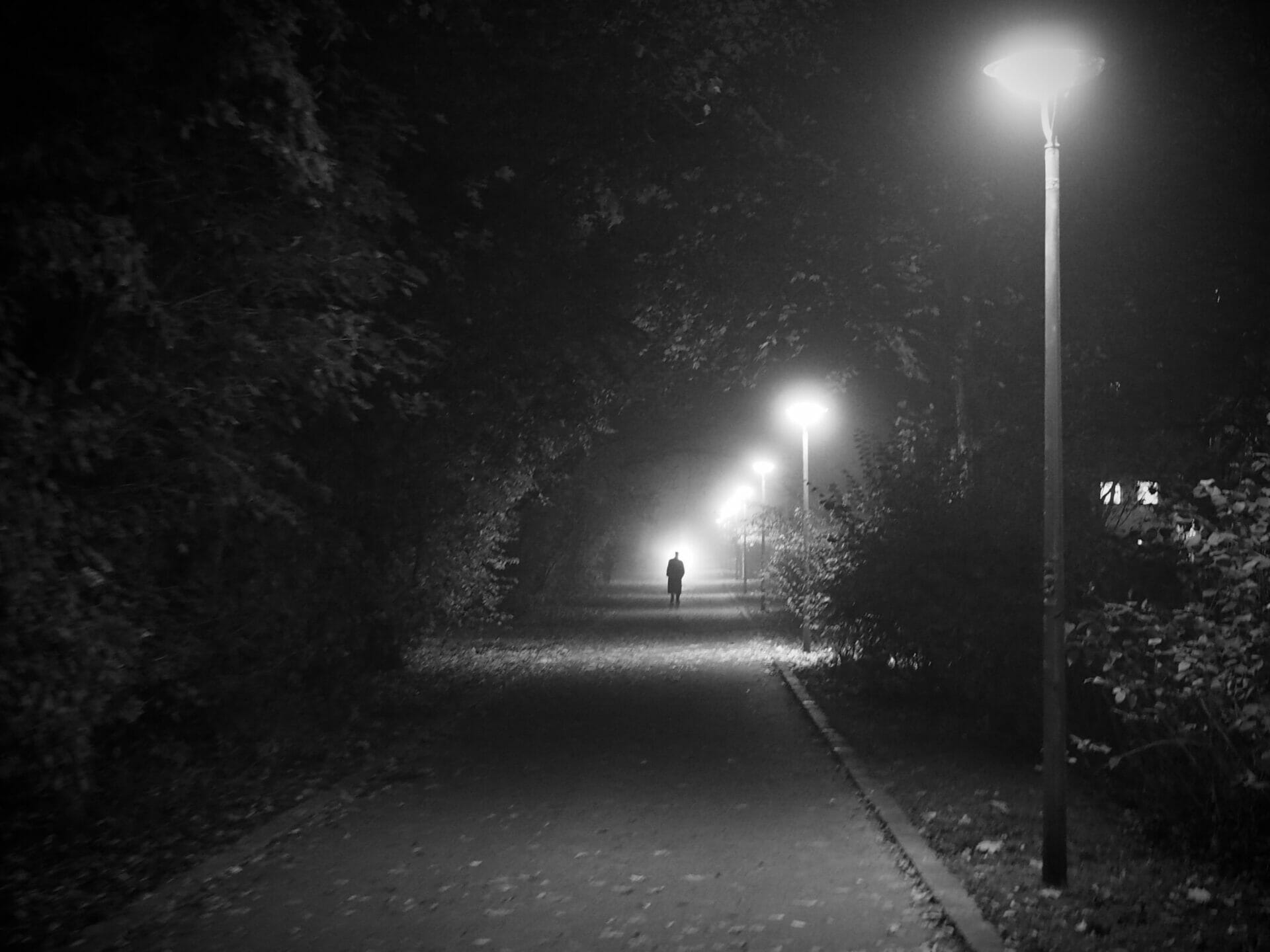
The village itself seems suspended in time. Its streets and interiors quietly bear witness to the lives within. Yet, viewers are compelled to watch, as if under the spell of a magical filter. Here, we encounter one of Béla Tarr’s defining gifts: He has the power to make the worlds he films feel charged with a sense of presence. He doesn’t need talkative characters. In the dim glow of a bar lamp flickering over cracked walls, in the focused stillness of a man sitting alone in a bar, or in the squeak of a rusted vehicle, emerges a worldview that speaks more profoundly than words ever could.
Using just a few simple objects and sequences, Béla Tarr establishes the emotional tone of the entire film. He depicts a worn-out community incapable of escaping its decadence. Within this decayed world, the characters’ choices and conflicts begin to take shape, and the plot emerges almost imperceptibly, carried by the weight of their surroundings. If a plot is needed at all, Tarr begrudgingly provides it.
Love Without Redemption: An Unromantic Affair
Damnation‘s protagonist, Karrer (Miklós B. Székely), is a depressed man who spends his days in a state of existential resignation. He is desperately in love with a married torch singer (Vali Kerekes) from the Titanik, which seems to be the only bar in the village. It’s another evocative space that recalls a well-known and tragic story. Karrer’s relationship with the singer is minimal: a brief fling and much disillusionment. From the beginning, neither of them is hopeful that their love will succeed. As the singer’s soft voice tells us at the start of the film, “It’s over, over, and there won’t be another.”
Béla Tarr does not have a romantic view of love. Yet, he is keenly aware that most of us do. He knows that many viewers will interpret Karrer’s love as a promise of salvation. The plot of Damnation, co-written by Tarr and László Krasznahorkai, skillfully plays with this expectation to reveal its naïveté. Love does not bring redemption. In fact, it turns out to be another form of entrapment. It is bound to the same forces of repetition and illusion that govern Karrer’s world. The final scene (spoiler ahead), in which Karrer crouches in the mud and barks with a stray dog, is not merely about the inevitability of degradation. It marks the point at which the illusion collapses entirely. Without the false promise of love, existence loses all direction. Meaning dissolves. Relief disappears. What remains is endurance without a horizon—madness at its purest.

Slow Cinema and the Weight of Time
Tarr’s directing style is slow and immersive. It is designed to make viewers aware of the weight of time and space. Gábor Medvigy‘s stark black-and-white cinematography emphasizes duration, texture, and spatial depth. Tarr’s long, unbroken takes capture characters in real time, generating tension through their almost theatrical stillness. Ágnes Hranitzky‘s editing is deliberately minimal, refusing narrative acceleration and allowing each shot to play out completely.
This visual strategy allows viewers to experience the characters’ moods, silently conveying the stagnant and melancholy nature of their existence. As meaning emerges from posture, rhythm, and the relationship between bodies and their surroundings, dialogue becomes secondary and often unnecessary. Furthermore, Mihály Vig’s music functions less as accompaniment and more as an environmental force. Like a sonic weather condition, it is omnipresent and unavoidable, slowly eroding any sense of momentum or hope. Through these audio-visual devices, Béla Tarr transforms ordinary actions and spaces into poetic reflections on isolation, hopelessness, and despair.
In conclusion, Damnation is a film that refuses to compromise on any level. As such, it is not a film for every viewer or occasion. However, it is a crucial record of a cinematic style gradually disappearing across Europe and a poetic depiction of human fragility.
Tag