 Collections
  Magazine
  Exhibitions
  ITA version













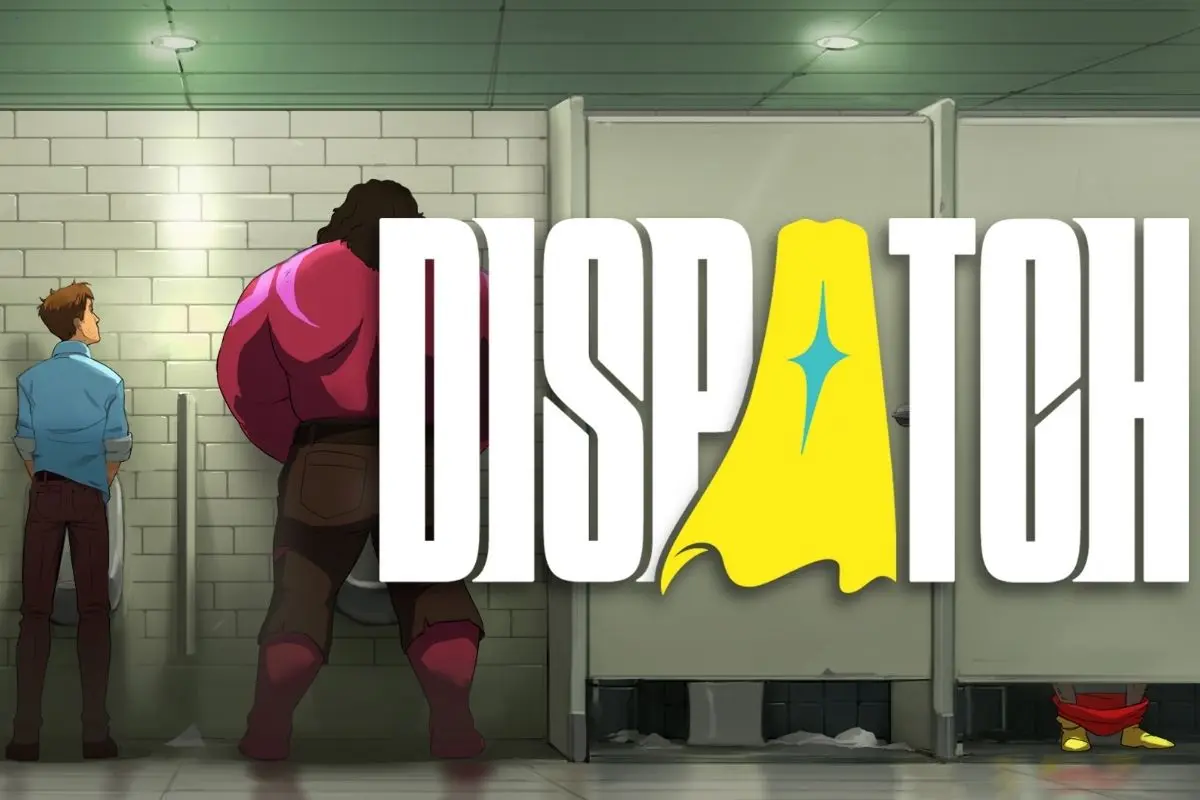
Why Dispatch Is the Most Human Superhero Game in Years


An everyman, you Robert always kept everyone guessing what he’ll say or do next.
The narrative adventure video game Dispatch finishes by reminding us that unpredictability doesn’t belong only to heroes or villains. It belongs to anyone.
A comeback story built on creative freedom
Dispatch is a comeback story. Former Telltale developers, Nick Herman, Dennis Lenart, Pierre Shorette, and Michael Choung, sought to reclaim the creative control they felt slipping away. After Tales from the Borderlands, they left a studio where corporate priorities outweighed the stories they wanted to tell. They felt their time at Ubisoft offered no real improvement: shifting productions, a cancelled Splinter Cell, and a growing focus on live-service projects left little room for narrative ambition.

After receiving an offer to create an interactive live-action game, in 2018, they founded AdHoc Studio. Filming for what would become Dispatch was set for March 2020, but the pandemic halted everything. The pause, rather than stopping the project, allowed the team to refine the script, rethink its branching structure, and sharpen its vision.
When production resumed in 2025, Dispatch emerged as a narrative adventure game with a clear identity, blending sitcom energy with emotional tension. It gives the genre new life without leaning on nostalgia. It works with confidence, and its theme of redemption drives both the story and the way characters relate to each other. Shows like The Good Place proved how humour and ethical struggle can coexist. Dispatch plays in a similar space but is grounded in a more fragile, chaotic world.
A chaotic, superpowered Los Angeles with a fragile core
The game is set in a version of Los Angeles populated by superhumans, aliens, demons, and people who look a little more ordinary. Robert Robertson, once known as Mecha Man, lives here. An explosion destroys his armour and sends him into a crisis of identity. With no heroic persona left, he ends up working at the Superhero Dispatch Network, the place that coordinates missions for newly reformed ex-villains.
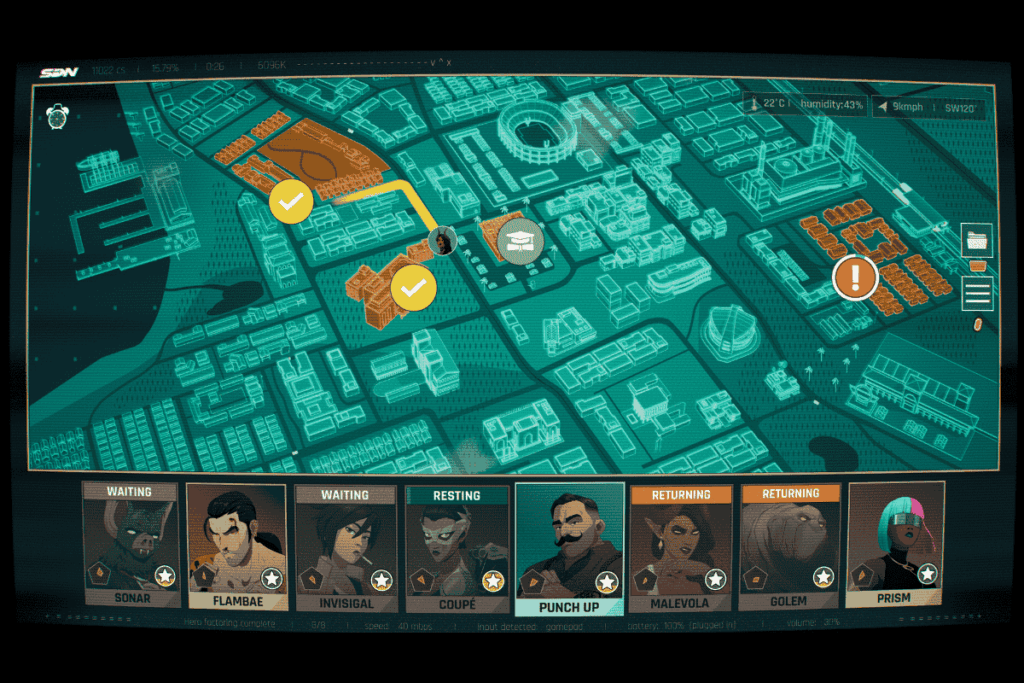
Robert is put in charge of the Z-Team, a complicated group with clashing personalities and unpredictable powers. Over eight episodes, he experiences a fall and a possible path upward. The missions he assigns are only part of the story. The rest lies in the trust he tries to rebuild with characters who carry anger, guilt, and hope in equal measure. It recalls ensemble worlds like Monster Allergy, where humour and vulnerability coexist without breaking the internal logic.
Team dynamics, choice, and the weight of redemption
Dispatch blends lightness and melancholy. The dialogue and cutscenes bring to mind works such as The Wolf Among Us or Life Is Strange, where conversations reveal as much as actions. The game structure is based on managing the team. Players assign tasks, balance personalities, watch timers, and try to keep everyone together. It becomes a form of emotional strategy. The pressure on Robert is mirrored by the pressure placed on the player.
Redemption is central. Each character has a past they cannot ignore, and the narrative grows through contradiction rather than a sudden transformation.
But Dispatch goes beyond redemption. Mental health quietly shapes the emotional core of the story: burnout, self-worth, shame, and the desire to start over are constant undercurrents for nearly every member of the Z-Team. The game never treats these states as dramatic twists but as everyday conditions that influence how characters speak, hesitate, or retreat.
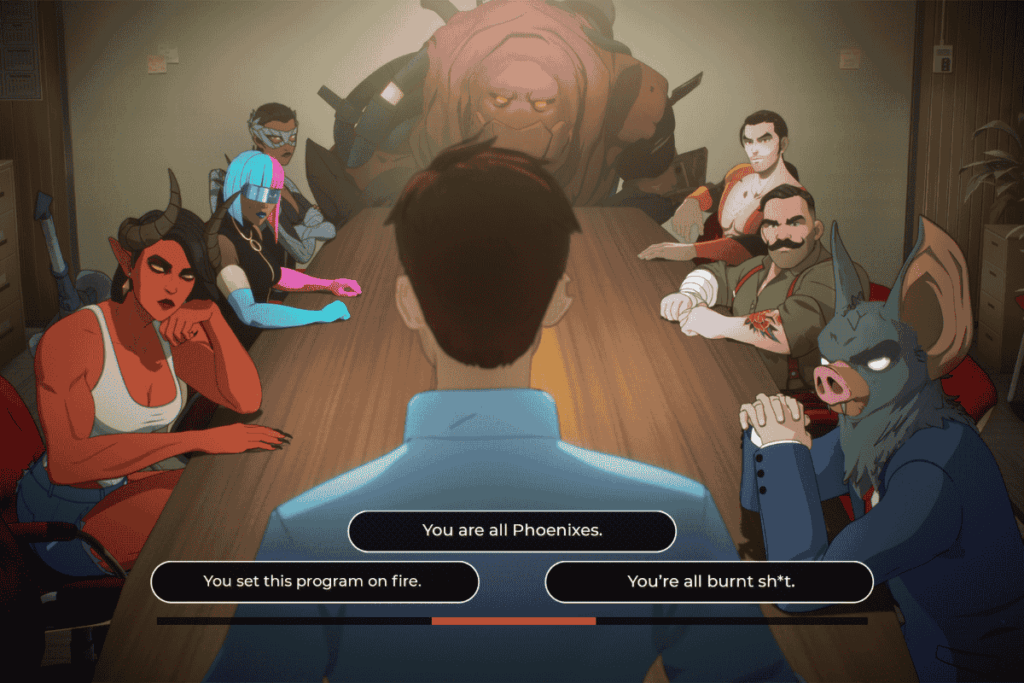
These fragile dynamics gain weight as the narrative branches. Multiple endings reflect not only plot variations but the consequences of how players choose to treat others — whether they listen, impose, forgive, or distance themselves. The power of choice shifts from steering a storyline to shaping relationships, making the finale feel like a mirror of the player’s own approach to care, pressure, and empathy.
For example, the hacking minigames introduce a different rhythm. They take the form of 3D labyrinths under time pressure and can feel chaotic, but they underscore the protagonist’s internal state. An exoskeleton no longer protects Robert. He has to rely on his own mind, and that mind struggles.
Expectations, self-sabotage, and the fight to change
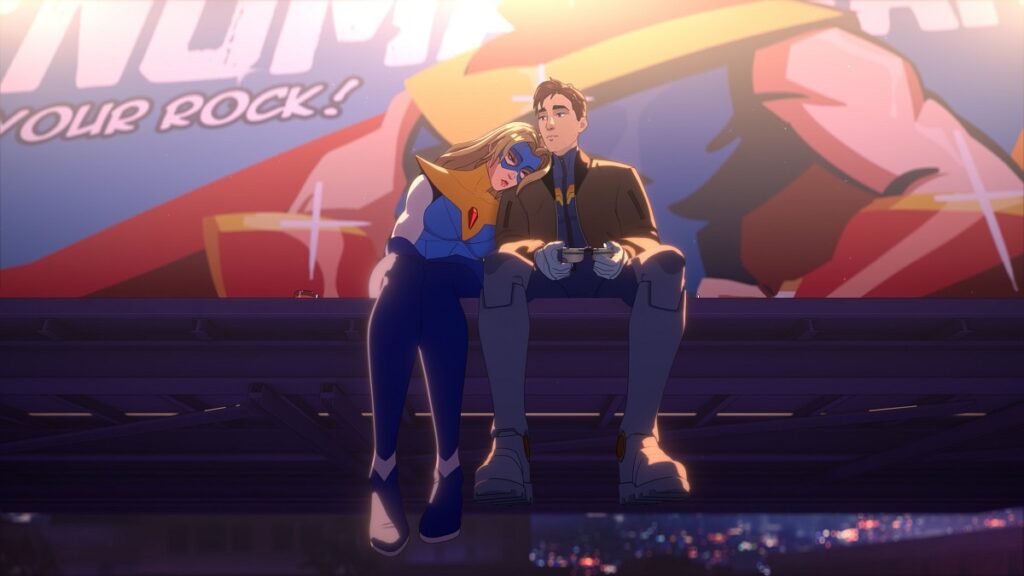
Mental health is also explored through character arcs. In particular, Blonde Blazer and Invisigal, the two potential love interests in the game, face issues that mirror Robert’s, creating a thematic pillar. Expectations, whether internal or external, are an essential motif in Dispatch. Blonde Blazer is the poster hero of SDN. She’s powerful, beautiful, and kind. Because of this, she feels trapped by her persona. She longs for moments where she can be human and stay away from the glamour of her job. The dissonance between her public and inner selves makes her feel inadequate.
She’s uncomfortable even in her love life. Her boyfriend, Phenomaman, Dispatch‘s Superman equivalent, won’t see Blazer as a person, but as an extension of his job. He believes all they have to be is superheroes. America Ferrera’s monologue in Barbie echoes the constant pressure to perform at your peak. Ferrera bemoans the endless requirements women have to deal with, from sexist stereotypes to new feminist expectations. In the same way, Blazer is afraid to express desires she believes are incompatible with her role.
On the same page is Invisigal. An asthmatic girl who becomes invisible while holding breath, she feels unwanted because of her powers. Invisigal has a past of crime. She believes her powers can only ever be used for mischief. Her disillusioned attitude constantly creates problems. Invisigal’s conundrum is a self-fulfilling prophecy, a term coined by sociologist Robert K Merton in 1948. In believing she’s only good as a villain, Invisigal sets herself up for failure, influencing reality through her own disposition.
In the game, expectations influence Robert himself. He thinks he has failed Mecha Man’s legacy and can’t live up to his father.
Breaking the cycle: how the Z-Team learns to choose differently
With the help of romance, the characters challenge these expectations and negative attitudes. Blazer and Robert are two individuals who are afraid to show what’s behind the mask. The protagonist creates a safe space for Blazer, where she can be whatever she wants. As she doesn’t need to adhere to an ideal constantly, Blazer realises her needs aren’t that incompatible. This mirrors Batman, the hero who alternates between feeling trapped as the Caped Crusader and as the socialite Bruce Wayne.
Theorised by Kurt Lewin after World War I, his Field Theory states that a person’s behaviour is a function of their psychological interior state and external space. That is to say, different environments and moments in life will generate different attitudes in the same person. Blazer then understands that she can be both a powerful and respectable hero while also taking time off and being a person.
On the other hand, Invisigal can break her self-fulfilling prophecy. Through Robert’s active support, she understands it’s the actions that make one’s self, rather than the existing conditions. Thus, even with her powers, she can be a force for good.
The entirety of Z Team mirrors Invisigal’s self-esteem improvement. Initially convinced by the world’s expectations of them as ex-villains, they break the circle by committing to their new job, becoming more and more convinced of themselves. Finally, Robert realises that he can be a hero whether or not he’s inside the suit. His value as a person is not dependent on the expectations imposed on him.
Stronger characters through sound design and casting
The soundtrack, composed by Andrew Arcadi, supports the emotional tone without overwhelming it. Soft synthesizers, subtle percussion, and minimal melodies shift as relationships evolve. Each member of the Z-Team has a small musical motif that appears during key scenes, and the music mirrors the group’s changing dynamics.
The performances elevate the writing. Aaron Paul gives Robert a quiet, tired humanity, marked by hesitation and small bursts of irony. Laura Bailey brings sarcasm and vulnerability to Invisigal. Erin Yvette adds warmth and awkward charm to Blonde Blazer. The cast works together with the score in a way that recalls character-driven productions like The Walking Dead, where delivery and silence both matter.
A community-driven story built for replayability
Players treat Dispatch as something to revisit. Its branching structure invites experimentation, discussion, and comparison, sparking screenshot exchanges, long forum threads, and personal theories. This replay culture echoes the collective interpretation often seen in other media, where players analyse narrative choices as if they were chapters of a shared anthology.
The game also benefits from its hybrid release model, part episodic series, part videogame, landing in a cultural moment shaped by binge-watching and serial consumption. The weekly cadence of episodes creates anticipation, community rituals, and a shared sense of waiting, strengthening engagement.
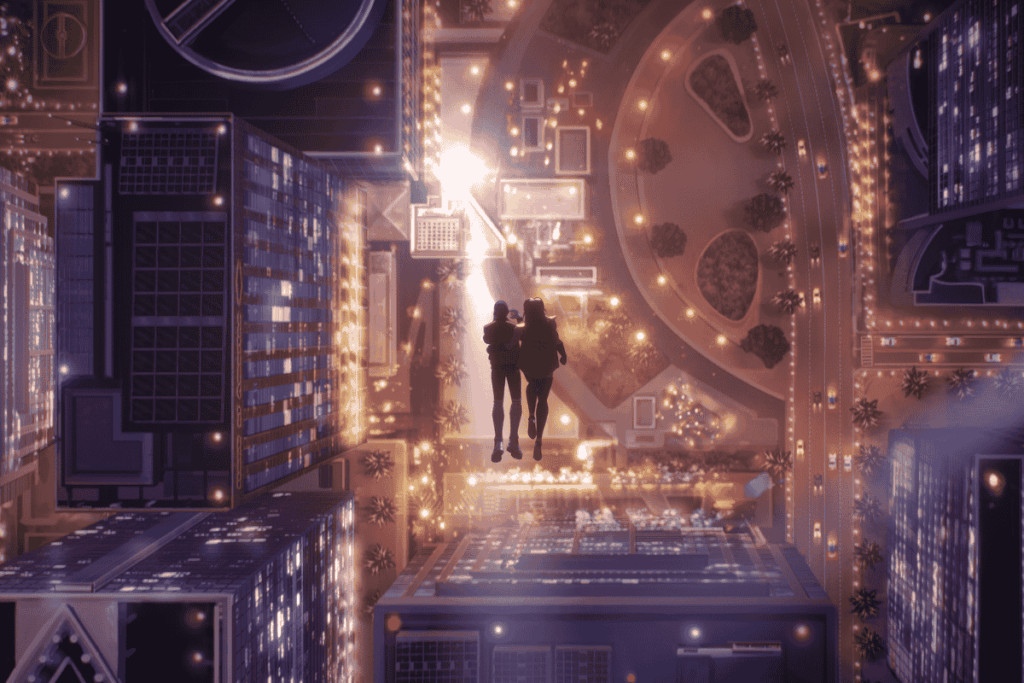
The game launched on PC, PlayStation, and Xbox and stands shoulder to shoulder with larger productions in ambition, proving that narrative design still has room to evolve. At a time when story-driven games are often labelled niche, it offers a counterexample built on patience, detail, and character work.
An indie success reshaping expectations for narrative games
Just weeks after the launch of the last episode, Dispatch continues to exceed every expectation. AdHoc Studio announced that the game has already sold more than two million copies. This is an extraordinary milestone, especially considering that it reached in a matter of weeks what internal projections had estimated over the course of three years.
We're also sad there are no new episodes this week, but thank you to the 2 million players that have joined us so far. Wouldn't be here without you. Art by Derek Stratton.
— AdHoc Studio (@adhocstudio.com) 19 novembre 2025 alle ore 21:00
[image or embed]
Its momentum carried into awards season. Dispatch was nominated for Best Indie Debut at The Game Awards, which took place on December 11, 2025. The nomination alone marks a remarkable achievement for the team, and many fans are already hoping, above all, that Season 2 will arrive as soon as possible.
Tag