 Collections
  Magazine
  Exhibitions
  ITA version













The Expanse TV Series | A Cold War of Politics and Tribalism in Space


Seasons
Runtime
The Expanse’s space is cold, as freezing as the Cold War is.
As a book series starting with Leviathan Wakes in 2011, The Expanse is a hard sci-fi story gripping with a political conflict between Earth and Mars. The two superpowers are struggling for dominion over the resources of the Solar System’s Asteroid Belt, where the hardened residents spend precarious lives, working in harsh conditions for the Inner Planets’ prosperity.
Under the pen name James S. A. Corey, writers Daniel Abraham and Ty Franck originally envisioned the setting as a Massively Multiplayer Role-Playing Game. The book series was adapted into a US-made TV series in 2015 by Syfy.
Realism and Hard Science in The Expanse
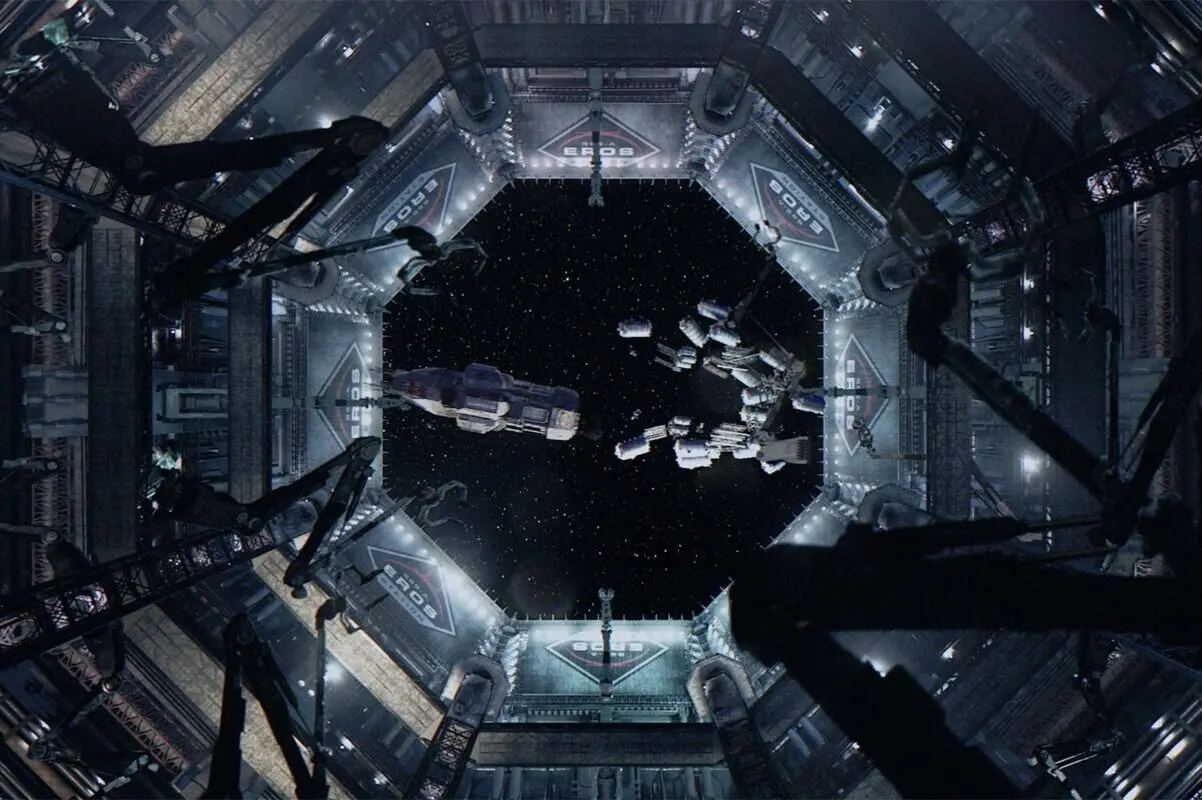
The Expanse’s story is a realistic one, both in its depiction of technology and its portrayal of humanity. Similar to the realism of Andy Weir’s The Martian, the show forgoes fantastical elements like faster-than-light travel or stylish spaceships in favor of a down-to-earth setting where the technological realism influences how people react. Even the show’s cinematography, under the direction of Jeremy Benning and Michael Galbraith, highlights this. As there’s no up or down in space, starships often appear at unusual angles, where it’s harder to tell which side is which. Similar to Battlestar Galactica, the camera zooms and flies alongside the speeding ships, giving the scenes a dynamic feel.
The ships are like skyscrapers, with the decks stacked one over the other perpendicular to the direction, opposed to classic depictions having the decks like a modern sea ship. The show’s designers crafted the designs in such a way that it’s harder to tell which side the viewers are looking at, to convey the feeling of the absence of directions in space.

A Political Thriller Set in the 23rd Century
Earth’s United Nations and Mars’ Martian Congressional Republic are the big powers in the Solar System. The two factions resemble the two opposing sides in the US-USSR Cold War, while the United Nations represents an evolution of the United States. A Federal Republic composed of the previous Nations of Earth, the UN fights for resources to keep the cradle of humanity fed. The Martian Republic, on the other hand, is a nation focused on a single objective: the terraforming of the Red Planet. To transform Mars into a habitable planet, Martians have built a highly militarized society, where everybody has their place and purpose.
Between these two giants, disenfranchised Belters struggle for survival, hopping from asteroid to asteroid orbiting the outer planets of the System. The Belters have no unified government and are extracting resources and wealth ultimately destined for Earth and Mars. Belters have to pay even for the air they breathe. Revolutionary and Extremist groups try to change the status quo, some fighting for reforms and representation, while others resort to violence and terrorism. Although all humans come from Earth, the UN and the MCR are colonialist powers in disguise, appropriating the Belt’s manpower and wealth for themselves, stripping asteroids and planets of minerals and other resources.
Like in the 2013 series House of Cards, The Expanse’s politicians manipulate, lie, and fight for the good of their own factions. Indeed, the series shows both the lowliest of people and those at the height of power. From a desperate thief to the UN Secretary, the political ramifications of the actions of the characters are felt throughout the Solar System.
Colonialism, Identity, and Tribalism Across the Solar System
The status quo is shaken by the discovery of an alien organism. Much like Ridley Scott’s Alien’s Xenomorph, the alien in The Expanse can’t really be reasoned with. Scientists try their best to study and understand it. Almost like a virus, the alien organism creates gruesome results when in contact with humans. Believing it’s a weapon, the factions begin a race to acquire the organism. While Earth and Mars start to turn their cold war into a hot one and the Belters’ Outer Planet Alliance moves forward with plans of independence, shadowy corporations conduct horrible experiments to harness the aliens’ power.

At the center, Captain James Holden (Steven Strait), Executive Naomi Nagata (Dominique Tipper), Pilot Alex Kamal (Cas Anvar), and Mechanic Amos Burton (Wes Chatham), crew of the Rocinante, try to set things right. The fight for the alien organism highlights one of the show’s themes: humans retreat into safe bubbles and side with their own tribes, without listening to outside groups. The instability the alien brings worsens the relations between the three groups. In contrast, the crew of the Rocinante does its best to unite humanity. As they come from different factions, the main characters bring different perspectives. While conflict is still present, the family on board the ship is reminiscent of Star Trek’s crew. Moreover, their cooperation eventually leads others to join their cause, like UN Deputy Undersecretary Chrisjen Avasarala (Shohreh Aghdashloo), who strives to prevent a war with Mars.
Belters are even more concentrated on themselves. Stereotyped and distrusted by the rest, Belters have created a strong bond based on identity. Because of life in space, Belters have grown taller and have weaker bones than their Earth or Mars counterparts. In fact, they are unable to stand on Earth, as its gravity proves too much for them. This physical difference is a motive for discrimination. In addition, thanks to decades of different cultures mixing, Belters have a unique Creole and body language. Belters’ language is both a symbol of the oppressed and a different mechanism to interface with the world. As in R.F. Kuang’s Babel, colonialism and language are deeply connected. Belters have the hardest time trusting others. They often see Earthers who genuinely want to help as just paternalistic oppressors, ready to subjugate them.
A Complex Look at Power and Politics
While The Expanse is a profoundly political show, it avoids beating its viewers with obtuse messages. As a result, the story engages with multiple points of view. While a sci-fi like Star Wars has a clear villain, here every faction has well-intentioned figures and bad apples. The story avoids painting the Belters as innocent victims. In fact, it shows how, while ultimately affected by colonialism, oppressed people always have a choice. The same for Earth and Mars. In fact, as the series progresses, leaders begin to question the status quo, and Holden’s ideas of cooperation seep in.

While racism against Belters is everywhere, common problems like discrimination based on sexuality or skin color are firmly surpassed. From villains to heroes, these characters are people first, and their preferences are only as crucial as their arc requires.
Fans of the series enjoy discussing themes of colonialism and racism on online forums. In addition, following the main tribalism message, fandom spaces often divide themselves into factions, jokingly swearing allegiance to one of the three leading powers of the story.
The Legacy of The Expanse and Its Expanding Universe
While the critical response was good, Syfy eventually canceled the show. Similar to the original Star Trek series, a firm fan response catapulted the series into the spotlight. They created a petition, supported by the actors and the writers. Eventually, Amazon Prime Video picked up the show. Amazon not only renewed the series but also injected more funding into its special effects. While The Expanse always tried to bring high-quality CGI for its spaceships and realistic sets, under Amazon, upgraded models and bigger set pieces started appearing.

Numerous novellas, graphic novels, and comic books populate the expanded media for the franchise. The Expanse even returned to the original idea. The franchise spawned a Board Game in 2017 and, in 2023, an adventure video game made by Telltale Games. In 2025, OwlcatGames announced The Expanse: Osiris Reborn, an action role-playing game that will follow the first season of the show. The game is taking inspiration from titles like BioWare’s Mass Effect.
Tag