 Collections
  Magazine
  Exhibitions
  ITA version













These days, the city of Milan is hosting Metafisica/Metafisiche, a wide-ranging exhibition on the concept of metaphysical art developed by the Italian painter Giorgio De Chirico. Not many exhibitions make you question how you read a room. This one does. Curated by Vincenzo Trione, the show gathers around 400 works – paintings, sculptures, photographs, design objects, architectural models, videos and more – loaned by over 150 institutions from across the world. On view through June 21 at Palazzo Reale and the Museo del Novecento, it is also part of the official cultural program of the Milano Cortina 2026 Winter Olympics.
De Chirico and the invention of metaphysical space
When people talk about metaphysical painting, they usually imagine something abstract or detached from reality. Giorgio de Chirico’s work proves the opposite, as it starts from specific elements and destabilizes them. Squares, statues, and arcades remain recognizable, yet they stop functioning within the familiar system through which people interpret space. This vision also comes from his background, shaped between Greece, Italy, and Germany. Born in 1888 in Volos, Greece, into an Italian family deeply connected to classical culture, De Chirico grew up between Mediterranean mythology and a fragmented European environment. After studying in Athens, he moved to Munich in 1906, where he encountered the works of Arnold Böcklin, Max Klinger, and, above all, the philosophies of Nietzsche and Schopenhauer, which challenged the idea of reality as fixed and definitive.
When, between Florence and Turin, he developed his first metaphysical squares, he introduced an existential question that would define his entire work: what happens when space continues to exist, but stops giving meaning to what it contains?
From Böcklin to De Chirico: how space became unstable
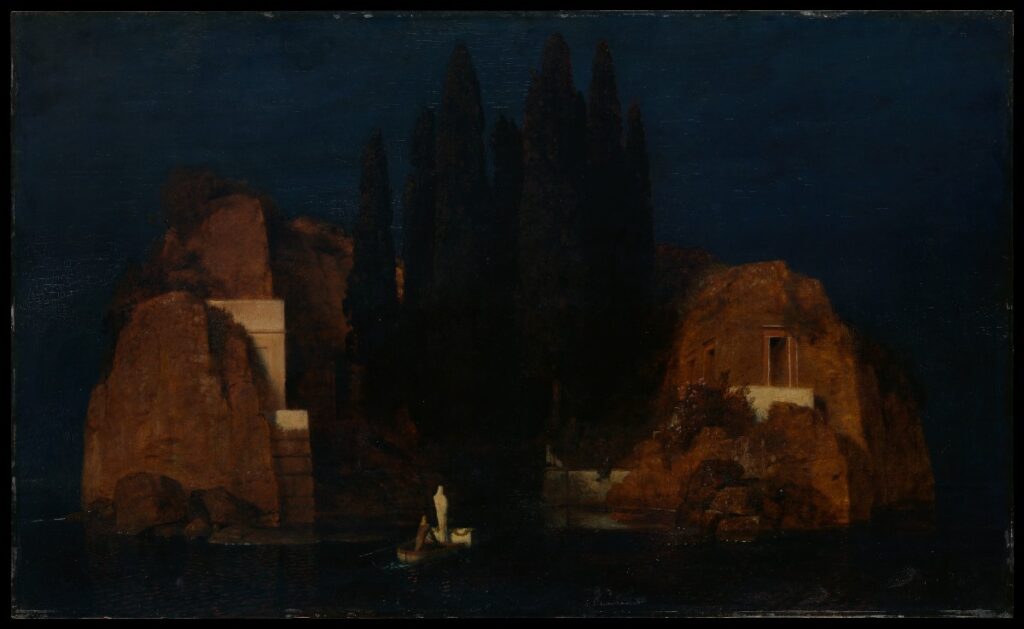
De Chirico’s relationship with the Swiss painter Arnold Böcklin goes beyond shared imagery. In De Chirico’s paintings, one can sense an echo of the suspended scenes that Bocklin created from a Symbolist perspective, in which man and time were suspended. This effect stems from the image’s very structure. Böcklin worked with enclosed, almost theatrical landscapes in which time appears suspended and figures seem isolated. He created dark, suspended atmospheres that still carried a narrative dimension. De Chirico took this logic and moved it into a completely different setting by abandoning myth and introducing the modern city.
His squares are neither alive nor empty. They seem to wait for something that never fully comes to pass. This is the decisive shift: metaphysical painting does not build another world, but alters the one that exists. Viewers recognize the elements in front of them, yet they can no longer connect them coherently, and this is where the unease begins. The disturbance does not come from absence, but from things no longer functioning as expected. Metafisica/Metafisiche traces exactly this shift, showing how De Chirico’s transformation of space became one of the most influential ideas in twentieth-century art.
The Transformed Dream and the logic of disorientation
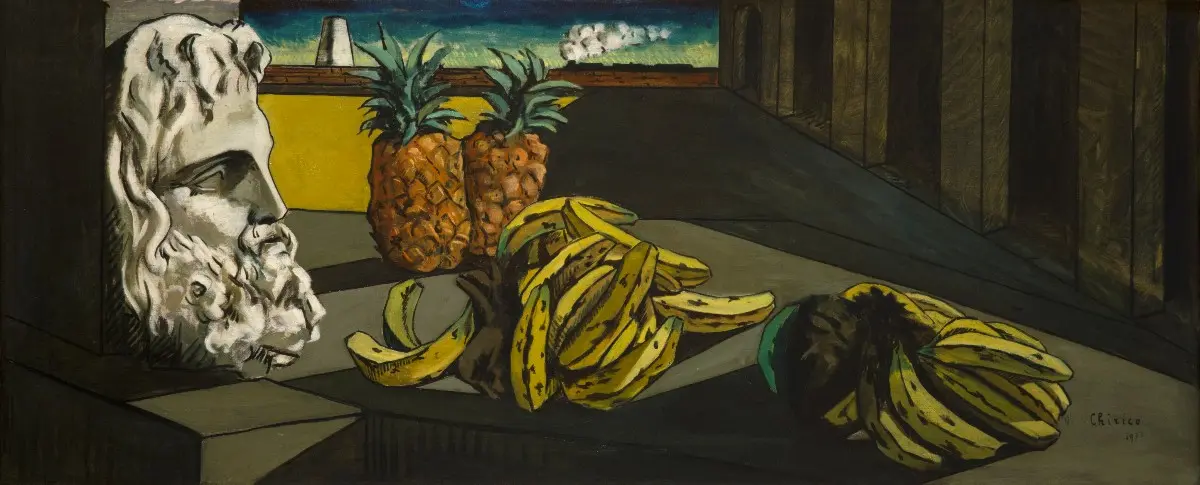
The Transformed Dream is one of the clearest works for understanding this mechanism. At first glance, it seems simple: a statue, some architectural structures, an orderly square where everything appears stable. Yet after a few seconds, something starts to feel wrong. The statue does not interact with its surroundings and remains isolated, as if it belonged to another system entirely. The perspective lines guide the eye, but they never lead toward a truly meaningful focal point. The dreamlike quality emerges through the strange presence of fruit. Why should bunches of bananas and a pineapple appear in the middle of a square?
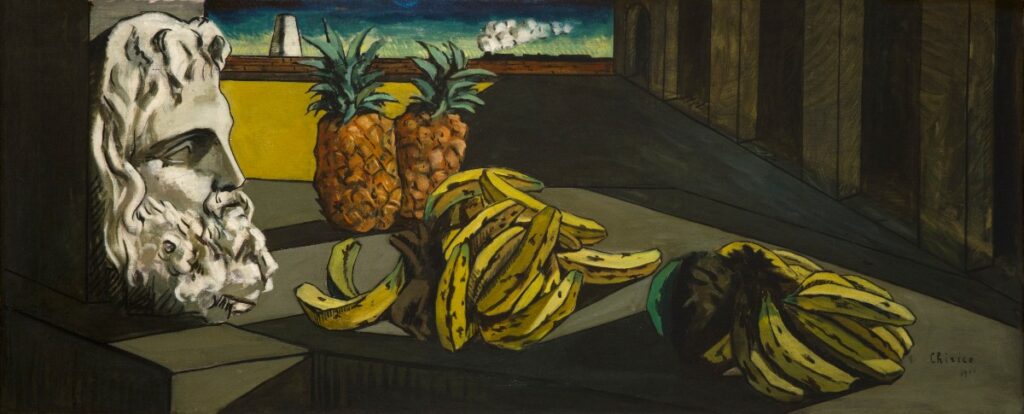
In the background, there is a steam train and perhaps a windmill, fragments of an ambiguous reality that never fully comes together. Even the light, which should clarify the scene, actually intensifies the distances rather than reducing them. The result is an environment built correctly but perceived as unstable. The title suggests a transformed dream, yet the transformation affects the viewer more than the image itself. What changes is not what we see, but the way we try to interpret it. The painting tells no story, yet it forces us to confront a question: how do we read a space that no longer provides reliable coordinates? This is precisely the experience that the De Chirico exhibition in Milan invites visitors to sit with.
Why the Metafisica/Metafisiche exhibition matters today
The exhibition Metafisica/Metafisiche starts precisely from this contemporary relevance and makes it visible throughout the city itself. The project places the historical movement in dialogue with the present, extending well beyond De Chirico himself. The project goes beyond De Chirico and encompasses the entire metaphysical group founded in Ferrara in 1917 – Savinio, Carrà, De Pisis and Morandi – before opening up to its international influence. The exhibition also traces the movement’s resonances into the present across disciplines such as film, design, fashion and music. This urban dimension is intentional. Only weeks earlier, Milan had hosted Design Week, which transformed the city into a network of installations, temporary exhibitions, and immersive environments.
During those days, courtyards, industrial spaces, and historic buildings constantly changed function, becoming temporary and often disorienting settings. The metaphysical exhibition enters the same urban logic, but makes it more self-aware. Looking at De Chirico today, in a city that continuously transforms itself, means recognizing how relevant his understanding of space still feels, especially when space stops appearing stable and becomes something we must decode.
Why De Chirico still feels contemporary
At this point, the question becomes unavoidable: why do images painted more than a century ago still feel so contemporary? The answer does not lie in their mysterious appearance, but in the structure they present.
Even today, we inhabit spaces we recognize but often fail to interpret completely. Cities change function rapidly, environments become temporary, and digital images accumulate without context. This creates a sensation similar to the one De Chirico constructs, where everything is visible but very little feels understandable. Metaphysical painting offers a way to read this condition by revealing what happens when the connection between objects, space, and meaning begins to weaken. It is not an aesthetic of mystery, but a form of lucidity. De Chirico places viewers before a reality that continues to exist while no longer guaranteeing stable interpretations.
How to visit the exhibition
Main venue:
Palazzo Reale — Piazza del Duomo 12, Milan.
Connected venue:
Museo del Novecento — Piazza del Duomo 8, Milan, featuring the section Milano Metafisica.
Palazzo Reale opening hours
- Tuesday, Wednesday, Friday, Saturday, Sunday: 10:00 AM – 7:30 PM
- Thursday: 10:00 AM – 10:30 PM
- Monday: closed
- Last admission: one hour before closing
Tickets and reservations:
Palazzo Reale – Metafisica / Metafisiche