 Collections
 Magazine
 Exhibitions
 ITA version







In 2022, Hannibal creator Bryan Fuller confirmed that his co-protagonists, Will and Hannibal, are in love. But what kind of love does NBC’s show, which aired from 2013 to 2015, present?
Inspired by Thomas Harris‘s book The Red Dragon, the first in the Hannibal Lecter tetralogy, the show makes attraction inseparable from fear and death. All interwined with transgression, as the show centers on the cannibal serial killer known as the Chesapeake Ripper, whose name was made famous by Anthony Hopkins‘s Oscar-winning performance.
Netflix recently added Hannibal to its US catalog.
- Hannibal’s Cast and Synopsis
- Why Is Hannibal a Gothic Romance?
- Queerness and Gender Roles in Hannibal
- Will Graham and Hannibal’s Obsession with Each Other
- Murder Husbands: How Hannibal and Will Turn Murder into Intimacy
- Tarot Symbolism and the Meaning of Death in Hannibal
- Love and Death: the Thrill of the Chase
Hannibal‘s Cast and Synopsis
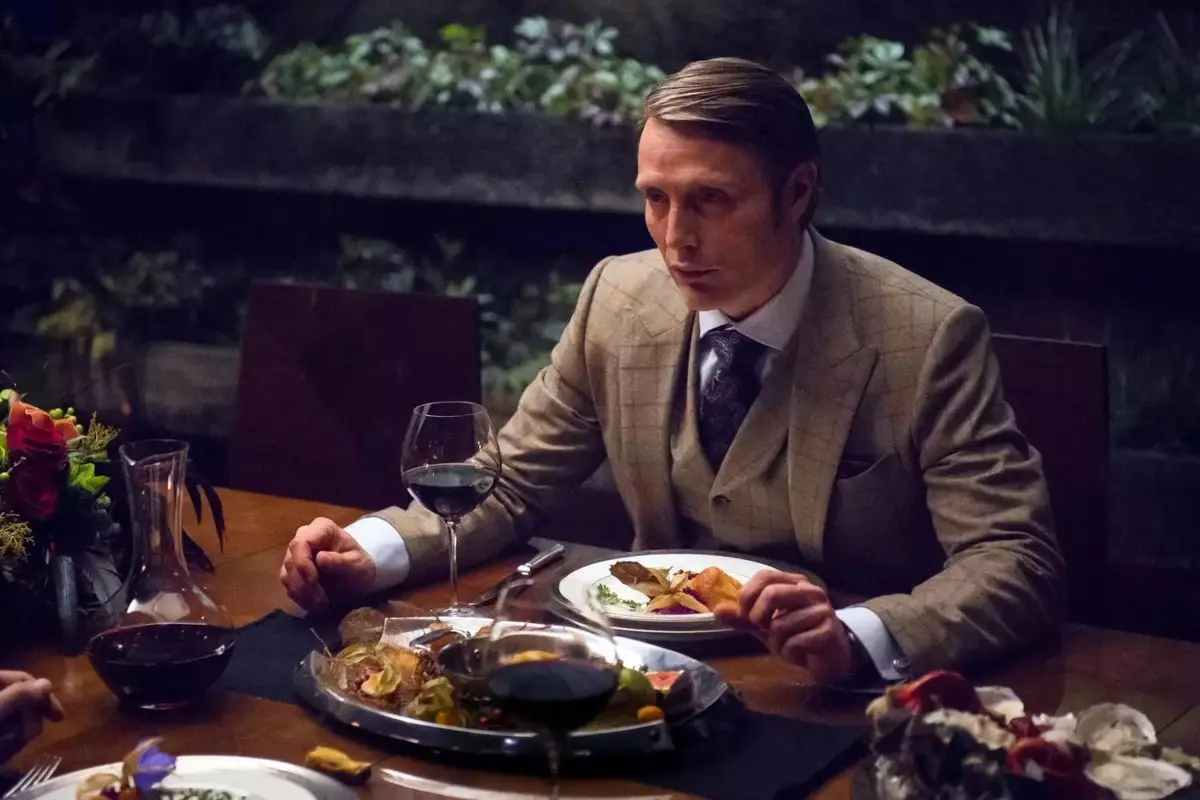
Mads Mikkelsen, a Danish actor known for his Machiavellian roles, plays Hannibal Lecter in the series. Mikkelsen was already well known when he played Le Chiffre in Casino Royale (2006), which made him famous internationally.
Hugh Dancy plays Will Graham, the show’s co-protagonist. Dancy was already famous for playing the love interest in rom-coms such as Ella Enchanted and Confessions of a Shopaholic. In Hannibal, he plays a former cop and brilliant profiler who teaches at the FBI Academy, so empathetic that he can put himself in a serial killer’s shoes to reconstruct his mind. Despite this, his superiors see his instability as a reason to keep him out of the field.
Fearing for Graham’s sanity, FBI agent Jack Crawford (Laurence Fishburne, known for The Matrix) asks psychiatrist Dr. Hannibal Lecter to informally keep an eye on Will. Needless to say, Lecter is incredibly drawn to Graham’s mind. Their flirting goes crazy in Hannibal’s office.

Why Is Hannibal a Gothic Romance?
Hannibal can be considered gothic fiction because it consistently explores themes such as murder, isolation, mystery, bad dreams, and insanity. This mix was already featured in Horace Walpole‘s novel The Castle of Otranto (1764), often considered the genre’s progenitor. Gothic stories usually feature supernatural entities such as ghosts, demons, or vampires. Settings include castles, crypts, and churches. Although they lack supernatural elements, Will’s dreams and hallucinations punctuate Hannibal‘s story.
We could go further by calling Hannibal a Gothic romance. The subgenre started with Ann Radcliffe‘s A Sicilian Romance in 1790, combining Gothic tropes with romantic plots. Its main characters are often women tormented by their romantic feelings. Indeed, relationships with the object of their desire are often obstructed or complicated, with no happily-ever-after. Essentially, a Wuthering Heights-type situation. Or a Morticia-and-Gomez-but-make-it-toxic type of situation.
As for gothic romance, Graham and Lecter’s relationship is extremely toxic. Their foreplay is manipulating each other, and their intimacy is literally stabbing each other. They are basically a match made in hell. And yet, Hannibal is extremely romantic in his own way.
Queerness and Gender Roles in Hannibal
Two reasons make queerness particularly well-suited to the gothic genre, as Hannibal confirms.
The first one has to do with the fact that queerness, despite all progress made by society, is still somehow in the realm of taboos. Needless to say, anthropophagy is also one of those behaviors generally considered unnatural. However, one may ask oneself: isn’t comparing queerness and taboos detrimental to the LGBTQ+ community? The answer depends on how the storyteller frames it. In fact, Gothic stories where queerness is embraced often include some criticism of homophobia and transphobia.
Another reason these themes work so well together is the absence of predetermined gender roles. They do not involve heterosexual power dynamics; therefore, the audience can enjoy taboos without the constant reminder of misogyny. It is both escapism and catharsis. It also allows the audience to detach themselves from the plot. One thing is to feel empathy; another is to have an abundance of it, as Will Graham does. His best asset is his downfall.
Will Graham and Hannibal’s Obsession with Each Other
Dim lighting and bluish color grading make up the show’s main aesthetic. However, a few scenes turn slightly warmer; these are the ones where Will Graham revisits crime scenes. They probably signify that Will feels alive when he tries to put himself in someone else’s shoes: this is ultimately what draws him to Hannibal. He can understand the reasoning behind Hannibal’s actions while also understanding himself better in his company.
Even when Will is not in the scene, he is constantly present. In the episode Kō No Mono (2×11), Hannibal says, referring to Will: “We’ll never be really alone, will we? He’ll always be in the room.” He says this while speaking to Alana Bloom, the woman he is currently dating and with whom Will had a brief romantic relationship.
This fixation is so intense that Will eventually confronts Hannibal about it: “You’re fostering codependency. […] You don’t want me to have anything in my life that’s not you” (2×12). The audience is drawn into the same fixation. Will’s constant presence, even when he is physically absent, makes the viewer experience something of Hannibal’s obsession with him.
Will’s influence extends beyond Hannibal, though. Other characters are also drawn to him. In the pilot episode, Alana Bloom says that she has “an academic interest in him.” Will’s unusual ability to understand criminals fascinates those around him, even when his methods are unconventional. His apparent fragility also works in his favor: even when he commits disturbing acts, other characters tend to see him as someone manipulated by Hannibal rather than fully responsible for his actions.
This ambiguity is part of Will’s appeal. The same empathy that makes him fascinating to Hannibal also leaves him vulnerable to his influence.
Murder Husbands: How Hannibal and Will Turn Murder into Intimacy
Hannibal and Will’s attraction is also never explicitly stated. Other characters tend to spell this out for the audience instead. Similarly, Hannibal never explicitly states whether he is the Chesapeake Ripper. The way he speaks about his murders always contains some level of plausible deniability. Most of the time, he avoids answering a question by asking another question, a method some therapists use to redirect the conversation back to the patient.
However, the fact that they are not explicit with their attraction does not mean that the show is queerbaiting the audience. Hannibal and Will are used to speaking in riddles. It is foreplay for them. Paradoxically, they lie when they speak explicitly.
Instead, truth lies in their articulated sentences and metaphors. Therefore, it would be off-character for both of them to state something so explicitly for the sake of denying queerbaiting allegations. But as mentioned before, side characters are not shy with their statements. For instance, they get nicknamed “Murder Husbands” by Freddie Lounds, a shady reporter who is always chasing the next big murder scoop. Even Will Graham himself dares to ask the “Is Hannibal in love with me?” question to Dr. Du Maurier (Hannibal’s former psychiatrist, played by Gillian Anderson), to which she answers yes.
Hannibal and Will are attracted to each other’s minds. They get off on each other’s intelligence and ability to manipulate one another. Talking about murder is their way of flirting. When Hannibal asks Will, “How do you want to kill me”? It is almost as if they are talking about sex. Will is definitely not helping his case either, as he states that killing someone with a gun feels “less intimate” than melee.
This fascination with Will’s mind goes so far that Hannibal is determined to eat his brain. For Hannibal, that would be the ultimate act of intimacy, as part of him would be inside his body. Speaking of which, Mads Mikkelsen has said that if Will and Hannibal had truly wanted to kill each other, they would have done so already.
Tarot Symbolism and the Meaning of Death in Hannibal
The show’s symbolic language extends beyond its Gothic imagery: in season three, tarot imagery reinforces the connection between death, betrayal, and transformation. Heavy spoilers ahead.
In tarot, Death generally represents endings, transformation, and the beginning of a new phase. The card first appears symbolically in Mizumono (2×13), when Hannibal mentions the Cappella Palatina in Palermo while imagining running away with Will. The chapel’s floor mosaic depicts a skeleton, linking death to the possibility of starting a new life together.
This symbolism becomes more explicit in Primavera (3×01). Hannibal’s heart-shaped corpse sculpture, placed on a three-legged stool, evokes the Three of Swords, a card traditionally associated with heartbreak, betrayal, and emotional wounding. In season three, betrayal is central to Hannibal’s relationship with Will.
The sculpture stands directly above the skeleton mosaic, bringing the two symbols together. Read from top to bottom, the image suggests that betrayal has crushed the possibility of a new life. Read from the bottom up, however, the swords appear to have passed through the heart, leaving open the possibility of renewal once Hannibal moves beyond his sense of betrayal.
The same sequence uses another tarot reference. After recalling the moments following Hannibal’s attack, Will lies upside down in a position resembling The Hanged Man, a card associated with reflection and suspension. The skeleton mosaic beneath him can therefore be read as Death reversed, suggesting an inability to move forward. Will remains trapped in his memories of Abigail and his betrayal of Hannibal.
The symbolism changes depending on the point of view. From Will’s perspective, the reversed Hanged Man and Death suggest hesitation and being stuck in the past. From Pazzi’s perspective, the Hanged Man becomes reversed while Death remains upright: reflection gives way to action. Pazzi wants Will to help him catch the Monster of Florence (a real-life Italian serial killer the show attributes to Hannibal), allowing him to finally close a chapter that has haunted him for years.
Through these images, Hannibal uses tarot less as a prediction of what will happen than as a visual language for its characters’ emotional states. Death, betrayal, reflection, and the possibility of transformation become different ways of representing the series’ central question: whether Will and Hannibal can leave their past behind and become something new.
Love and Death: the Thrill of the Chase
Hannibal takes love to the next level. Its photography feels like velvet, and it helps create this obscure, yet impalpable allure. Hannibal and Will’s dynamic is, as Mads Mikkelsen puts it, like a cat-and-mouse game in which they exchange roles. But instead of a comedic chase, it is a hunter-prey or fisherman-fish dynamic, a parallel the show itself draws.
They are, however, both exceptionally smart and cunning. Their dynamic could be ultimately described as a dance or as a game of chess. The thrill of the chase, the deceit, and the beauty of death are the reasons why this show is so unexpectedly romantic.
Since their story ended with one of the most dramatic and romantic cliffhangers of the whole show, fans cannot help but wonder whether we will see more of their relationship in the future. Hopefully, if streaming shows renewed interest in the series, there could still be a chance of a fourth season.