 Collections
  Magazine
  Exhibitions
  ITA version













Guillermo del Toro’s Frankenstein | A Bold Reimagining of Mary Shelley’s Classic


Runtime
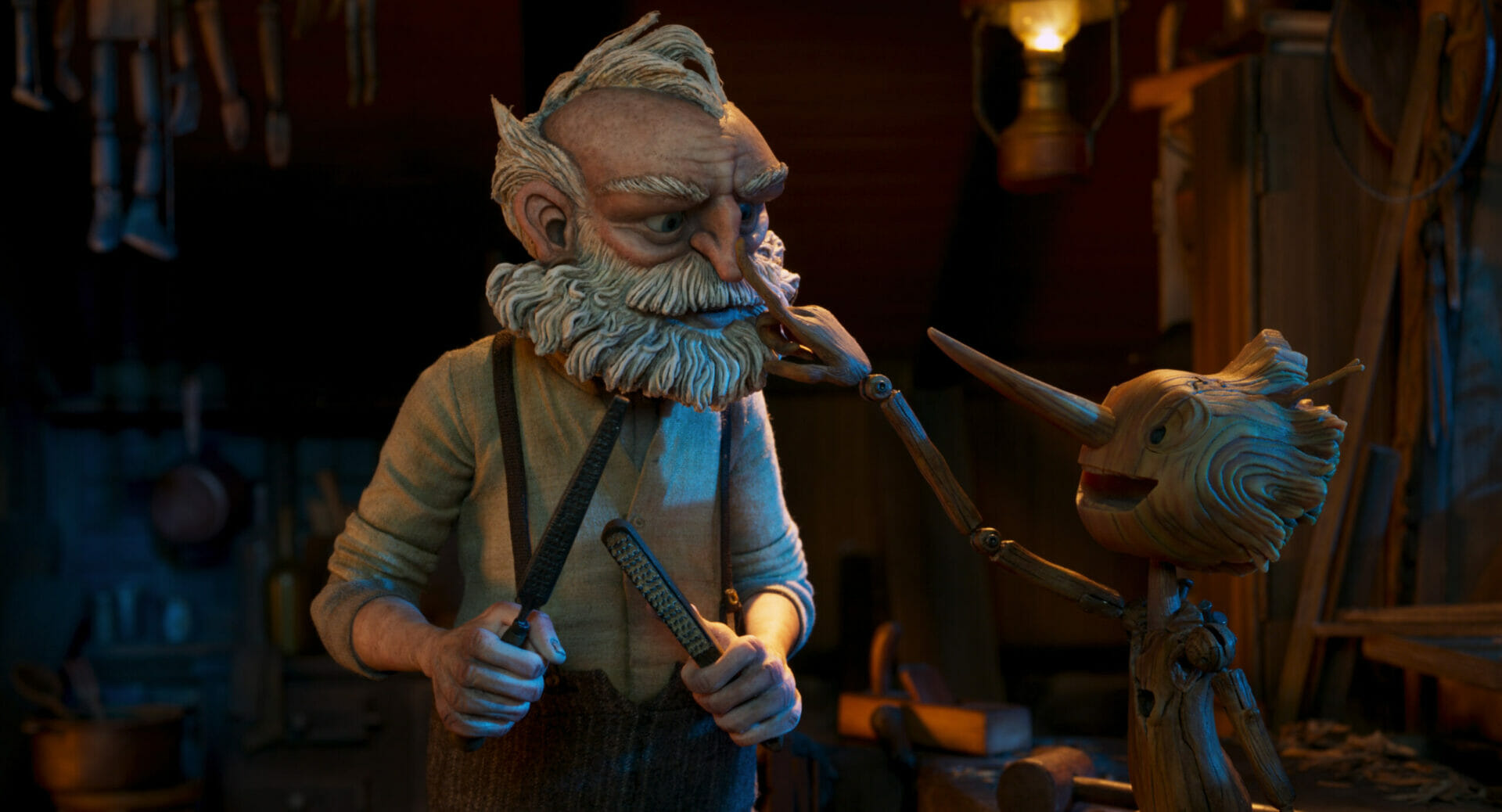
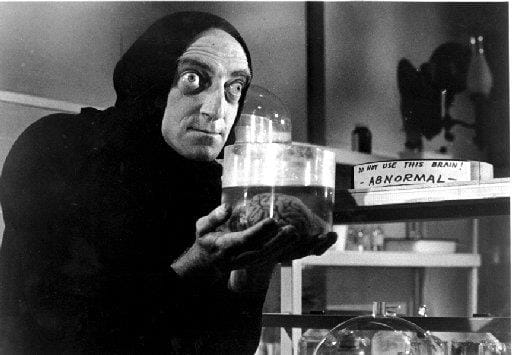
Since childhood, Guillermo del Toro has dreamed of adapting two timeless literary works into films: Carlo Collodi‘s Pinocchio and Mary Shelley‘s Frankenstein; or, The Modern Prometheus. While Pinocchio finally hit the big screen in 2022, it is Frankenstein that is now stepping into the spotlight. The director continues the extensive cinematic tradition inspired by Shelley’s enduring 1818 masterpiece. From James Whale‘s 1931 Frankenstein, featuring Boris Karloff‘s iconic Creature with the bolt neck, to Kenneth Branagh‘s 1994 adaptation, to Bernard Rose‘s 2015 modernized interpretation, filmmakers have reimagined Shelley’s tale across generations. Just when it seemed that this long-standing legacy had run its course, Guillermo del Toro came along with his magic touch, managing to bring the Creature to life once more.
This adaptation breathes new life into a story that has haunted the collective imagination for centuries, starring Oscar Isaac as Doctor Victor Frankenstein, Jacob Elordi as the Creature, and Mia Goth as Elizabeth and Claire Frankenstein. While staying true to the tale of a hubristic scientist defying nature to create life and a Creature seeking revenge on his Maker, the Academy Award–winning director adds his personal touch, delving deeper into the characters’ tangled minds and aching hearts.
Frankenstein premiered at the 82nd Venice International Film Festival, where it received a remarkable 14-minute standing ovation. Following a limited theatrical release that earned over $112 million, the film became available globally on Netflix on November 7. By combining pop sensibilities with a timeless myth, del Toro has created a new vision of the modern Prometheus, perfectly tailored for contemporary audiences.

- Frankenstein Reborn: Points of Departure From Shelley’s Original
- From Father to Son: Inherited Shadows
- Colors and Shapes: The Use of Visual Language
- The Making Of: The Monster Becomes Human
- Mirrors: Exploring the Duality Within
- Back to the Beginning: The Future of Frankenstein
Frankenstein Reborn: Points of Departure From Shelley’s Original
Can straying from the original lead to a stronger adaptation? When it comes to literary classics, critics and cinephiles often debate where to draw the line between honoring a seminal work and allowing the necessary creative license to reinterpret it for a new generation of filmgoers. Some adaptations stir more controversy than others. Consider Emerald Fennell’s upcoming adaptation of Emily Brontë‘s Wuthering Heights, for example, which once again features Elordi in a leading role. Despite being Netflix productions, the two films have sparked very different reactions regarding their tone, style, and approach to the original material.
Del Toro departs from his usual approach of sharply defining heroes and villains by deliberately blurring the line in Frankenstein. He fully immerses the film in the novel’s gothic atmosphere, yet his focus remains unmistakably on the human experience. In his own words: “But everybody in the movie has a failing and a lack. I love that. They all need love, because that’s the only answer, right? I think it’s a very tender movie. For me, it’s a melodrama and a drama. I don’t see it in terms of a horror movie.” The result is a tale of monsters and men, of flaws and longing, told with surprising tenderness and heartwarming compassion.

To condemn human greed and arrogance, del Toro sets his story during the mid-19th-century Crimean War. The battlefield carnage and open-air cemeteries provide Victor Frankenstein with the body parts he needs to defy death. This marks the first and most obvious departure from the original novel. The pieced-together body gives the Creature an appalling yet strikingly human presence, emphasizing horror and vulnerability.
Christoph Waltz joins the cast as Heinrich Harlander, a character created specifically for this story. Harlander funds Frankenstein’s research and ambitious project, but he conceals a morbid personal motive behind his exaggerated enthusiasm. In this morally ambiguous story, Waltz’s Harlander embodies opportunism and the corrupting influence of capitalism, exploiting Victor’s ambitions for his own sinister purposes.
From Father to Son: Inherited Shadows
How much of the harm passed down from our parents becomes our own, and how far are we willing to go to prove them wrong? These are some of the central questions driving del Toro’s new retelling of Frankenstein, which approaches the classic story through a distinctly psychoanalytic lens.
The director grounds the film in themes of fatherhood, guilt, and the shame of failing to meet imposed expectations. Victor’s backstory is completely rewritten to highlight the source of his obsession: the early loss of his mother and his lingering resentment toward his father, a self-proclaimed infallible doctor whom he still blames for her death. Oscar Isaac brings a feverish, almost electric exuberance to the role of Victor, delivering a performance that fully realizes del Toro’s intent. The tension between father and son is evident in uncanny details such as Victor’s persistent habit of drinking milk well into adulthood and the image of an umbilical cord that refuses to sever.
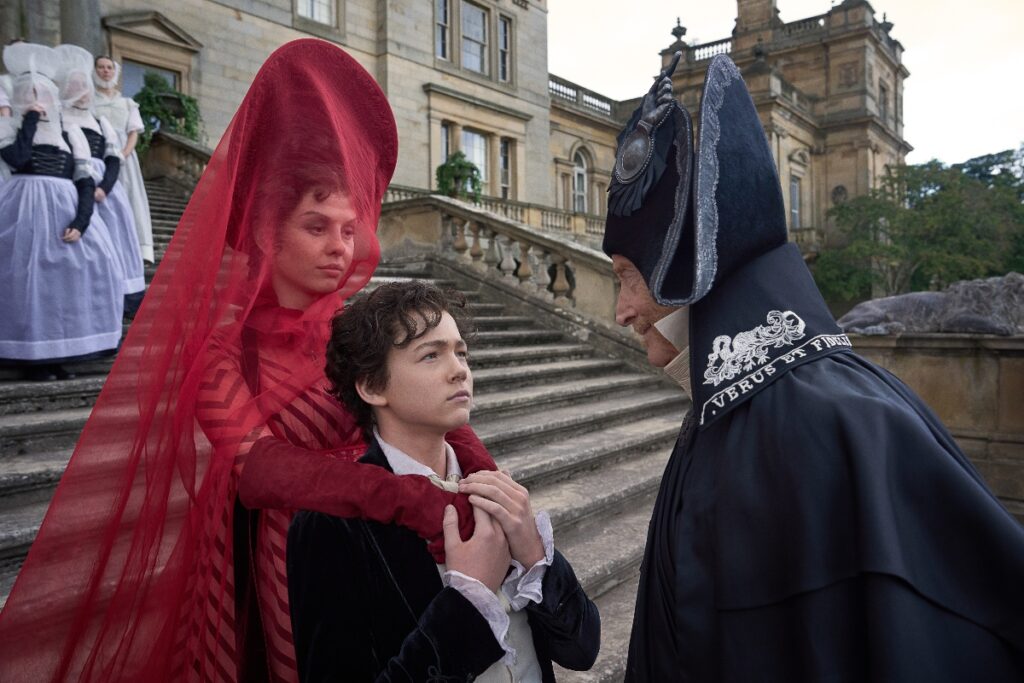
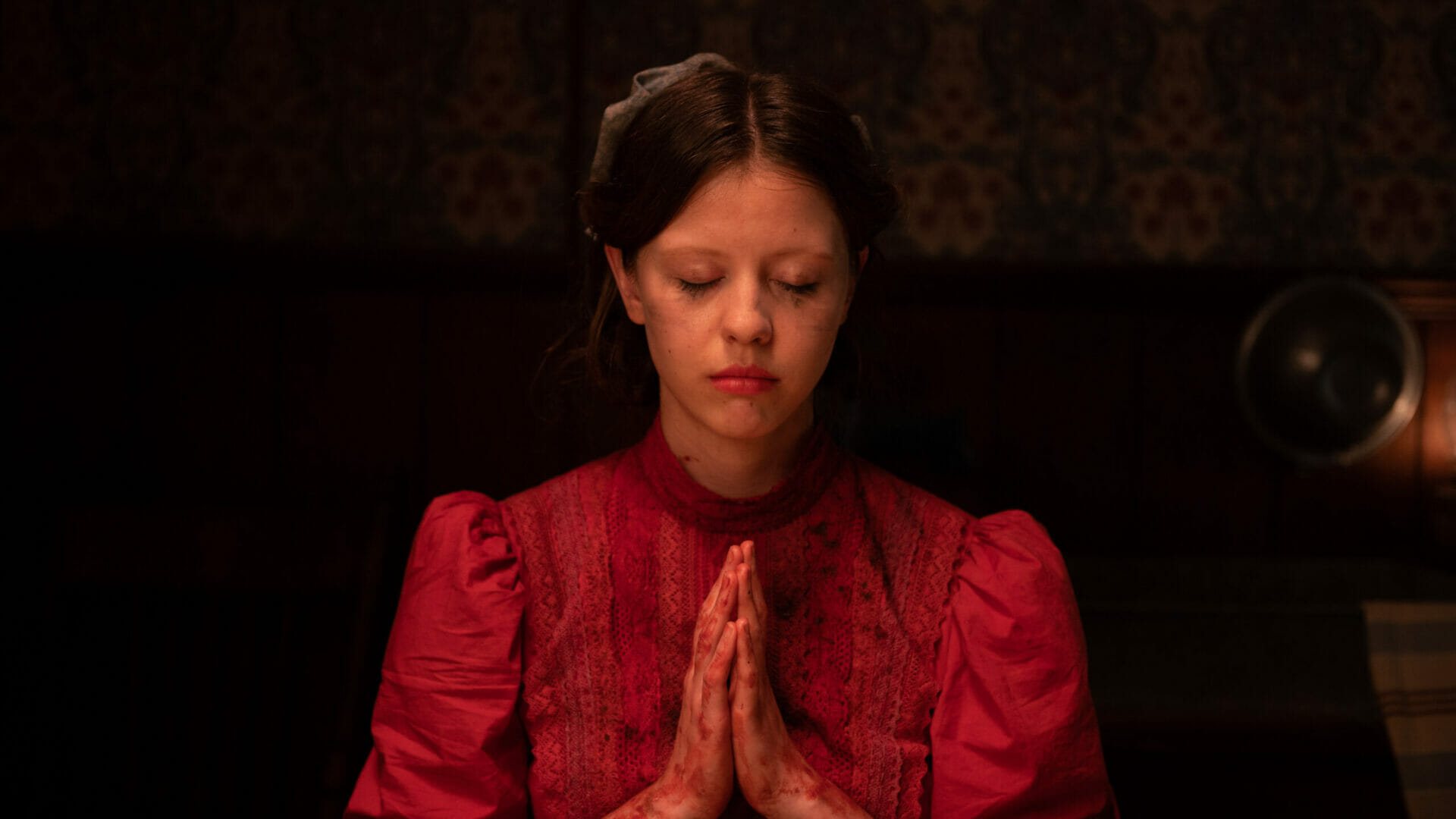
Who better than Mia Goth, the current gothic icon, to play two roles in the film? Best known for her breakthrough role in Ti West‘s horror trilogy, Goth embodies Claire, Victor’s mother. With her face subtly altered by light prosthetics, Goth offers a tender counterpoint to the rigid authority of Leopold Frankenstein (Charles Dance). Goth also brings a reimagined Elizabeth to life, who is now engaged to Victor’s younger brother, William (Felix Kammerer). Far sharper than the original character in Shelley’s novel, she can hold her own against Victor, matching his intellect and promptly challenging his confidence. Initially, she is skeptical of his project. However, shaped by her convent upbringing, she comes to see the Creature as innocent and pure, untouched by original sin. With a love that is both maternal and romantic, she is the only character to recognize the Creature as fully and profoundly human.
Obsessed with the idea of cheating death and determined to both trample the myth of his father and finally confront his own grief, the iconic Doctor Frankenstein represents science gone awry: a thriving intellect that turns in on itself and inevitably leads to self-destruction. Del Toro splits the film into two parts: Victor’s tale and the Creature’s. This gives the Creature agency and the right to tell his own version of the story. At its core, the bond between Victor and the Creature mirrors Victor’s relationship with his father. Tragic and tender, it becomes the story of a man condemned to eternal grief and solitude.
Colors and Shapes: The Use of Visual Language
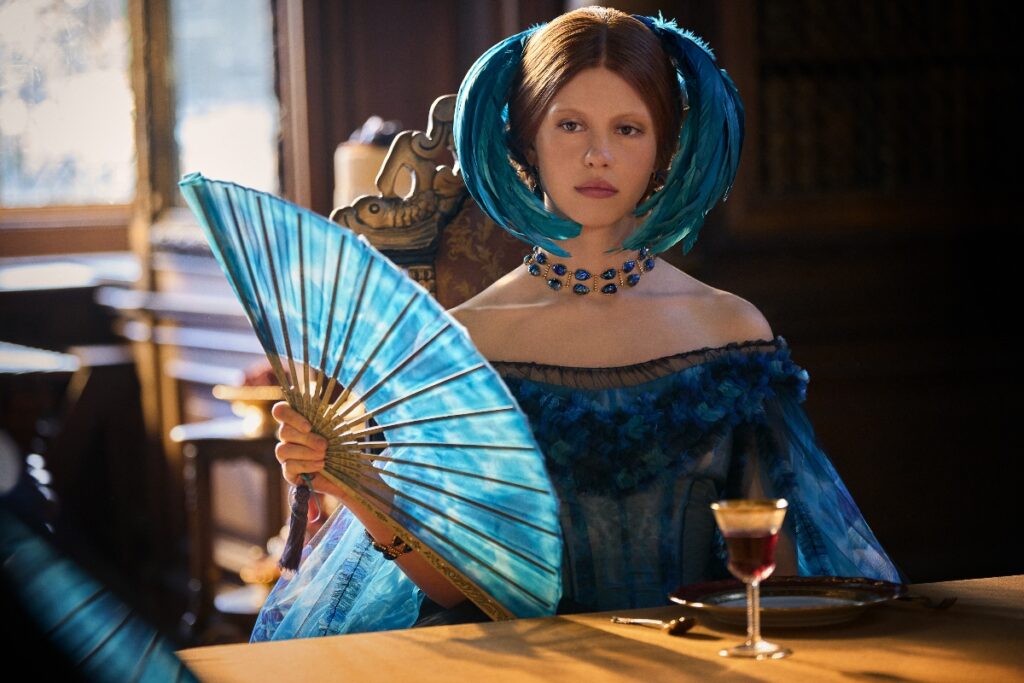
Del Toro reunited with his longtime collaborator, Dan Laustsen, to craft the film’s cinematography. Using large-format cameras, wide lenses, diffusion filters, and colored gels, he achieved a romantic softness and dreamlike texture in the film. The film is saturated with hidden meanings resting on a precise color-coded language. Red and amber tones evoke lineage and the weight of childhood, while blue hues and deep shadows hint at the recurring theme of divine imperfection. Gold, like a false halo, suggests the illusion of divinity. Together, these colors form a visual symphony that reinforces the film’s emotional core.
This choice is further elevated by the work of Emmy Award–nominated costume designer Kate Hawley, who understands that each character’s wardrobe speaks for itself. Blending historical silhouettes with contemporary influences, she collaborated with del Toro to create a work that feels less like a period drama and more like an otherworldly fantasy.
Frankenstein showcases the mastery of production designer Tamara Deverell. Her work was pivotal in bringing the director’s lifelong vision to life. With minimal CGI and predominantly full-scale, handmade sets, the film achieves an entirely human atmosphere. The sets are also rich in recurring symbols, most notably circular shapes. As Deverell explains in the press notes, “They represent the circle of life—the beginning, the end, the endless ouroboros, the snake eating its tail.”
The Making Of: The Monster Becomes Human
– Make one like me.
A dialogue between The Creature (Jacob Elordi) and Dr. Victor Frankenstein (Oscar Isaac)
– And then what? Procreation. Reproduction. Mm… A home? A grave? Death begetting death begetting death. A race of devils propagated upon the earth. Obscenity perpetuating itself.
– I am obscene to you, but to myself I simply am.
Frankenstein is a film about hubris, death, and rebirth. It is a cautionary tale about the terrifying dangers of pursuing one’s ambitions at any cost. Though it may initially seem like a simple horror story, this monstrous tale is, at its core, an ode to outcasts and the misunderstood.
Del Toro aims to rehabilitate the image of the Monster, who is both frightful and prodigious, as the word’s etymology suggests. According to a Mary Shelley expert, del Toro downplays the Creature’s violent impulses. Rather than going on killing sprees, the Creature primarily acts in self-defense or to protect those he loves. This reveals his capacity for genuine affection.
Throughout his career, del Toro has demonstrated a profound fascination with monsters, particularly their humanity. This theme is evident in films such as Pan’s Labyrinth (2006) and The Shape of Water (2017). In the press notes, the director stated: “He needs to feel like a baby, and then he needs to feel like a philosopher, like a man. The growth of the Creature is one of the salient things that Mary Shelley did in the book, and this movie does as well.” Rather than a “freakish experiment,” the Creature is portrayed as a pure, innocent child of God who comes to life as a being of deep empathy in search of affection. Del Toro turns away from Whale’s stammering monster and restores the eloquence that Mary Shelley originally gave the Creature. He transforms the Creature from an object of fear into a fully realized, emotionally complex character.
Del Toro’s work marks a significant advancement in cinematic portrayals of bodily differences and otherness. Unlike earlier portrayals in which Frankenstein embodied deviance and danger, del Toro’s Creature is portrayed as a sage who carries the horrors of war and demonstrates a need for unconditional love. While the film’s fast pace has been criticized for making the Creature’s development seem too sudden, his intellect and soul redefine Shelley’s original cautionary tale. Thanks to growing awareness and sensitivity toward uniqueness today, the film sparks conversations about empathy, authenticity, and fighting unwarranted stigma. In this regard, the film evokes David Lynch‘s The Elephant Man (1980). Like the Creature, the Elephant Man is a figure whose characteristics provoke fear and marginalization. However, he simultaneously challenges viewers to question their assumptions about disability and what society deems as “normal.”

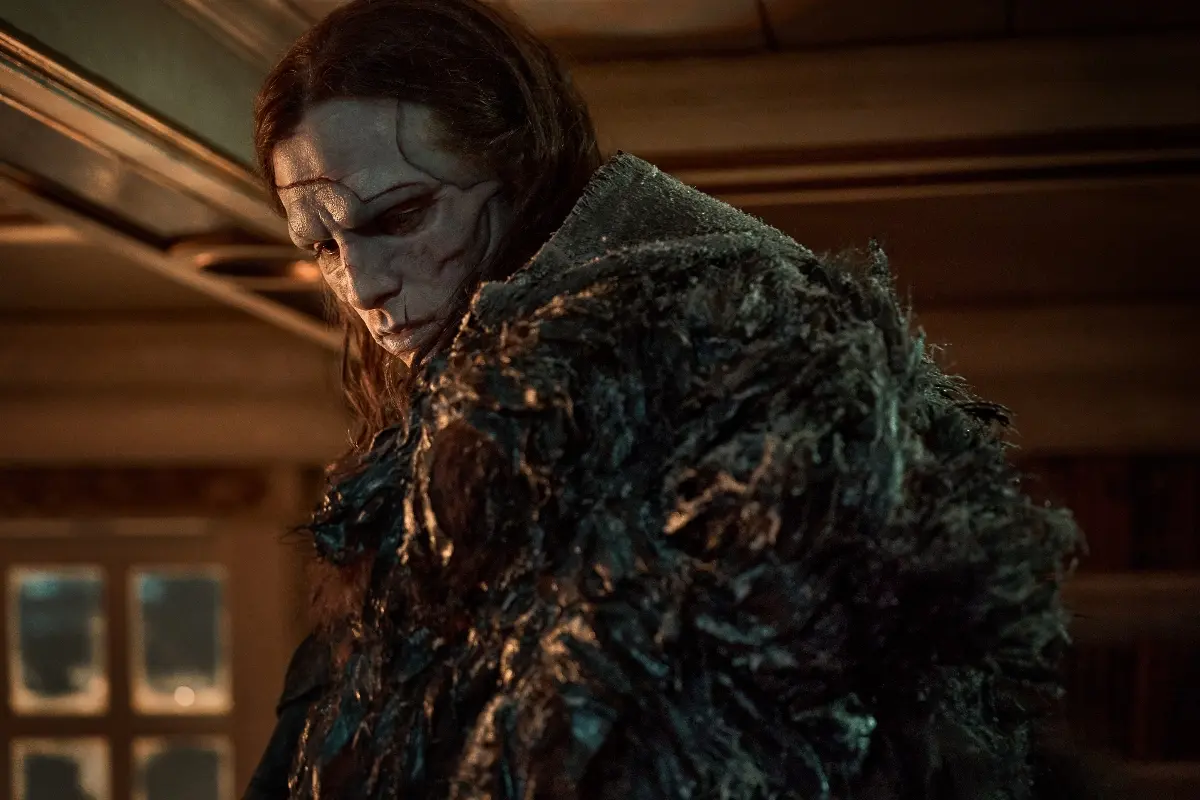
As mentioned earlier, the production is notable for its remarkable craftsmanship. Continuing their successful collaboration, del Toro partnered once again with makeup and prosthetics master Mike Hill to bring Victor Frankenstein’s (im)perfect being to life. Hill designed 42 separate prosthetic appliances that took ten hours to assemble, creating the look of a man turned inside out, literally wearing his heart on his sleeve. Despite being composed of limbs and organs from different corpses, the Creature possesses a certain charm, which is amplified by Jacob Elordi‘s appeal. His commitment to the role is impressive; in silent scenes, his eyes and body speak louder than words ever could.
The Euphoria star is unrecognizable in the role. To fully embody the Creature, he trained in Butoh, a Japanese dance style known for its spasmodic, contortion-like movements. He also listened extensively to Mongolian throat singing to recreate the Creature’s haunting, guttural voice.
With his kind eyes and expressive movements, Elordi proves to be the right choice for the role of the Creature. He brings a rare sensitivity to his performance, making the Creature more human than ever before. While every Frankenstein adaptation invites the audience to sympathize with the Creature, in this version, that mission becomes central. Viewers witness the Creature’s profound vulnerability and intelligence, and see more of their own humanity in him than in the brilliant yet ruthless Dr. Frankenstein, played by Oscar Isaac.
Mirrors: Exploring the Duality Within
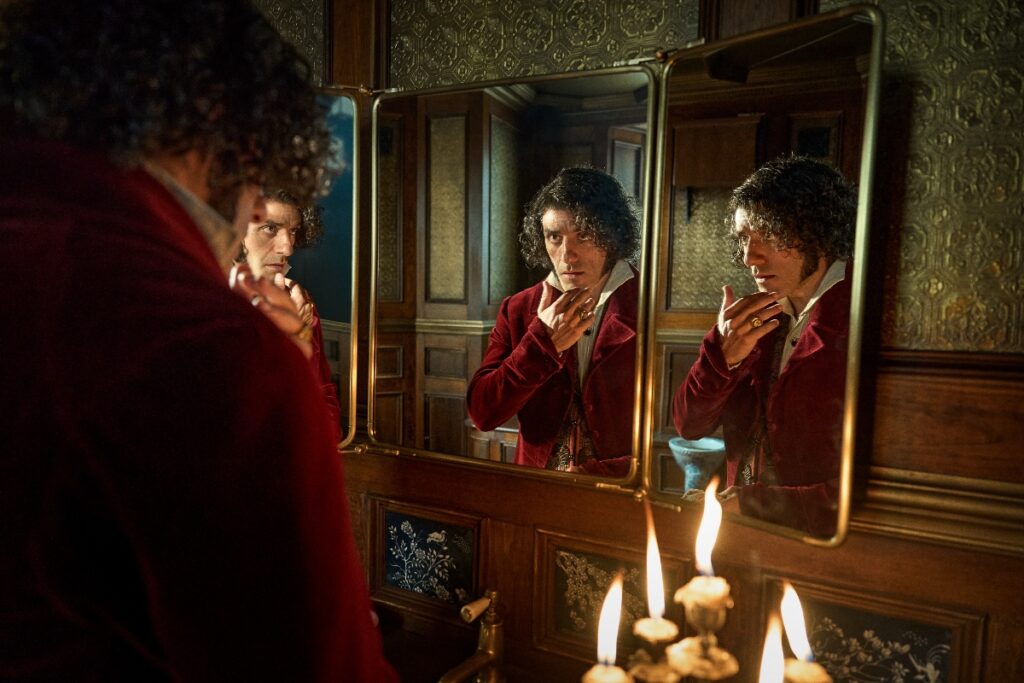
Del Toro is well known for his interpretation of horror as a reflection of one’s flaws and inner darkness. In this project, he seeks to illuminate the duality within each of us: the eternal tension between nature and culture, instinct and morality, and creation and destruction. After all, good and evil are two sides of the same coin. This is why the mirror is essential to the film’s iconography, serving as a lens that reveals who we truly are, including the parts of ourselves that we cannot bear to confront or outright reject.
For instance, Victor and his Creature never appear on screen side by side, only in opposition. They share a single frame only through a mirror. Victor speaks to the Creature while staring at his reflection. Suddenly, the Creature steps into view behind him like a shadow materializing. The mirror captures them as a single entity. Creator and creation are two sides of the same coin: indistinguishable and inseparable.
Meanwhile, the image of Medusa, petrified on the wall of Victor’s laboratory, evokes another misunderstood monster. Her presence is no coincidence, as according to myth, Perseus could kill her only by using a mirror. Once again, Frankenstein‘s imagery reminds us that our identity, flaws and all, contains a truth that can be both a blessing and a curse. The Creature ultimately encapsulates this idea in a powerful, self-explanatory statement addressed to his Maker, revealing the true origin of monstrosity.
Back to the Beginning: The Future of Frankenstein
And thus the heart will break, yet brokenly live on.
Childe Harold’s Pilgrimage, Lord Byron
The film ends with a line from Lord Byron, returning to the origins of Shelley’s novel and perfectly crowning the Creature’s redemption arc. “Particularly in these times, when only monsters play God, I really love the humility the Creature has at the end,” notes del Toro, offering an invitation to make peace with our earthly limits and a warning about the danger that ensues when human ambition oversteps them.
Returning to the initial question about adaptations/remakes, del Toro’s Frankenstein seems to be in a class of its own. It weaves a broader reflection on humanity into a familiar story. Despite ongoing debates about the legitimacy of unfaithful retellings, the film has received numerous awards and widespread praise for its performances and production quality. It received five nominations at the 83rd Golden Globe Awards. At the 79th British Academy Film Awards, Frankenstein won three BAFTAs: Best Production Design, Best Costume Design, and Best Makeup and Hair. With nine nominations, including Best Picture, Best Adapted Screenplay, Best Cinematography, and Best Supporting Actor, it is a frontrunner at the upcoming 98th Academy Awards.
Del Toro transforms a classic horror story into a gothic fairy tale by rewriting the original ending and (spoiler alert!) allowing the Creature to live on, thus fulfilling both his artistic vision and his childhood dream. By projecting his own biography onto this grand canvas, he reminds us that the wounds passed down through generations can only heal through forgiveness.
Tag