 Collections
  Magazine
  Exhibitions
  ITA version














Until 11 January 2026, Palazzo Reale in Milan hosts the first retrospective in Italy dedicated to the work of Leonora Carrington, a multifaceted and enigmatic figure, described by André Breton himself as “an enchantress with a gentle and mischievous gaze.”
A sweeping retrospective beyond borders
Following its presentation in Milan, the exhibition will travel to Paris, opening at the Musée du Luxembourg from 18 February to 19 July 2026.
Called the “witch” of Surrealism for her exploration of esoteric, magical, and spiritual themes, Carrington experimented with multiple languages: from painting to writing, from theatre to critical reflection. Both her art and her life reflect a profound fascination with the mystical, folklore, and unconventional female powers, standing in stark contrast to the artistic and social norms of her era.
Leonora Carrington: art, magic, and surreal rebellion
The exhibition, organized by the City of Milan and produced by Palazzo Reale, Mondo Mostre, Civita Mostre e Musei, and Electa, features over sixty works, illustrating the remarkable arc of Carrington’s career and her connection to Italy, from her early encounters with Renaissance and Flemish painting to a full exploration of her biography. Born in Lancashire with Celtic roots, she lived in Paris, southern France, Spain, and New York. She ultimately settled in Mexico, where she became, alongside Frida Kahlo, one of the most significant artists of the twentieth-century cultural landscape.
Curated by Tere Arcq, the exhibition includes paintings, photographs, books from the artist’s personal library, unpublished documents, and furnishings, providing an insight into the life of one of the most unique and visionary figures of the 20th century. The exhibition is organized into thematic sections that explore Carrington as artist, migrant, exile, mother, avant-garde feminist, and environmentalist.
Early maturity: myth, biography, and self-representation
I was too busy making art, so I didn’t have the time to be anybody’s muse
Leonora Carrington
The first section explores Leonora’s early artistic maturity, shaped by traumatic experiences and a profound inner transformation. Here, pictorial and literary language intertwine, as do myth and biography. Carrington overturns traditional surrealist imagery: while her colleagues sought a muse in women, she chose to represent herself as an autonomous, independent subject. In the series Sisters of the Moon, painted at sixteen, she envisions a female-centered cosmogony populated by imaginary figures and fantastic beasts (Diana, The Witch, Lucienne). The central themes of her work already emerge here: sisterhood, esotericism, and the literary dimension.
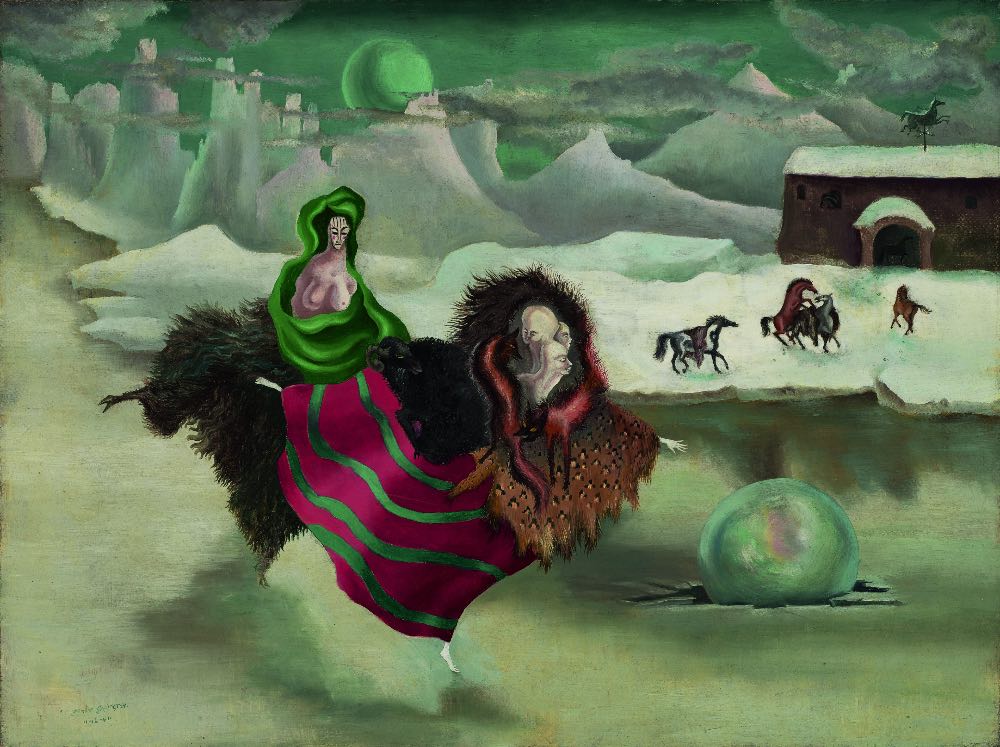
The second section, The Bride of the Wind, takes its name from the moniker given to Carrington by her partner and leading Surrealist, Max Ernst. This part of the exhibition shows her approach to the Surrealist movement, which the artist reinterpreted in a profoundly personal way. This period also covers one of the most dramatic periods of her life: war, arrest, and internment in a Spanish sanatorium in Santander, followed by exile in New York. Works from this period include Caballos and La joie de patinage, in the latter depicting the artist fleeing European horrors while embracing a fragile new rebirth, symbolized by the freedom of skating.
Between dreams and nightmares
The following section explores memory, origins, and longing for lost shores. The works feature numerous references to Celtic myths, inherited from her Irish mother, and the writings of authors she adored, including Lewis Carroll, Jonathan Swift, and the Brothers Grimm. By the mid-1940s, Carrington moved permanently to Mexico and started a family, engaging with key figures in the Mexican art scene, including Frida Kahlo and Diego Rivera. During this period, dreamlike and spectral memories of her English childhood resurfaced in works such as Las tentaciones de San Antonio (1945) and The Elements (1946), both reflecting her Renaissance and Flemish training.
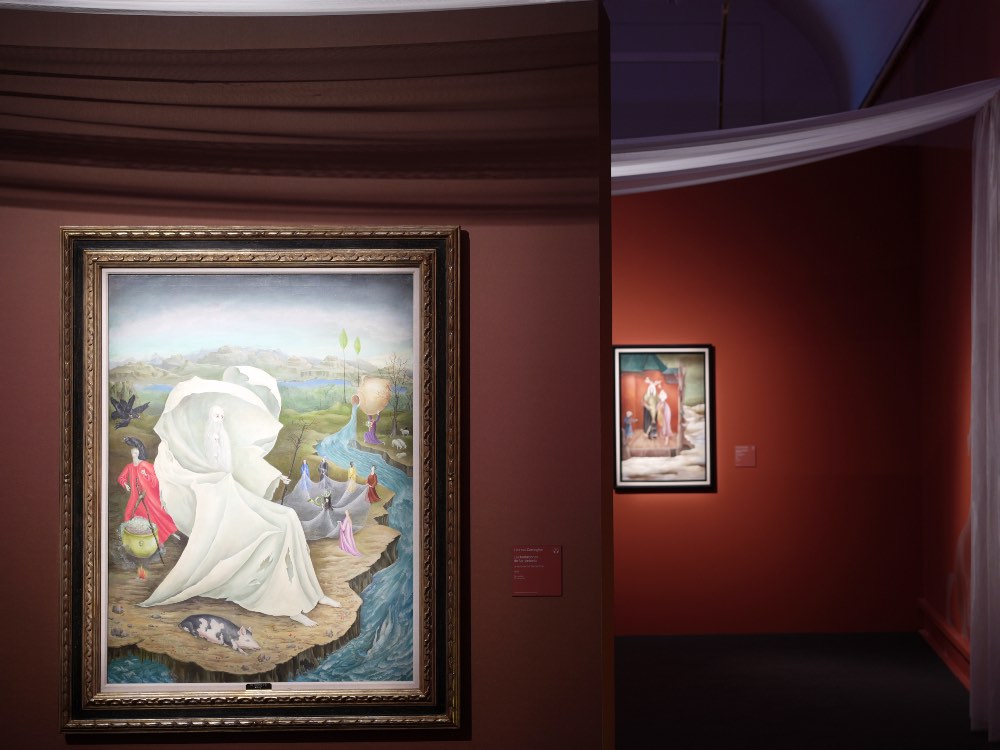
In Las tentaciones de San Antonio, her meticulous Flemish attention to detail is evident: the intricate landscape, the vivid red of the devil’s robe, and the contrast between background and figures. Traditionally, Saint Anthony is depicted with symbolic attributes related to his miracles; here, he faces physical, spiritual, and psychological temptations. This subject, which was very popular during the Renaissance – particularly in Flemish painting, as in Hieronymus Bosch’s Triptych of the Temptations of Saint Anthony, from which Carrington draws her visionary and symbolic style – was later also reinterpreted by Dalí in his own work. The saint’s iconography lends itself to exploring dreamlike themes and the unconscious, central to Surrealism.
The heroine’s journey: tarot, mysticism, and inner maps
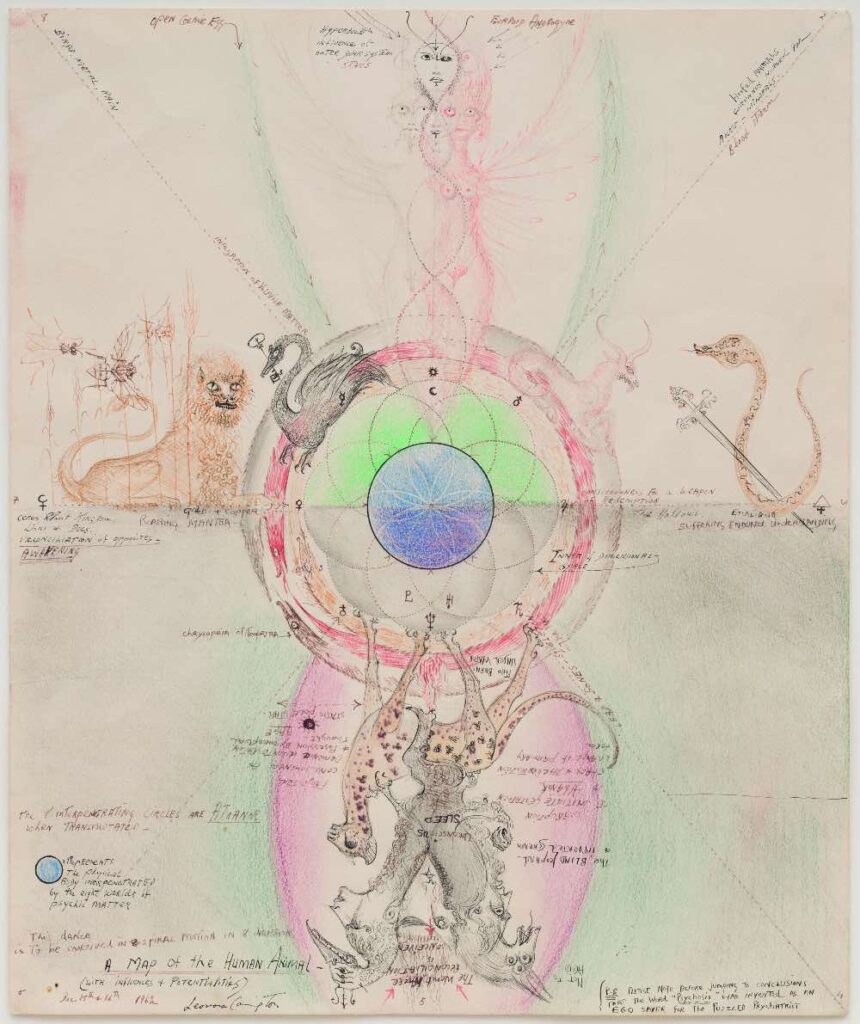
The section The Heroine’s Journey traces the artist’s quest for inner maps to navigate life and confront her demons. Carrington draws on mystical and spiritual traditions to construct this symbolic itinerary. Emblematic of this is A Map of the Human Animal, a visionary diagram illustrating her mental breakdown and subsequent journey towards healing after her internment. It is a veritable topography of the soul, in which esoteric elements and mystical figures represent the process of transmuting suffering into knowledge. The work draws on a wide range of interests, from Kabbalah to astrology, witchcraft to Tibetan Buddhism.
Carrington’s fascination with tarot, the occult, astrology, and spiritualism is central to the Dark Places of Knowledge section. The paintings here are enigmatic and resistant to straightforward interpretation, partly because Carrington herself refused to clarify her sources of inspiration, in keeping with esoteric practices that require secrecy and elude rational explanation. The section includes her Major Arcana, a personal reinterpretation of tarot in which classical symbols, Surrealism, and Mexican mythology converge. For Carrington, tarot was not only a divinatory tool but a map for exploring the unconscious and stimulating the mind.
The alchemical kitchen: women, ritual, and transformation
The final section explores how Carrington incorporates magical traditions and arcane symbolism through alchemical and mythological references. Among the works on display, The Lovers (1987) stands out, representing an alchemical marriage. The figure with the red leg, a hybrid between a jackal and a wolf, is an enigmatic symbol of primordial freedom, instinct, and the wild feminine. The surrealist style suggests that relationships are not merely physical or rational but also psychic and symbolic, in which the union of lovers can represent an inner journey or the discovery of the other’s profound dimension.
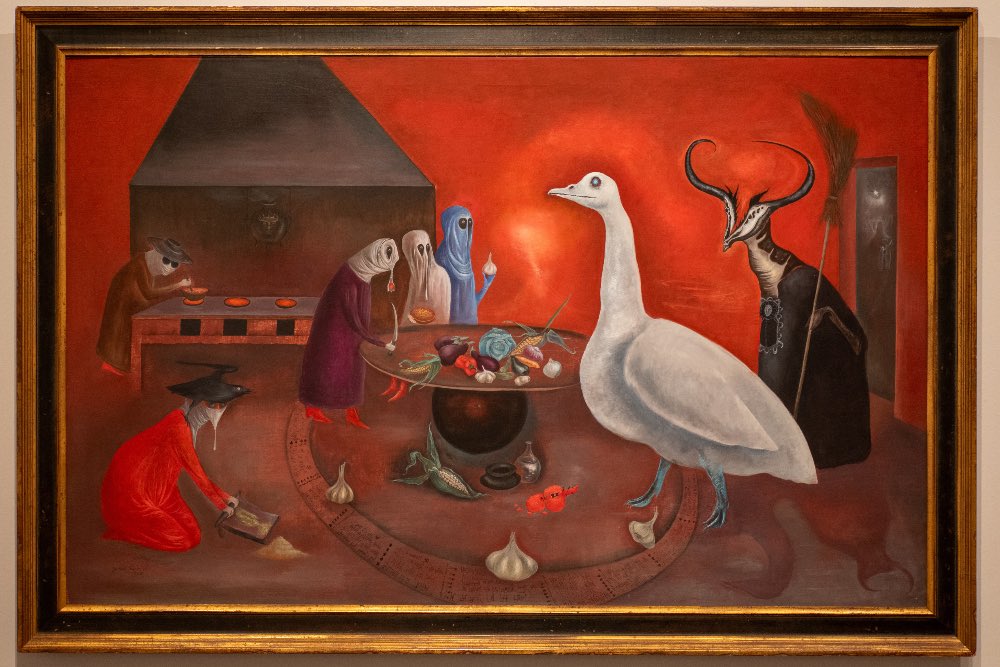
The exhibition concludes with The Alchemical Kitchen, where the kitchen, traditionally associated with female constraint, becomes a space of power and transformation. Here, women reclaim their knowledge through alchemy, magic, and witchcraft. Grandmother Moorhead’s Aromatic Kitchen (1974) exemplifies this, depicting a group of mysterious figures cooking around a table within a circle of spells, under the watchful eyes of a giant goose and a witch. The red room evokes the warmth of fire and the final stage of alchemical transformation, symbolizing the creative ritual and the transformative power of women in the ritualized kitchen.
Female Knowledge as Resistance
The catalog concludes with a text by Carrington herself, first published in Mexico in 1970 and republished in 1981 in Cultural Correspondence no. 12 under the title Female Human Animal. In this brief but powerful piece, she addresses female identity with irony and sarcasm. Eschewing conventional definitions, the text dismantles stereotypes and gender categories, presenting the woman as a fluid and elusive entity. Every sentence strikes at patriarchal constructs, making it a miniature manifesto and a fitting conclusion to the exhibition.
In conclusion, the exhibition at Palazzo Reale in Milan presents the creative life of a unique woman: artist, migrant, exiled, and pioneer of a feminist thought that was not theoretical but embodied, who made imagination a tool of resistance and knowledge.
Tickets, Opening hours, and the next leg in Paris
Address
Palazzo Reale Milano
piazza Duomo, 12
Closest Metro Station: Duomo, on line n.3
Opening hours
Tuesday to Sunday: 10:00 am – 7:30 pm
Thursday: open until 10:30 pm
Last admission one hour before closing.
Closed on Mondays.
Tickets and next leg in Paris
Open ticket: €17
Full price: €15
Reduced price: from €13 to €10
Schools: €6
Families: 1 or 2 adults €10 / children aged 6 to 14: €6
Buy online
View all discounts and special offers
After Milan, the Leonora Carrington exhibition will be presented in Paris at the Musée du Luxembourg from 18 February 2026 to 19 July 2026.