 Collections
  Magazine
  Exhibitions
  ITA version













Cobra Kai | From ’80s Karate Rivalry to a Modern Story of Redemption


Seasons
Runtime
Among the many recent revivals of successful 1980s productions, Cobra Kai did not seem to have the cards to make its mark in the overcrowded world of seriality. Conceived as an expansion of the themes and story arcs of the characters from the Karate Kid cult movie franchise, the TV show debuted in 2018 on YouTube Red and, after the first two installments, moved to Netflix in 2020. Jon Hurwitz, Hayden Schlossberg, and Josh Heald, the creative trio behind the show, cleverly leveraged the nostalgia factor. Indeed, they cast a large delegation of 1980s stars, including the iconic William Zabka and Ralph Macchio, who were already protagonists in the 1984 movie, playing Johnny Lawrence and Daniel LaRusso.
Luckily, Cobra Kai does not consist of mere quotationism of the movie universe from which it stems—an option from which the scriptwriters could easily have been tempted, showing an unsuspected “ability to tap into the complexities of humanity” (Variety). Indeed, the show’s six seasons hinge on Johnny’s redemption journey and deepen his rivalry with Daniel, balancing their leading roles with a new wave of teenage actors and developing multiple subplots that involve personal growth, parenting, teacher-student relationships, and the value of sports. The 80s may be gone, but the adrenaline-fuelled succession of karate fight scenes and training sessions with electric guitars rocking in the background still seems to be able to entertain a wide variety of TV viewers.

The Valley’s most infamous dojo returns
More than 30 years have passed since the legendary final match of the All Valley Tournament, in which the novice Daniel LaRusso (Ralph Macchio) prevailed over the karate wunderkid Johnny Lawrence (William Zabka). That confrontation sealed the reverse fate of the two opponents. While Daniel has become a successful and wealthy entrepreneur, universally acclaimed as a winner and beloved by his family, Johnny’s life has fallen apart. He hops from one sporadic job to another, has a failed marriage behind him, and a son, Robby (Tanner Buchanan), who despises him.
Trying to get back on track by leveraging his still-vibrant passion for martial arts, Johnny reopens Cobra Kai, the old dojo where John Kreese (Martin Kove), his former sensei, had forged him into a karate champion in the 1980s. Unexpectedly, he runs into his first student, Miguel (Xolo Maridueña), an anonymous kid new to Los Angeles who his schoolmates are bullying. With the promise to turn him into a fearless and confident person, Johnny teaches Miguel the “way of the fist”, the reckless and hubristic philosophy that also guided the original Cobra Kai.
As the dojo regains popularity and Miguel starts dating his daughter, Samantha (Mary Mouser), Daniel’s old fears and his passion for karate resurface, along with the teachings of his departed master, Nariyoshi Miyagi. This set of circumstances rekindles the unquenched rivalry between Johnny and Daniel, which, of course, can only be solved on the mat.
Reviving an 80s milestone
Cobra Kai‘s concept is as simple as it is effective: What if the antagonist had a second chance to redeem his unfortunate choices? The unwavering reference point of the TV show is John Avildsen‘s 1984 movie The Karate Kid, an absolute 80s staple on par with The Goonies, Blade Runner, Stand By Me, and other timeless cult classics. In addition to quotations that have become part of everyday speech, like the evergreen “Wax on, wax off”, the movie imprinted in the collective memory the image of a young Ralph Macchio who, in the crane stance, shoots down an uppity William Zabka in an ultimate karate confrontation. Cobra Kai takes its cue right from that image, shifting the perspective from the protagonist, Daniel, to the antagonist, Johnny.
As Jake Nevins (The Guardian) observed, “Cobra Kai is keenly aware that nostalgia is its biggest draw”. The show is filled with countless references to The Karate Kid franchise – for those who didn’t know, the 1984 movies had no less than three sequels – and even flashbacks with archival shots blended with the original takes. One at a time, almost all the key characters of the quadrilogy came back in the show, from the devious senseis Kreese and Silver (Thomas Ian Griffith) to Daniel’s teenage girlfriend Ali (Elisabeth Shue). Even the comeback of the legendary Mr. Miyagi, which would have been materially impossible due to Pat Morita‘s death, is cunningly enacted through continuous quotations and flashbacks.
In addition, following the example of Stranger Things, the soundtrack by Leo Birenberg and Zach Robinson features a diverse selection of 80s hits, including those by Survivor, AC/DC, Dead or Alive, Billy Idol, Van Halen, Kenny Loggins, and many others. The effect is that of entering a time machine and reliving the flamboyant and energizing vibes of the golden decade.
A timeless rivalry
The leading theme of the show is undoubtedly the relationship between Daniel LaRusso and Johnny Lawrence, which tends more frequently towards collision. Similar to Jim and Dwight from The Office and Jack and Locke from Lost, they represent a textbook case of incompatible opposites on many fronts. Johnny, who in The Karate Kid was a rather two-dimensional antagonist, is now the main character: he has remained the hotheaded, impulsive man he was in the movie franchise, approaching life carelessly and guided by stereotypes borrowed directly from the 80s.
Johnny is vaguely racist, homophobic and xenophobic, all of the things that made him a villain in 1984, but in the 2018 context of the show, he’s a flawed hero, an unreconstructed male relic of a time before political correctness was a thing.
Daniel Fienberg on The Hollywood Reporter

His naivety and clumsiness in dealing with everyday issues, though, combined with the continued and unjustified use of terms like “badass”, can only arouse the audience’s sympathy. On the other hand, Daniel, now a wealthy car show owner, has kept his prudent and thoughtful attitude, albeit indulging in boorishness and prejudging points of view other than his own. The Johnny-Daniel dualism retraces timeless pairs of antitheses. It draws from some legendary sports rivalries, such as those between Cristiano Ronaldo and Lionel Messi in football and between Roger Federer and Rafael Nadal on the tennis court.
Masters and students
Such an opposition also entails a generational conflict dynamic. Indeed, both Johnny and Daniel struggle to overcome their past and let go of the value systems that forged them as karateka and men. Johnny still suffers from the toxic relationship with Kreese, his former master and the founder of Cobra Kai, who trained him according to three adamant commandments: strike first, strike hard, and show no mercy. On the other hand, Daniel-san has developed a true devotion to Mr. Miyagi, so much so that he does not accept any idea of karate that does not reflect his defensive philosophy.
This impossibility of communication spans generations and reaches the new karate recruits, who soon find themselves face to face with the same dilemmas and issues that their teachers encountered in their youth. Miguel and Robby – Johnny’s son – become opponents both in love, falling for Sam, Daniel’s charming and popular daughter, and on the mat, representing the two opposite approaches that their masters taught them. Eventually, though, the push for reconciliation between the two factions can only come from the students, who recognize that neither of the two philosophies can stand alone.
A fist to solve it all
Following in the footsteps of the Rocky franchise and 1981’s Chariots of Fire, and before works like 1996’s Space Jam and 2009’s Invictus, The Karate Kid demonstrated the great potential of sport as the core theme of audiovisual productions. Sporting performances are, in themselves, narrative arcs in a nutshell, capable of condensing a broad spectrum of emotions in just a few minutes and encapsulating the essence of many life battles. If the 1984 movie set the stage for the final match by focusing on Mr. Miyagi’s teachings to a clumsy and inexperienced Daniel, Cobra Kai distributes the tension across 6 seasons, assuming the aspect of a sports league where victory and loss, friends and rivals, switch at a fast pace.
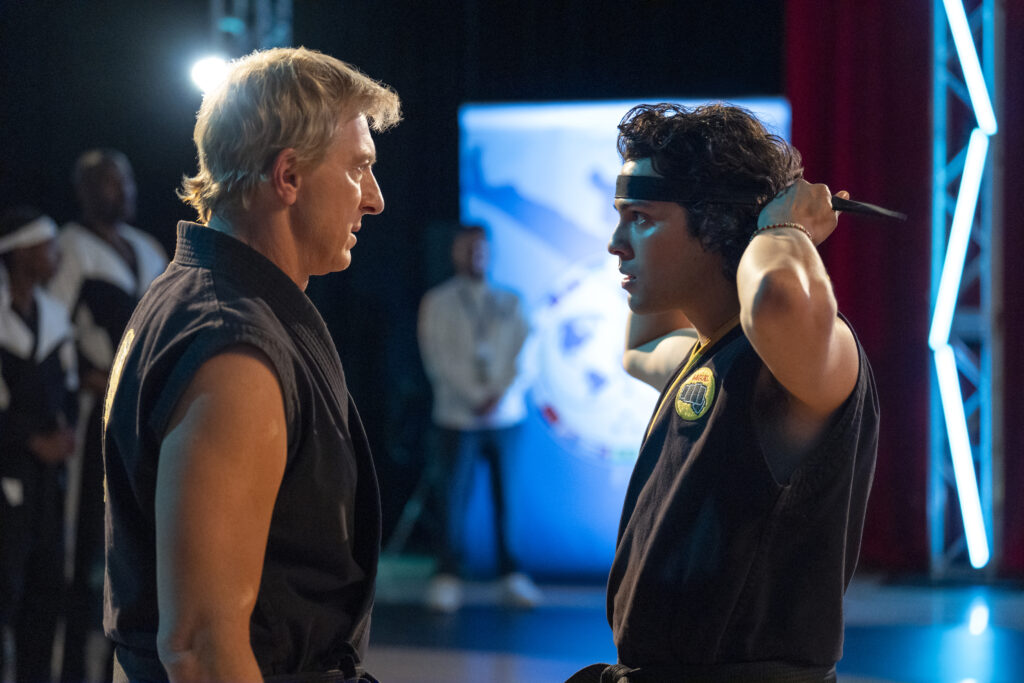
The show portrays karate and sports practice in general as a means of both redemption and personal growth, preparing individuals for daily hardships. The best examples of its educational value are the characters of Miguel and Johnny. The first one joins the dojo as a fearful and bullied kid from a disadvantaged neighborhood and gradually turns into a confident and well-rounded person. As to Johnny, the recovery path is much longer and burdened by the weight of past mistakes, but ultimately possible and within reach thanks to karate.
However simplistic and repetitive in the long run, Cobra Kai‘s core idea that every issue can find a solution on the mat through the cathartic power of physical confrontation speaks to the most visceral and primal part of the audience’s conscience. It can’t fail to arouse the curiosity to find out how everything will come to a close.
Tag