 Collections
  Magazine
  Exhibitions
  ITA version













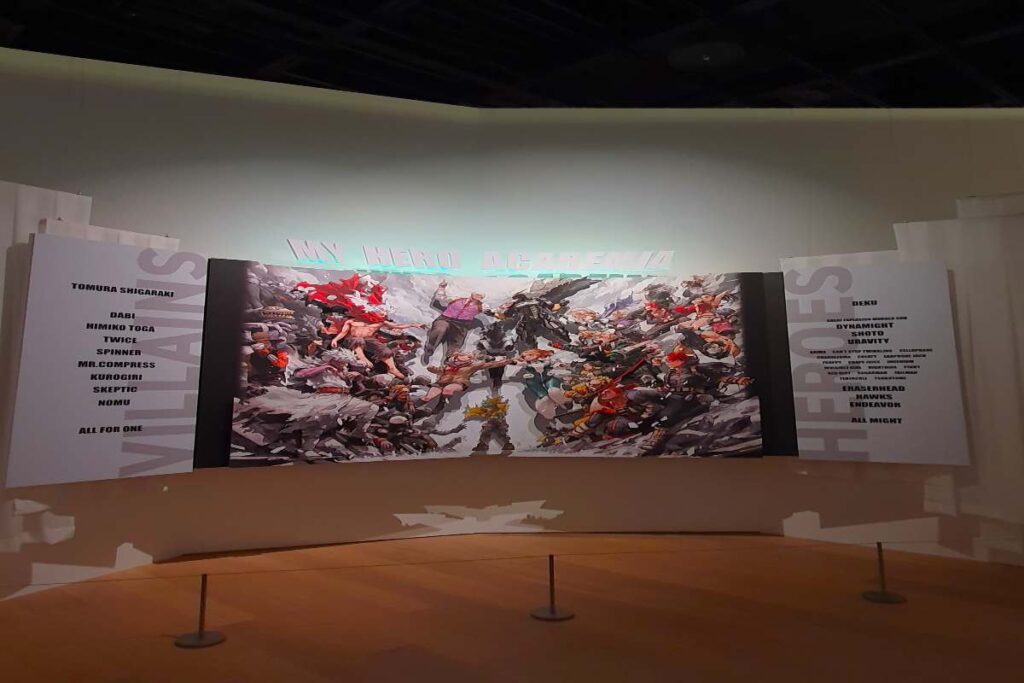
He grew passionate about manga by reading Dragon Ball, One Piece, and Naruto. He discovered superheroes through Spider-Man and Spawn. Kōhei Horikoshi’s background clearly reflects that of an author who went on to create a shonen manga sensation about superheroes: My Hero Academia. To celebrate the manga’s conclusion, an exhibition was held at the Creative Museum in Tokyo from June 21 to August 31, with another scheduled to open in Osaka in October. Although drawing heavily on his sources of inspiration, Horikoshi succeeded in writing and illustrating a work that enriches both the battle manga tradition and the superhero genre. The original display panels showcased the author’s style and technique, offering insights into his illustrations. A chronological arrangement of the artwork guided visitors through the story while highlighting the legacy its characters have left with readers.
Who Is the True Hero? Cooperation at the Core of My Hero Academia
In a world where most people are born with superpowers, or “quirks,” superheroes are the norm. As many superhero stories do, My Hero Academia raises the classic question: What does it mean to be a hero? Its protagonist, Izuku Midoriya — better known as Deku — pushes it further: how can I become the greatest hero of all time?
In an interview, creator Kōhei Horikoshi explained that, for him, a hero is someone who helps you when you’re about to give up. Put simply, anyone can be a hero if they take even a small action to help others and make the world a better place. This echoes the archetype of Superman — the symbol of hope who keeps faith alive in oneself, in society, and in the future. In My Hero Academia, this role is embodied by All Might: muscular, smiling, and admired by nearly everyone. He is the figure who inspires Deku and his peers to strive for more.
But that’s only half the answer. Throughout the manga, Horikoshi stresses that no one can be a true hero alone. Lone heroes take on an impossible burden that both crushes them and produces two consequences: people grow careless, assuming heroes will handle everything. Some inevitably feel abandoned, because no hero can save everyone on their own. This is why collaboration and empathy are central themes in My Hero Academia. Horikoshi reinforces them through an ensemble narrative, where every character’s arc contributes to answering the story’s central question: what does it take to be a hero? An idea clearly exposed by the exhibition, which matches the chronological structure with the intertwining relationships of the main characters.
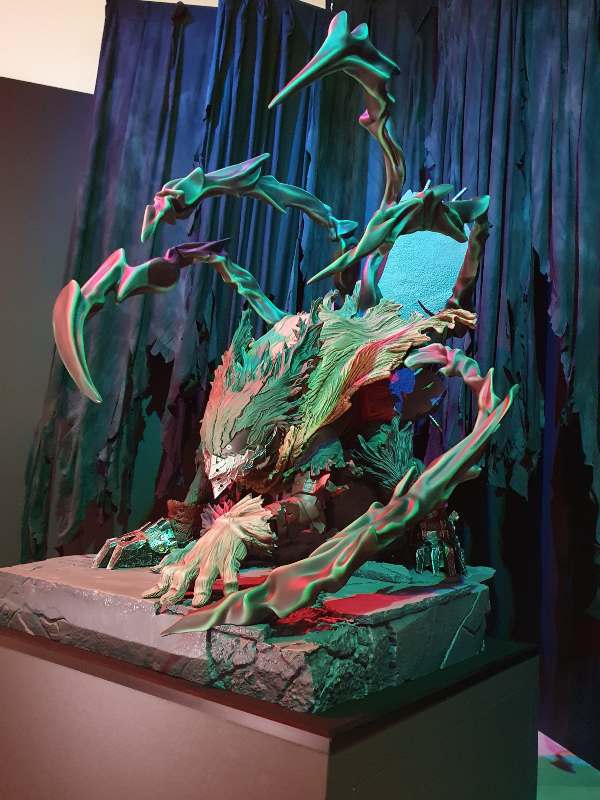
All Might and Toshinori Yagi: The Symbol and the Man Behind the Hero
My Hero Academia addresses the issue of individuality from the outset, depicting a world where superheroes are publicly ranked by their popularity and service to society. At the top stands All Might, the number one hero and symbol of hope, who believes he has made the greatest villain, All For One, harmless, at least for a while.
All Might’s arc alone captures the essence of Horikoshi’s work. Far from being just the “cool mentor” doomed to a dramatic death (like Jiraya in Naruto), he is a layered character torn between his heroic persona and his human self, Toshinori Yagi. He guides Deku and the students with wisdom and support, but also continues to learn himself.
For years, All Might carried the world on his shoulders until he decided to take Deku as his apprentice, and that cycle began to break. By passing on the One For All — a unique quirk that can be inherited — he chose a quirkless boy with the heart of a hero, Deku, while also acknowledging his own declining strength and need for a successor. From then on, his journey becomes one of recognizing that no one can bear what he endured alone. He learns, painfully, how his constant presence had made society dependent and complacent.
In his final, moving battle against All For One, All Might completes his arc: no longer fighting with his own strength alone, but using a combat suit that symbolizes all he has learned from his students.
All For One, Shigaraki, and the Villains: Dark Mirrors of the Heroes
Another aspect that makes My Hero Academia stand out is its treatment of villains and their ties to the heroes. The ultimate antagonist is All For One, the mirror opposite of All Might. The number one hero embodies an ideal many aspire to, wielding a quirk passed down through generations to protect others. All For One, instead, steals quirks, and his goal is to dominate and control.
Other villains, however, are mostly outcasts — people pushed into violence after being neglected or abandoned, even by heroes, when they most needed help. Against this backdrop, Horikoshi reminds us that even the simplest act — like an old woman reaching out her hand to a child — can be an expression of true heroism.
Tomura Shigaraki exemplifies this failure: nobody reached out a hand to him. All For One takes advantage of him, molding him into an avatar of chaos and destruction that wants to punish the society that abandoned him. Horikoshi builds on what could seem like a cliché to craft a powerful duality: on one side, Deku, who wants to save everyone; on the other, Shigaraki, who refuses salvation. Shigaraki becomes both a warning and a limit. Even as Deku and his friends learn that they can be true heroes only by relying on each other, they also have to accept that they can not fix everything. Shigaraki’s death serves as a poignant reminder of what happens when society turns its back on those in need.
Beyond this, My Hero Academia also takes time to explore the villains’ relationships. Shigaraki is not alone in his grief and hate. Like him, Spinner, Dabi, and Toga act as dark reflections of the heroes. As Twice makes especially clear, what unites them is not only the desire to sow chaos but, above all, the shared wounds of abandonment.
Deku and Bakugo: Beyond the Classic Shonen Rivalry
Unlike classic shonen rivalries like Goku and Vegeta, Deku and Katsuki Bakugo’s relationship is defined less by opposition and more by mutual growth. Initially, Bakugo is arrogant, aggressive, and obsessed with being the best, while Deku is idealistic and selfless. Yet, their rivalry evolves into a dynamic of reciprocal development. Bakugo gradually learns to temper his aggression, confront his perfectionism, and recognize the value of teamwork. His efforts to call Deku by name, for example, symbolize his growing respect and acknowledgment that Deku is not merely a rival to surpass, but a peer and collaborator.
Deku, in turn, gains insight from Bakugo’s intensity and drive. Observing Bakugo’s struggles with his own flaws teaches Deku lessons in humility, self-confidence, and the importance of collaboration. This is particularly evident when Deku must act alone, facing challenges reminiscent of All Might’s past mistakes: the influence of Bakugo and their classmates helps him navigate these trials without repeating old errors.
Their relationship works because it seems real. Bakugo never ends up like the “rival turned villain” archetype, like it happens to Sasuke Uchiha in Naruto. He shares Deku’s admiration for All Might and operates with an equally strong sense of justice. This subversion of shonen clichés enables the series to delve into the emotional complexity of both characters. Their interactions touch on themes of rivalry, personal responsibility, and the courage to change, showing a growth that is as much emotional as it is physical.
Ultimately, Deku and Bakugo exemplify a nuanced vision of male characters in My Hero Academia: ambitious, flawed, and competitive, yet capable of empathy, reflection, and mutual support. Through them, the manga enriches the genre, truly balancing a world of superpowers and battles with the achievement of understanding, connection, and emotional maturation.
The Todoroki Family: deconstructing toxic masculinity
Considering that shōnen manga are primarily aimed at a young male audience, it is also remarkable how My Hero Academia explores the theme of masculinity. This emerges in Bakugo and Deku’s rivalry, in All Might’s arc of accepting help and confronting his limits, but finds its most potent expression in Enji Todoroki and his family.
The obsession with surpassing All Might consumes Enji, one of the strongest heroes. Harsh, unpleasant, and fixated on being the best, he embodies a distorted side of hero society, where prestige outweighs responsibility. Unable to outshine All Might himself, he projects his ambition onto his children, hoping they will achieve what he could not. When Toshinori retires and Enji finally becomes the number one hero, his victory feels hollow: he must now face the consequences of the pain he inflicted on his family. The revelation that the villain Dabi is his firstborn, Toya, presumed dead, becomes an open accusation against Enji and exposes the darker side of the hero system.
In this context, Shoto Todoroki — Enji’s youngest son, Deku’s classmate, and a central character — plays a key role. Like Toya, he bears the scars of his father’s expectations, but with the support of his peers, he chooses to overcome rather than seek revenge. It is also through Shoto that Enji begins to recognize his failures and attempts to atone for them. Conflict remains inevitable, and Toya’s wounds — like Shigaraki’s — may be beyond healing. Yet the Todoroki family as a whole learns to confront their past and take responsibility, even if forgiveness is uncertain.
Ochaco Uraraka and Himiko Toga: Female Characters in My Hero Academia
Even though shonen manga readers are mostly male teenagers, in My Hero Academia, there are plenty of well-portrayed female characters, which often take center stage. Especially the thematic interplay between Ochaco Uraraka and Himiko Toga is key to the narrative, echoing the duality between Deku and Shigaraki or Shoto and Dabi. Their relationship is less about direct conflict and more about contrast: Ochaco embodies empathy, aspiration, and the human drive to make a positive difference, while Toga channels isolation, trauma, and a search for belonging. Through their interactions, the series examines how similar needs — recognition, connection, and identity — can manifest in radically different paths. Ochaco’s determination to become a hero and support those she cares about marks her growth. Toga’s trajectory, on the other hand, illustrates how personal pain can twist ambition into destructive impulses.
The tension between them operates on multiple levels. Ochaco’s resilience and compassion underscore the values of heroism, showing how vulnerability can coexist with strength. Toga, by contrast, exposes the fragility behind aggression and villainy, hiding her loneliness and a desire for understanding. When their paths intersect thematically, the narrative emphasizes empathy not only as a trait of the protagonists but as a lens through which the audience can understand even those deemed irredeemable.
World-Building, Costumes, and Character Design: The Manga Style
Unlike American comics, few manga are set in societies built around superheroes. Tiger & Bunny portrays heroes as sponsored celebrities concerned with their image, while One-Punch Man utilizes the Hero Association to both parody and celebrate the battle shonen genre. My Hero Academia, on the other hand, presents a world where superheroes are an integral part of society, much like in Marvel Comics. In fact, its main characters attend a school designed to train future heroes. The setting offers rich possibilities: visually, with thrilling fights and well-crafted characters; thematically, by exploring the impact of one’s actions on others.
The colorful cast, whose quirks are inventive and distinctive, is showcased early through the admission exam and the school’s sports festival. These tournament-like sequences — a staple of shonen manga — allow the author to stage spectacular battles and develop the cast, much like Dragon Ball’s Tenkaichi Budokai or Naruto’s Chunin Exam. Horikoshi’s dynamic, detail-rich drawing style enhances these fights, often using a loose panel layout to follow the characters’ movements. The character designs also stand out, blending the flashy look of American superheroes with functional details, gadgets, and features that make the costumes both practical and stylish.
Crucially, each battle serves the story. Horikoshi treats fights not as mere exchanges of blows but as moments that push the narrative forward. From Deku’s early struggles with One For All to All Might’s decisive clashes, every confrontation carries meaning. It is tied to slower sequences of dialogue, flashbacks, or everyday life, keeping the story compelling throughout.
The Lasting Legacy of My Hero Academia and Its Characters
Over the past forty years, Shonen Jump has published some of the best-selling and most influential manga of all time. In the 1980s, Akira Toriyama’s Dragon Ball set a new standard for battle comics, later carried forward by titles like Naruto, One Piece, and Bleach. Among them, My Hero Academia has earned its place, with a decade-long run (2014–2024) and over 100 million copies sold worldwide. In its final chapters, Horikoshi offers a glimpse into the future, where Deku and his friends have grown into adults. The exhibition deepens that vision with several illustrations by Horikoshi, showing them in quiet, everyday scenes that feel almost like snapshots from a life beyond the page. It leaves the impression of a story that could have gone on much longer, much like reading the manga, which is fueled by an abundance of characters and possibilities in its world.
Whatever Kohei Horikoshi does next, his work has already marked a step forward in showing how a shonen manga — through battles, superpowers, and teenage aspirations — can explore complex themes of empathy, guilt, and collaboration.