 Collections
 Magazine
 Exhibitions
 ITA version







Daddio: How a Late-Night Taxi Ride Reveals the Power of Human Connection


Runtime
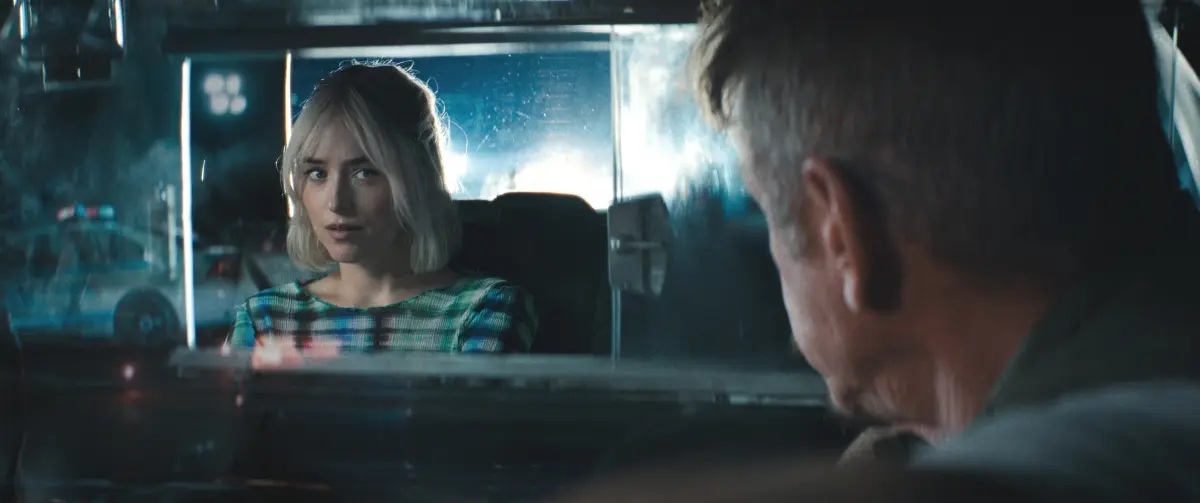
Deep conversations, rearview-mirror glances, and an unexpectedly long late-night taxi ride are the main ingredients in screenwriter Christy Hall’s feature directorial debut, Daddio, which premiered at the 50th Telluride Film Festival. The entire story takes place inside a cab on a night ride from JFK International Airport to Manhattan. Only two actors share the screen: Dakota Johnson (who is also a producer) and Sean Penn.
Distributed by Sony Pictures Classics, the film focuses on the power of random encounters and their impact on life. It’s a bottle movie in which a nearly claustrophobic space embraces two strangers and the entire narrative, illuminating the authenticity that can emerge from a chance encounter. What if you felt seen and understood by a complete stranger in a seemingly hostile world?
- Daddio: The Story of Two Strangers in a Taxi
- Daddio and the Art of Minimalist Filmmaking
- How Christy Hall Filmed Daddio in a Taxi
- Daddio and the Disappearance of Human Connection
- Christy Hall’s Promising Directorial Debut
Daddio: The Story of Two Strangers in a Taxi
Girlie (Johnson), a woman in her thirties, arrives at JFK and takes a taxi to her Midtown Manhattan home. The cabbie is Clark (Penn), a middle-aged man. Stuck in traffic due to an accident, Clark teases Girlie, who is distracted by explicit messages she’s receiving on her phone from the married man she’s having an affair with. Disgusted by the interaction, Girlie soon finds refuge in talking to Clark.
The two engage in a kind of therapeutic, mutual psychoanalysis session. Clark delves into the “father-daughter” dynamic of Girlie’s secret relationship. Meanwhile, Girlie begins to explore her dark, painful past in Oklahoma. What starts as an everyday conversation between a cynical driver and a wary passenger quickly becomes an intimate, candid exchange that reveals their most authentic selves. Their confessions forge a profound, rare human connection over the course of a taxi ride.

Daddio and the Art of Minimalist Filmmaking
Before Daddio, other filmmakers had taken on the stimulating and daunting challenge of filming an entire movie in real time inside a car. In 2013, Steven Knight wrote and directed the psychological drama Locke, starring Tom Hardy as a man driving and speaking on the phone. In 2004, Michael Mann released Collateral, in which a hitman (Tom Cruise) takes a cab driver (Jamie Foxx) hostage and forces him to drive around while committing crimes. Jafar Panahi’s 2015 docufiction film Taxi portrays the Iranian director driving around Tehran and offering sharp social commentary and denunciation of the regime, all while pretending to be a taxi driver.
In short, the film industry and its audiences have always been fascinated by movies and stories set inside a car. Whether it’s just the driver or a full car, the setting sparks something. The same is true of Daddio, an intimate drama that explores the fragility of human relationships, and more, all within the confines of a yellow cab.
Hall strips cinema down to its essence. As a seasoned screenwriter, she demonstrates complete control over narrative pacing and character development. Daddio features neither spectacular action scenes nor special effects. It focuses exclusively on the two protagonists and puts dialogue at the story’s heart. Two conversations occur simultaneously: one offline between Clark and Girlie and another online between Girlie and the married man. Once the car falls silent, the focus turns to the virtual interaction. There is no empty time, only an endless exchange of words and gazes.
The director skillfully uses the confined space, alternating between close-ups and extreme close-ups, as if forcing conflict and comparison with the other, a tension already emphasized by the tight space. Furthermore, intense glances in the rearview mirror highlight the search for connection and the ongoing debate. The editing highlights every line. It accelerates during lively exchanges and slows down to focus on facial expressions and subtle details during intimate monologues. Besides tapping out the rhythm, editorial and directorial choices guide the viewer’s gaze, determining who controls the scene.
Finally, Dickon Hinchliffe’s delicate score enhances the emotions and sets the mood with soft piano music that never dominates the scene. The music softly accompanies the growing intimacy expressed through gazes and words, never imposing on the scene.
How Christy Hall Filmed Daddio in a Taxi
Hall originally conceived the screenplay as a play, imagining it as a production for the independent theater circuit, perhaps in the East Village. By the end of 2017, however, it had become one of Hollywood’s most highly regarded unproduced screenplays and made it onto that year’s Black List. Johnson was the first to join the production, sending the script to his longtime friend, Penn.
After her film hit the big screen, Hall could have included more scenes outside the car. However, inspired by films such as The Whale, she chose to keep just one location. She believes that this setting allows for the deepest confessions because it’s where people feel free to open up. New York City slowly unfolds outside the windows at night, like a character in its own right, yet also an anonymous, poetic backdrop. Due to the short 16-day shooting schedule and limited budget, the production couldn’t afford a blue or green screen. Instead, they filmed on a soundstage and surrounded the cab with giant, high-resolution LED panels that projected real footage of New York City streets. This allowed the actors to interact with the images, creating a sense of reality. Additionally, cinematographer Phedon Papamichael manipulated the projections in real time to intensify the immersive experience.
Johnson and Penn’s performances are also essential. As Sheila O’Malley points out in her Roger Ebert review, Daddio is a film about faces:
Dakota Johnson’s and Sean Penn’s faces fill the screen, shot in extreme close-up—just the eyes sometimes, the smiles, the thoughts happening behind the eyes. Hall’s dialogue compels you to listen, to lean in, but Johnson and Penn draw us into their separate worlds and histories, each face telling a million stories.
Sheila O’Malley
Even the tiniest gestures reveal a character’s true nature. Girlie is a tough young woman who hides her insecurities behind deliberate mannerisms. Clark is a vulnerable man who wears his scars with pride. They are two wounded souls who never imagined where a random meeting could lead.

Daddio and the Disappearance of Human Connection
Hall wrote the story with two main concepts in mind: capturing a disappearing world and illustrating how a stranger can change someone’s life.
The alternation between online and offline exchanges in Daddio highlights this first aspect. Hall makes it clear that we have come to confuse connection with contact today. If technology is, as Clark argues, shifting value from the physical, human world to a virtual, automated space and replacing human interaction to the point of rendering even cab drivers obsolete, then this film is a precious time capsule preserving a fragment of that vanishing world. In this sense, Daddio reminds us that a simple talk with a cabbie isn’t as common as it used to be.
Yet, the connection between Clark and Girlie isn’t just because they’re necessarily physically close. Instead, it flourishes because they both choose to expose themselves, letting the veil of appearance fall away for a genuine encounter. In the cab, there’s a constant sense that anything could happen. Their conversation bridges gaps of generation, gender, and experience. It flows spontaneously and unpredictably. It is not a calculated chess match; it is pure instinct, as if Clark and Girlie are following their primal nature. Their bond is immediate. Above all, their connection feels far more real than Girlie’s with the man on the other side of the screen.
Daddio highlights the stark paradox between digital intimacy, virtual romance, and real-world connection. Moreover, it raises the question of whether it is easier to be oneself with a stranger. Where does real confidence lie? Is it in deep, long-term knowledge or in instinctive, random connections? The film doesn’t provide a clear answer, but it suggests it comes down to courageous honesty. Girlie and Clark share a moment, and during that time, they are both completely honest. They show vulnerability and don’t hide their feelings. This transparency allows intimacy to exist.
Christy Hall’s Promising Directorial Debut
In 1989, director Richard Linklater met a woman, and they talked all night while walking through Philadelphia. This encounter inspired his 1995 film Before Sunrise and its sequels, because the story couldn’t end there. Similarly, Daddio leaves with the same feeling: will they ever meet again?
Both films emphasize the importance of fate, chance, and personal choice in people’s lives. If Clark acts as a therapist at first, he soon starts taking the wraps off himself. He never judges; he instills confidence and a warm calmness, although he can be rough and direct. Maybe that’s exactly what attracts Girlie: she’s tough, too. She wants someone who won’t underestimate her or try to protect her, and this random stranger can do that. This is why their meeting pushes them both to reflect on their lives and where they’re going.

In a world where everyone is connected, yet isolation is a social issue, Christy Hall captures a disappearing microcosm. She documents the tiny yet immense magic that can happen when one surrenders to chance and opens up to a stranger. This is especially true when the stranger will disappear after a brief yet eternal moment. Clark and Girlie remind us of the opportunities we all encounter. It’s the dream of a night when anything seems possible if you seize the opportunity and aren’t afraid to take a risk. They are fragile and imperfect, but strong enough to follow fate’s path because they can show their true nature. It’s an epiphany you won’t forget, even though it started like a chaotic taxi ride.
Tag