 Collections
  Magazine
  Exhibitions
  ITA version













Backrooms Explained | Kane Parsons and the Horror of Liminal Spaces


Runtime
Have you ever wondered what would happen if you could step inside your own mind? What hidden corners, forgotten memories, and nameless fears might be lurking there? In his debut film, Backrooms (2026), distributed by A24, 21-year-old American YouTuber and director Kane Parsons (@kanepixels) turns this question into something deeply unsettling.
Parsons came from a background rooted in ARGs (Alternate Reality Games) and web series. He had already demonstrated a talent for creating atmosphere and unease through brief, self-edited footage that he posted on YouTube. With the support of producer James Wan, best known for his work on the Insidious, Saw, and The Conjuring franchises, Parsons brought his vision to the silver screen. With this psychological horror film, Parsons has the potential to leave a lasting mark on modern Hollywood.
Parsons became the youngest director to collaborate with A24, marking an early career milestone. The film grossed more than $300 million at the international box office. The success of Backrooms was further strengthened by its strong ensemble cast, featuring Chiwetel Ejiofor and Renate Reinsve, and written by Will Soodik. The actors’ performances grounded the film’s surreal world in emotional realism.

Parsons and his team seem to have a clear, long-term vision for the project. They have carefully planted details that hint at a much larger narrative beneath the surface. With a sequel already in the works, an extended version of the film was re-released in theaters on July 3 under the title Backrooms: Everything Must Go. The release features an additional 16 minutes of theater-exclusive footage and takes audiences deeper into the story’s lore, offering a glimpse into what lies ahead.
- What Is Backrooms About? Plot Explained
- Who Is Async in Backrooms?
- Backrooms Explained: Liminal Spaces and the Original Creepypasta
- Behind the Backrooms: Production Design and Sound
- Backrooms’ Meaning: Why the Film Is About Alienation
- Backrooms and Other Stories About Liminal Spaces
- Why Backrooms Became a Horror Phenomenon
What Is Backrooms About? Plot Explained
Set in the 1990s, the Backrooms movie follows Clark, played by Academy Award nominee Chiwetel Ejiofor, who is known for his role in John Ridley‘s 12 Years a Slave (2013). Once an aspiring architect, Clark now owns Cap’n Clark’s Ottoman Empire, a failing furniture store. His life has become defined by personal disappointment and unfulfilled ambitions. Struggling with loneliness and isolation after his divorce, Clark seeks help from Mary Kline, a therapist played by Renate Reinsve. Following her breakthrough in Joachim Trier‘s The Worst Person in the World (2021) and the acclaim surrounding Sentimental Value (2025), Reinsve brings a quiet emotional intensity to the role. She provides a sense of clarity and grounding amid the film’s growing psychological uncertainty.
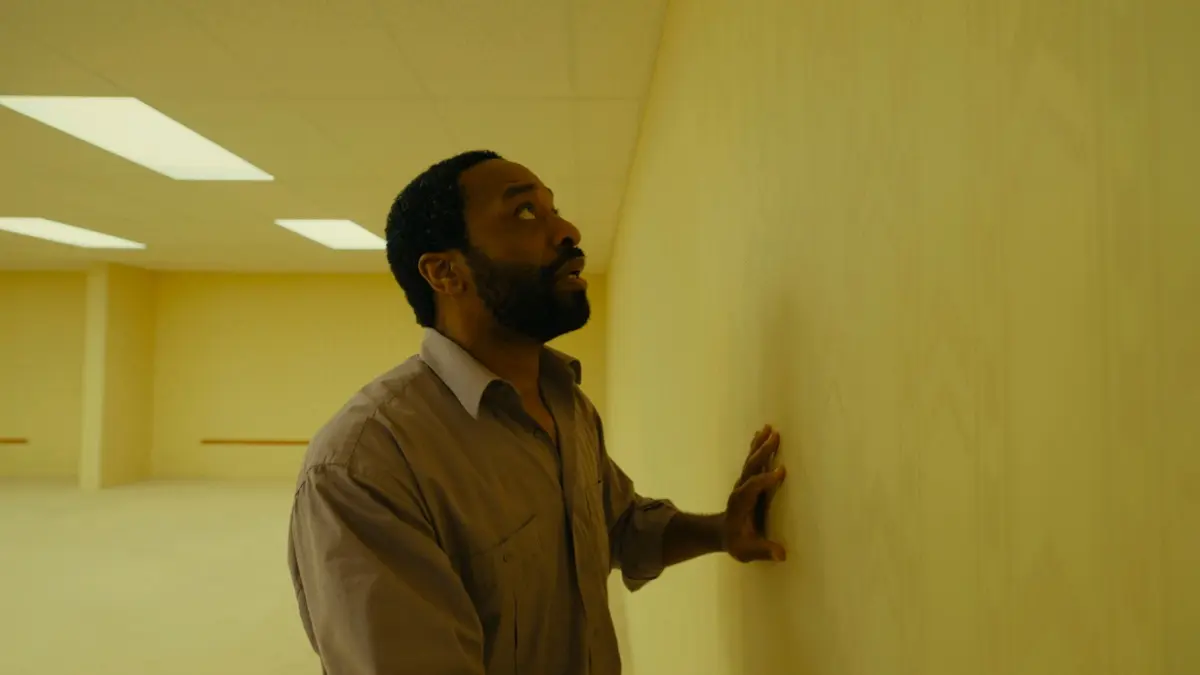
The narrative takes an unexpected dark turn when Clark discovers a portal to a parallel dimension hidden beneath his showroom’s basement. This dimension is known as the Backrooms. Initially, the space appears to be an extension of the store itself, with its maze-like corridors bathed in yellow fluorescent light. But only up to a point. As he ventures deeper into this endless, irrational world, the illusion of familiarity begins to collapse. Furniture and clothing fuse into the walls. Rooms appear inverted. Eerie creatures seem to lurk in the background.
Who Is Async in Backrooms?
When Mary follows Clark into this sinister world, she must confront her inner demons while desperately searching for a way out. Meanwhile, a research organization known as Async constantly surveils the Backrooms, attempting to understand the nature of this parallel dimension and its effects on those who enter it. Yet, despite their efforts, the mystery remains unsolved.
Backrooms Explained: Liminal Spaces and the Original Creepypasta
At its core, the Backrooms film phenomenon stems from a viral creepypasta that originated on online forums. More specifically, it emerged from a photograph posted on the image-based bulletin board 4chan in 2019. The photograph merely depicted an ordinary, empty room lined with yellow carpet, faded wallpaper, and neon lighting. Despite its ordinary appearance, the image captures an unsettling atmosphere that feels inexplicably wrong and unnatural. The space evokes the “uncanny valley” effect: it is familiar enough to be recognizable yet distorted in a way that creates discomfort, as if reality itself has become displaced.
This closely relates to the concepts of liminality and liminal spaces. Liminality refers to a transitional state, whether physical or emotional, that exists within undefined boundaries and resists clear coordinates. Often, these spaces are ordinary environments, such as hallways, offices, waiting rooms, and empty public areas, that become unsettling when stripped of human presence and purpose. In Backrooms, people access this place by “no-clipping” out of reality and unintentionally slipping beyond the boundaries of the physical world.
Fascinated by the concept of the Backrooms, Kane Parsons uploaded his first video in 2022, which became a web series. He edited the project himself, blending live-action footage with various visual media and using software such as Adobe Photoshop and Blender. He created and animated shadowy creatures inspired by the original creepypasta, which would later become intertwined with the film itself. Parsons also drew creative inspiration from the interactive video games he grew up with, particularly Portal and Half-Life. These games’ atmosphere and storytelling helped shape his vision of the Backrooms universe. The series quickly gained massive online attention, far exceeding his expectations, and eventually attracted the attention of A24.

Behind the Backrooms: Production Design and Sound
To recreate the aesthetic of Parsons’s early, self-made videos and the immersive feeling of first-person games, cinematographer Jeremy Cox used a handheld shooting style with a RED Komodo camera. Filmed in a cropped Super 16 format, the footage was enhanced with visual effects in post-production and transferred to VHS to preserve its raw quality. Cox explained this creative choice, stating, “We didn’t want the film to feel inherently ‘cinematic.’ We didn’t want it to feel glossy, or like a fabrication of itself.” The goal was to invite the audience into the Backrooms and avoid the plasticity that comes with film production.
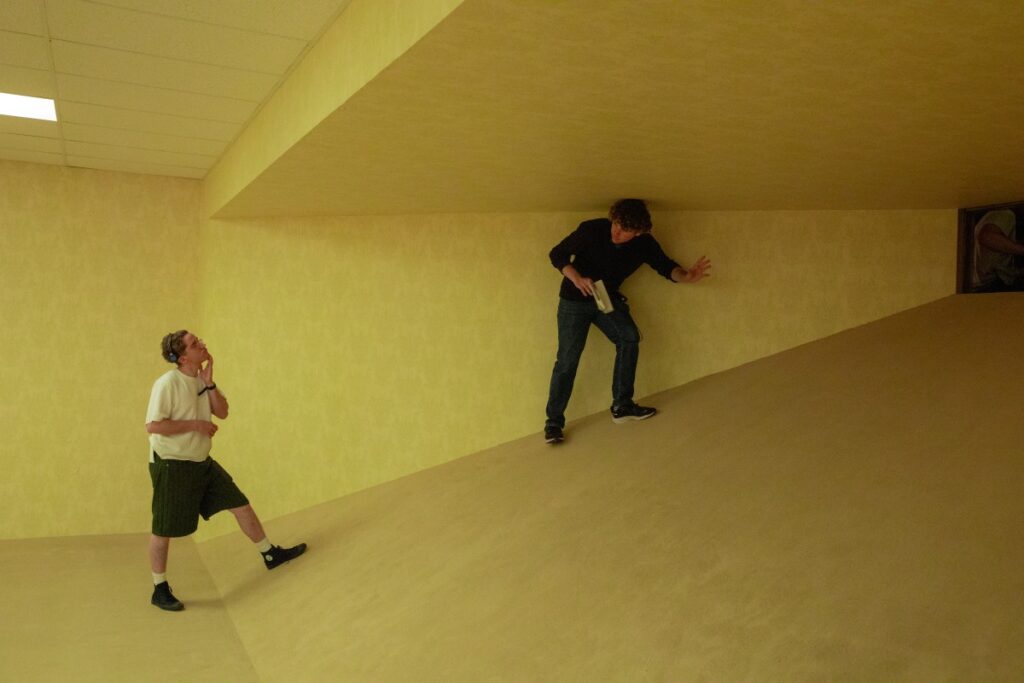
According to the film’s press notes, Parsons said that “the Backrooms had to feel all-consuming.” To bring this concept to life, the director collaborated with production designer Danny Vermette to build over 30,000 square feet of Backrooms movie sets. To further emphasize the place’s overwhelming scale, they filmed many scenes with wide-angle lenses, creating a distorted, almost hallucinatory effect. This practical approach contrasts with the increasing use of generative AI. Parsons has expressed concerns about generative AI’s role in the creative process, claiming that it undermines the human element at the core of filmmaking.
Sound design also played a crucial role in bringing the Backrooms to life. Sound designer Eugenio Battaglia amplified ordinary sounds, such as echoing footsteps and the constant buzzing of overhead lights, transforming them into sources of tension. Parsons used to create his own scores for the web series. This time, however, he found a fitting collaborator in Canadian composer Edo Van Breemen. Staying true to the director’s original vision, Van Breemen helped craft ominous musical motifs with electronic textures that intensified the film’s anxiety-inducing atmosphere.
When discussing liminal spaces, David Lynch is an inevitable mention. He made this phenomenon a central element of his cinematography. His surrealist films, such as Blue Velvet (1986), Eraserhead (1977), and Mulholland Drive (2001), have been major sources of inspiration for Parson’s Backrooms, influencing its dreamlike atmosphere and unsettling sense of reality. The natural and industrial settings in Lynch’s films often create a sense of dissonance that helps shape the emotional landscape of his characters, revealing that true horror lies at the threshold between the ordinary and the impossible.
Backrooms‘ Meaning: Why the Film Is About Alienation
Although the film was shot entirely in Vancouver, the story is set in San Jose, California, evoking the 1990s Silicon Valley technological landscape. The setting not only serves as a backdrop but also reinforces the film’s themes of alienation and disillusionment associated with sprawling capitalism, where ambition, productivity, and technological progress often come at the expense of personal connection. In many ways, the story reflects anxieties that continue to resonate with younger generations today, including Parsons.
“And now, as an adult, you’re still stuck right where you started… alone,” Mary tells Clark during one of their therapy sessions. Later, Clark repeats the line inside the Backrooms, offering a distorted reflection of reality. This space forces him to confront the fears he has long tried to ignore. However, when he revisits these traumatic experiences, he struggles to move beyond them. Despite receiving help, he begins to wallow in pain and finds a disturbing sense of comfort in rumination. He is eventually consumed by it.
Among the many fan theories, some interpret the Backrooms as a metaphor for therapeutic work, describing it as a space where disembodied, fragmented memories resurface. However, the only way out is through, and immersing oneself in trauma does not necessarily lead to physical or emotional liberation.
As the storyline unfolds, the audience realizes that Mary and Clark have more in common than initially thought. Renate Reinsve stated in the press notes that connecting to her character was “a way to understand the world on a level much deeper than words can communicate. It’s both eerie and a relief at the same time.” This is also why Mary feels intrigued by the idea of crossing the distorted mirror. However, in her attempt to save Clark, she risks losing herself.
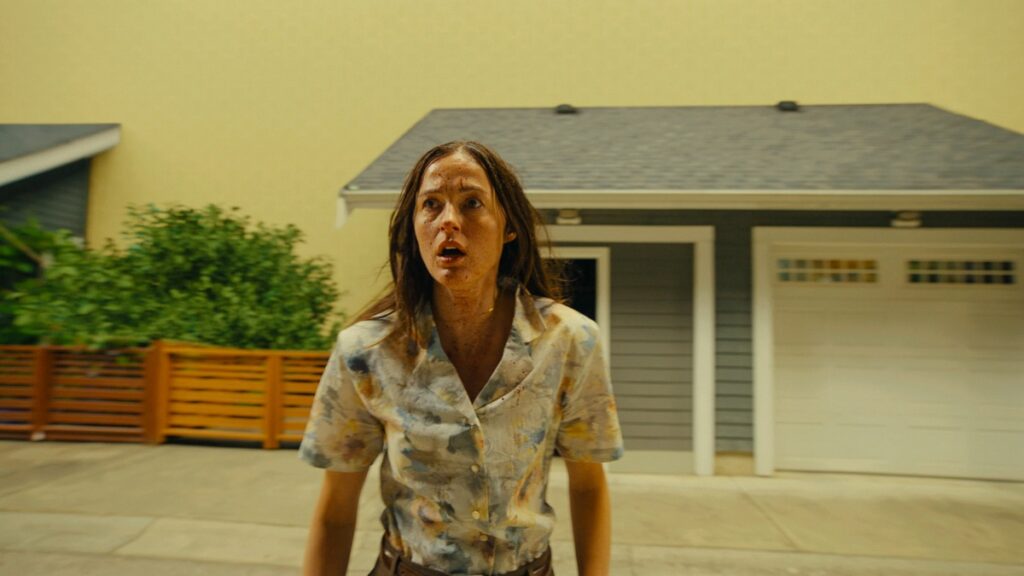
The protagonists’ performances, particularly their physical acting, stand out and have earned wide acclaim from audiences and critics alike. Since the film relies heavily on their interaction with the surrounding space, the two leads effectively convey the environment’s paradox: vast and oppressive, limitless yet claustrophobic.
Backrooms and Other Stories About Liminal Spaces
Indeed, the concept of liminality and transitional spaces lends itself to multiple interpretations, especially when portrayed through visual media. Although the film brought the idea into mainstream discussion, boosting its popularity, Backrooms‘ audience is certainly no stranger to this concept.
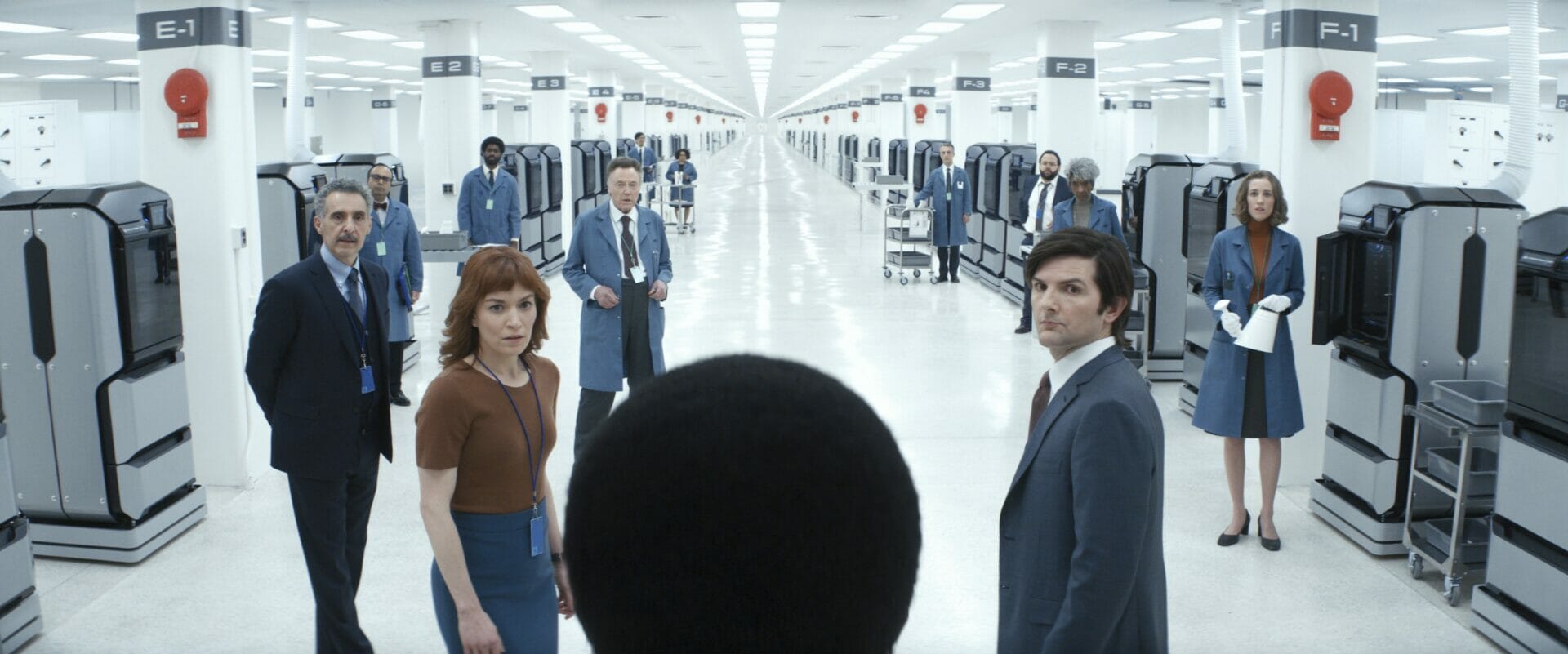
First and foremost, the Backrooms movie shares many similarities with Severance, the 2022 series created by Dan Erickson. Set in the present day, the show follows employees working on the “severed floor” of Lumon Industries. This company has developed a procedure that allows workers’ professional and personal identities to be completely separated. The labyrinthine, often empty corridors and office spaces are a clear example of liminality. Like Clark, the characters experience profound alienation as they navigate a workplace designed to strip them of their identity. Thus, sterile offices and endless corridors become environments of psychological disorientation and institutional control in both narratives.
Despite the generational shift, both the Upside Down in Stranger Things and the Backrooms construct alternate spaces that mirror and distort reality. They use the idea of a parallel dimension to externalize fear, isolation, and the unknown. The iconic TV series by the Duffer Brothers uses the Upside Down to give form to these anxieties in a more “fable-like” manner, where isolation and danger are ultimately confronted through friendship and collective action. In contrast, Parsons’ film offers a far more solitary response and provides no clear resolution or sense of communal escape. Unlike Parson’s Backrooms, where emptiness and repetition generate dread, Stranger Things builds its horror through excess. Both, however, rely on these transient spaces to create discomfort and reveal a hidden layer of ordinary life.
Why Backrooms Became a Horror Phenomenon
With the growing popularity of indie horror films, Backrooms has undoubtedly earned its spot at the top. Curry Barker is competing for the top position with his feature debut, Obsession (2025), which, like Backrooms, began with a modest budget and generated shocking success. While some viewers have criticized the movie for being confusing or inconclusive, it may be too early to pass final judgment. By leaving narrative threads open, the film allows space for interpretation and further development.
Certainly, these films remind the film industry that it is worth investing in independent projects and supporting emerging creative talent. It also shows that bold storytelling can appeal to viewers across different generations. Maybe because in a world shaped by financial and environmental crises, war, and ongoing social instability, stories centered on personal dissatisfaction, loneliness, and toxic relational dynamics no longer read as conventional horror but instead feel terrifyingly real.
Tag