 Collections
  Magazine
  Exhibitions
  ITA version













My 2 Cents Review | Zerocalcare’s Netflix Series and the Anxiety of Adulthood


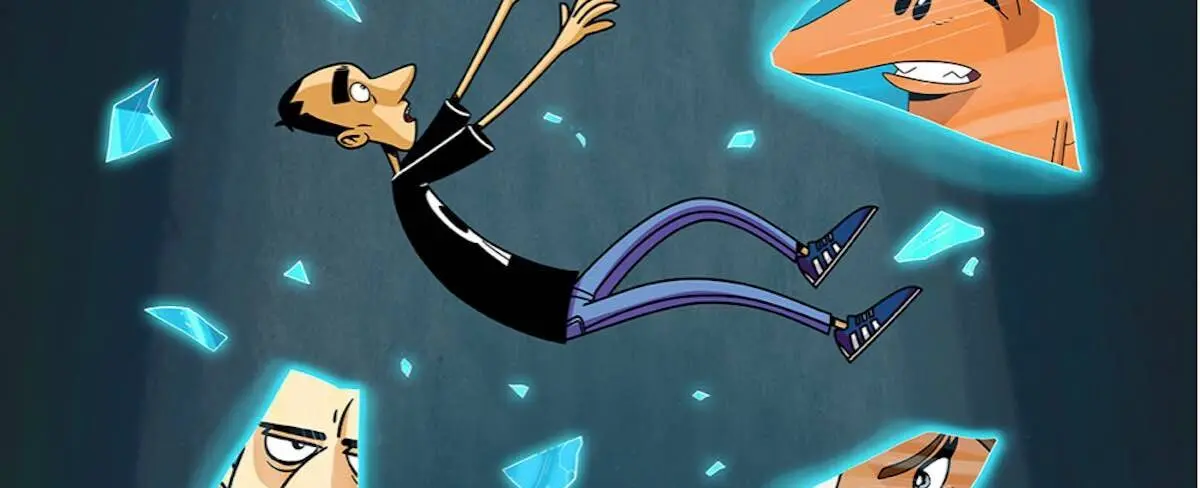
After Tear Along the Dotted Line and This World Won’t Tear Me Down, My 2 Cents marks Zerocalcare’s most mature work to date. Premiering on Netflix after a preview at the Turin International Book Fair, the series revisits the cartoonist’s familiar world while confronting a generation that entered adulthood without ever feeling prepared.
If the first series explored grief and the second turned its gaze toward political conflict, My 2 Cents brings those two dimensions together. It asks what remains after ideals, friendships, and dreams have collided with the reality of adulthood – and why so many people in their 30s or 40s feel they have lost themselves along the way.

Who is Zerocalcare/Michele Rech?
Although still relatively unknown outside Italy, Zerocalcare has become one of Europe’s most distinctive graphic storytellers. Under the pen name Michele Rech, he transformed deeply personal comics into a cultural phenomenon by combining autobiographical storytelling with political commentary through his distinctive style of ironic self-analysis.
Set against the backdrop of contemporary Rome, his works capture the anxieties of a generation navigating precarious jobs and fading ideals. Thanks to the global distribution of his Netflix series, his unmistakable voice – at once deeply local and surprisingly universal – has begun to resonate with audiences far beyond Italy.
My 2 Cents Plot: Based on Many True Stories
In My 2 Cents, the characters are the same as in previous shows and comics, three years after the events of the previous stories. Sarah has a troubled relationship. Zero becomes a business partner in Cinghiale’s bar, and Secco disappears as he becomes a father. But Cinghiale gets into trouble with Paturnia, a moneylender who terrorizes the neighborhood. Zero also has to face one of his greatest fears: sharing his personal space. When Sarah asks for his help, he agrees to give shelter to a girl escaping from a violent man. Yet, she’s not just “a girl”: she’s Smeralda, his old flame, a relationship that never truly began but that he never managed to forget.
As happened with previous works, many viewers wondered how much of the story was autobiographical. Zerocalcare himself explained that the show is not based on a single real event but rather on a mosaic of people and situations collected over the years. Smeralda, Paturnia, and Cinghiale’s story is fictional yet emotionally recognizable because it draws on lived experiences.
Zerocalcare’s Themes: Toxic Relationships and Everyday Struggles
Zerocalcare has a long history of dealing with socially active stories, both in his comics (such as Kobane Calling) and in his shows. This World Won’t Tear Me Down still appears focused on politics and ideals, even as it highlights their impact on reality. Instead, his last Netflix series centers on ordinary people’s struggles, especially those experienced by people living on the margins.
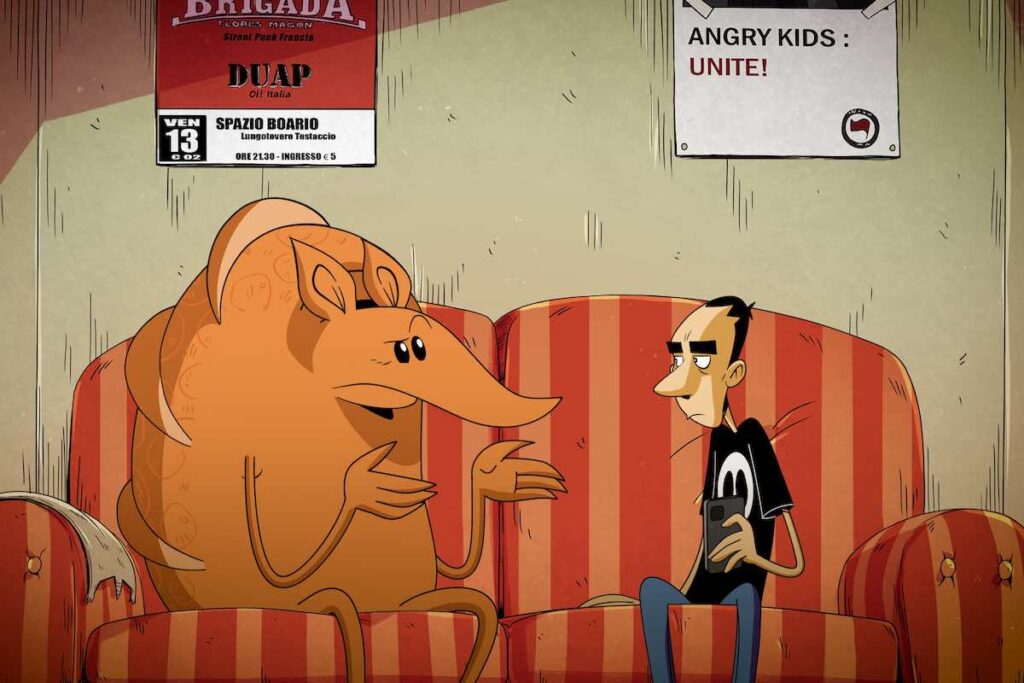
Cinghiale can’t pay his debt, but it’s not due to drug addiction, nor an affair, as their friends thought. He needed increasing amounts of money to support his family, and now he is caught in a criminal environment that controls the neighborhood and preys on its most vulnerable residents.
The series also explores the mechanisms that trap victims inside abusive relationships. Sarah and Smeralda experience different forms of violence, yet both reveal how manipulation and emotional dependency can make escape painfully difficult. In Celine Song’s film Past Lives, two old friends meet again after years and wonder what their lives might have been like if only they had stayed together. Similarly, Smeralda embodies every unrealized possibility in Zero’s life. She represents every “what if” that adulthood inevitably leaves behind.
The series also explores the self-analysis and intimate dimension that define the cartoonist’s style. Through his endless conversations with Armadillo, Zero gives shape to a quieter, more mature anxiety than in previous series. This feeling comes from realizing that adulthood has already arrived without resembling anything he had imagined. Dreams have simply dissolved into compromise and missed opportunities.
The Language of Zerocalcare’s Inner World
While preserving his typical drawing style, Zerocalcare has increasingly introduced realistic elements into his recent works. In My 2 Cents, there are even a couple of live-action scenes, while in the new edition of The Armadillo Prophecy, he added a preface with some extremely realistic portrayals. As Zerocalcare suggests, these moments reveal his ongoing reflection on the ability of comics and animation to represent reality and preserve memory.
Another common element with previous work is the dubbing, which also mirrors his inner perception. Zerocalcare voices all the characters (except the Armadillo, whose voice is provided by Valerio Mastandrea). Only in her final scene does Smeralda change her voice, adopting a new one from Emanuela Fanelli. This transformation marks her final turning point: she’s no longer a character in Zero’s mind, but an actual person.
Like the previous productions, My 2 Cents also has a distinctive soundtrack. Reflecting the author’s evolution, punk songs give way to a mix of pop and indie tracks. While his collaboration with Giancane continues to grow, Coez also contributes to the emotional impact of the soundtrack. Other tracks, ranging from early 2000s pop hits to underground rock, become part of the narrative itself, reinforcing the emotional connection between music and memory.
A Story That Speaks for a Generation
The stream of consciousness has always been at the heart of Zerocalcare’s storytelling. This show, however, reaches a new level of maturity. Thoughts interrupt one another, memories intrude on the present, and seemingly unrelated digressions gradually reveal a coherent emotional landscape. Rather than recounting events, the series recreates how the human mind processes reality, drawing the audience directly into Zero’s anxiety and inner conflicts.
This narrative structure reflects the fragmented experience of contemporary life. Like the literary tradition from which it takes inspiration, the uninterrupted flow of thoughts leaves little room to breathe and conveys the uncertainty that shapes modern adulthood. By speaking honestly about himself, Zerocalcare gradually shifts from autobiography to a broader portrait of his generation. His fears and unresolved questions become instantly recognizable because they echo experiences shared by many others.
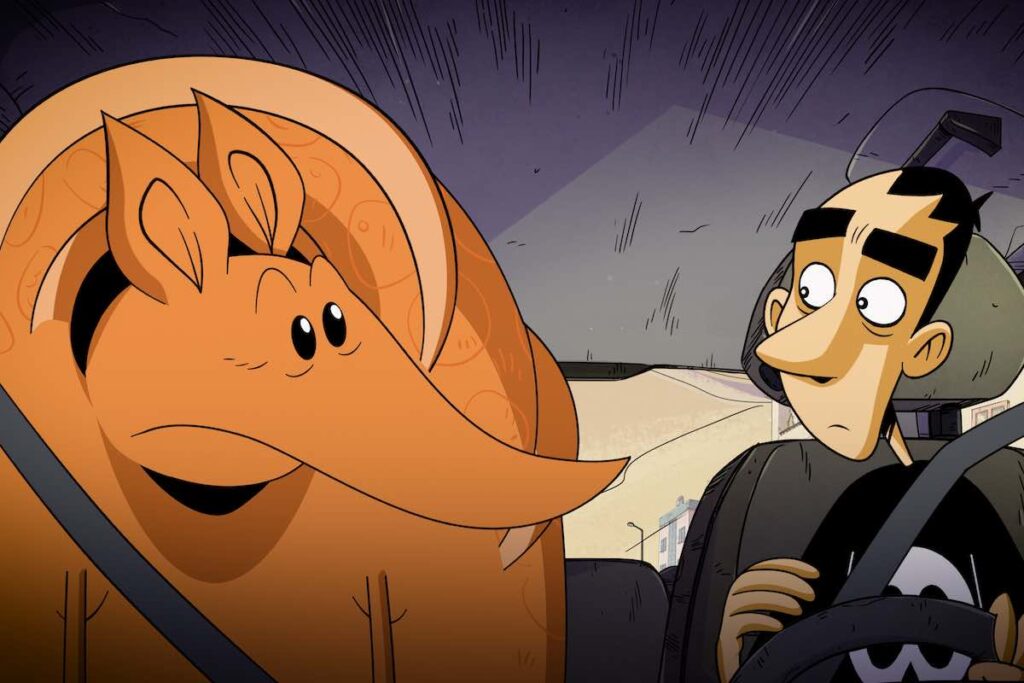
Instead of defining adulthood through traditional milestones, My 2 Cents focuses on the invisible changes that come with time. The series portrays a generation that has entered adulthood without ever feeling prepared, carrying expectations inherited from the past while facing a future that offers few certainties. In this sense, it recalls Zygmunt Bauman‘s concept of liquid modernity, where stable identities and predictable life paths have dissolved, leaving individuals to navigate uncertainty without reliable landmarks.
Yet the story never settles into resignation. Loneliness remains one of its dominant emotions, but the story never loses sight of solidarity. Zerocalcare suggests that growing older is less about reaching a destination than about learning to endure uncertainty alongside others. Whether a home is built of stone or straw matters little if there is someone nearby when the storm arrives.
My 2 Cents refines Zerocalcare’s storytelling without abandoning the elements that made his work distinctive. Familiar characters return alongside self-deprecating humor and restless inner monologues, while pop culture references continue to shape his unique narrative style. By transforming one man’s inner conflicts into a shared emotional experience, Zerocalcare confirms his greatest strength: making deeply personal stories feel universal.
Tag