 Collections
  Magazine
  Exhibitions
  ITA version













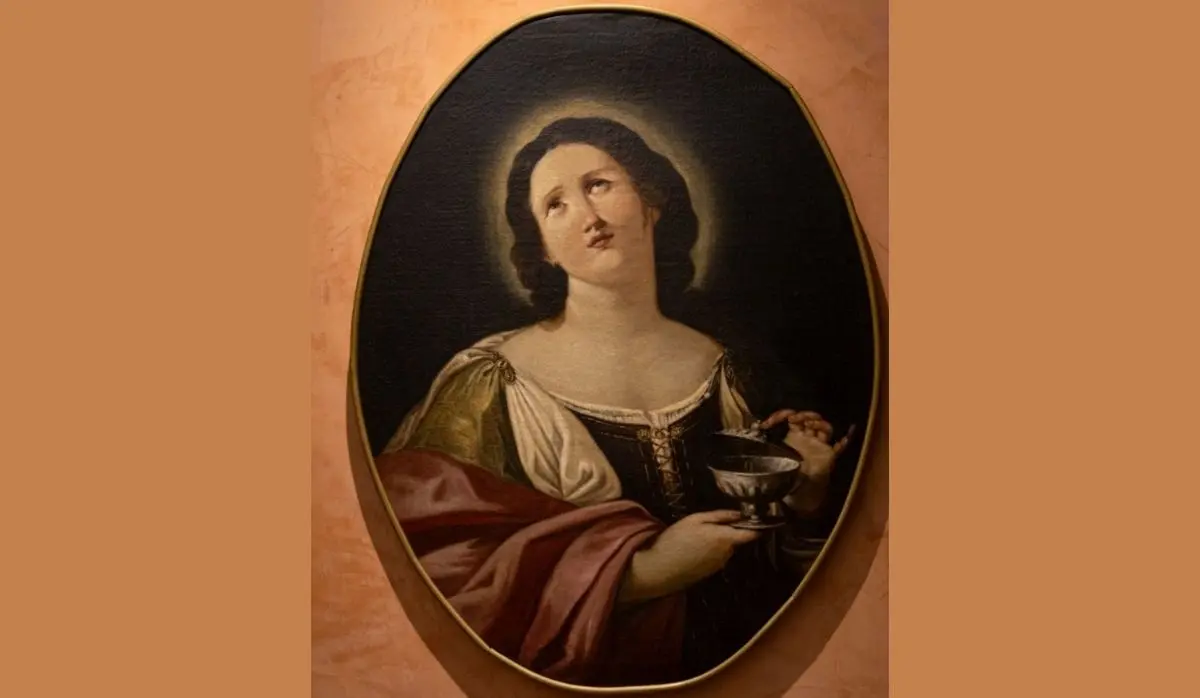
Rediscovering Mary Magdalene | The Restored Oval Painting at the Morcelli Repossi Collection


The Pinacoteca and library of Morcelli Repossi are a cultural treasure located on the outskirts of Brescia in Lombardy, Italy. The museum and archive host a collection comprising paintings and archival materials dating back to the fourteenth century. Among the various portraits of noble women hangs a portrait: Mary Magdalene, who people consider the first woman to challenge strong social conventions of her time.
Following her conversion to the Christian faith, Mary Magdalene played a pivotal role in the Bible, not only as a female disciple of Jesus but also as his most devoted defender, demonstrating fervour and lifelong allegiance. Mary Magdalene might stand as one of the earliest advocates of women’s roles in the history of religion. By asserting her voice, she distanced herself from the place assigned to women at the time, such as subordination to men, silence, and exclusion from leadership roles, to become the ‘apostle to the apostles‘ by breaking those patriarchal norms and emerging as a pioneering figure.
The Particularity of the Oval Painting
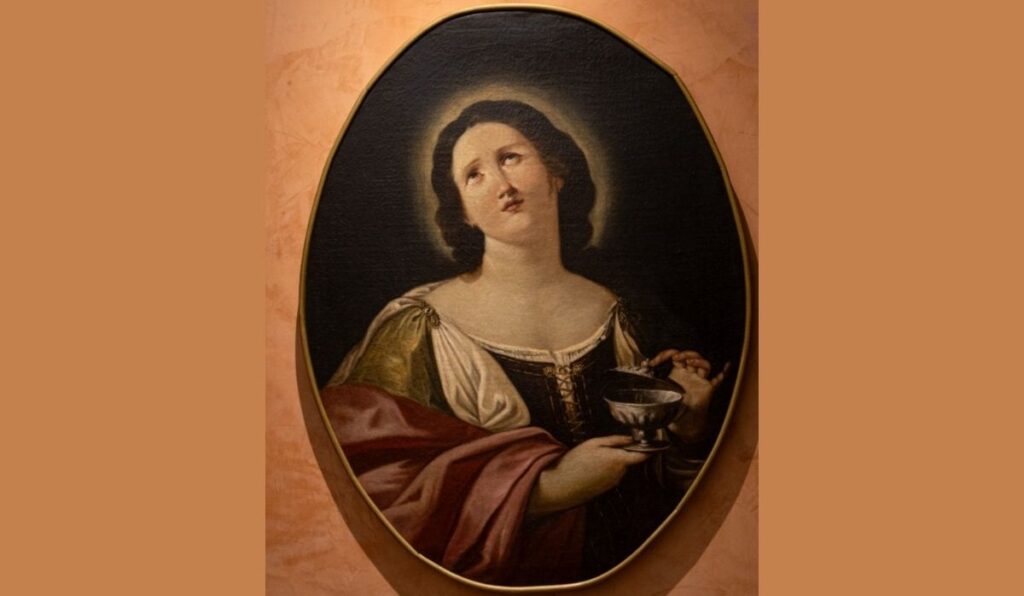
The oval-shaped painting of Saint Magdalene in the Repossi Collection, an oil on canvas by an unknown painter, is substantial in size (71 cm x 92.5 cm). The oval arrived in 1918 as part of a series of paintings donated by the Italian sculptor Antonio Rota.
Due to a pair of eyes placed in the small silver vase, which represent traditional attributes of Saint Lucia, the painting was initially, and for an extended time, included in the collection’s catalogue as a portrait of the Saint mentioned above.
The Restoration of the Oval Painting and Magdalene’s Rediscovered Voice
Following a recent restoration, Saint Magdalene once again found her identity and voice. After removing the overpainting, we can now admire her as she was initially intended. The bust of The Saint appears on a simple composition, wearing contemporary sixteenth-century clothes.
Magdalene boasts a tightened chest, thanks to a crossed bustier, and her large white shirt peeks out from the sides of her arms. Two additional fabrics overlap and overspill: a greenish sleeve tied with a pin and an abundant reddish cloth, all covering her cinched waist. The décolleté opens at the shoulders, showing her rosy skin. However, this subtle delicacy is overshadowed by the large, low-cut, revealing neckline, while her face tilts to the left towards the sky, conveying drama and devotion. The length of her sharp nose descends vertically. It matches the corners of her mouth, shifting through an imaginary line, as the viewer’s gaze is drawn toward the felt vial containing aromatic oils with which she is preparing to anoint the body of Christ.
Unfortunately, despite the restoration, the information regarding the previous owner, the overpainted picture, and the associated documents remains untraceable. The painting bears no signature. However, the stylistic clues of a distinctly oval-shaped face, small facial features, and a long, pointed nose indicate the Emilian school, as these are characteristics attributed to their works.
The Emilian Delicacy of a Penitent Saint
Although its author, commissioner, and purpose are difficult to determine, the oval format follows the aesthetic canons of the Emilian school after the Counter-Reformation. The contemporary Emilian Guido Reni provides a parallel example. In depictions of Mary Magdalene, the one held at the National Gallery of London features many elements that seem similar. The Saint stands centrally, lifting her eyes heavenward, and her long golden hair envelops her upper body, and the background is dark.
Within these attributes, we can identify the placement of the ointment jar in the oval, which has evolved from a mere characteristic to a central element of the entire composition. In this balance between ecstasy and restraint lies the essence of seventeenth-century Emilian art, able to turn devotion into a form of silent visual elegance, where the devoted can focus on a quiet yet solitary meditation.
Media Evolution: From Jesus Christ Superstar to Davis’ Mary Magdalene
In all movies from the start of the 1900s, Mary Magdalene has held a secondary or tertiary role, highlighting her outstanding devotion to Jesus and the Christian faith. In the notorious film Jesus Christ Superstar, Mary Magdalene plays a maternal and caring role, with a somewhat stereotypical feminine fragility. Throughout the film, the character appears to be experiencing internal struggles while grappling with the uncertainty of potential romantic feelings for Jesus.

It was not until 2018 that Australian director Garth Davis dedicated his film Mary Magdalene to the Saint. She is finally depicted as the main protagonist. In the movie, the protagonist is portrayed as devoted yet determined, strong, and independent. Therefore, a version that is vastly discordant with the ancient and more recent representations, including that in Jesus Christ Superstar.

Despite the passage of centuries and the evolution of religious beliefs, Mary Magdalene still stands as a captivating figure. Perhaps remaining relatable, as we, to this day, continue to struggle to make our own voices heard in a world that doesn’t listen. Even now, her perception continues to provoke discussion: was she a devoted sinner, the first rebel woman, or both? In modern terms, one could argue that Mary Magdalene was the first feminist in history.
By removing the overpaintings that silenced Mary Magdalene, her powerful presence rests in the light, where she can metaphorically speak to us again. An identity concealed, a voice reborn after time—an eternal symbolic legacy of resilience and strength.
Tag