 Collections
  Magazine
  Exhibitions
  ITA version












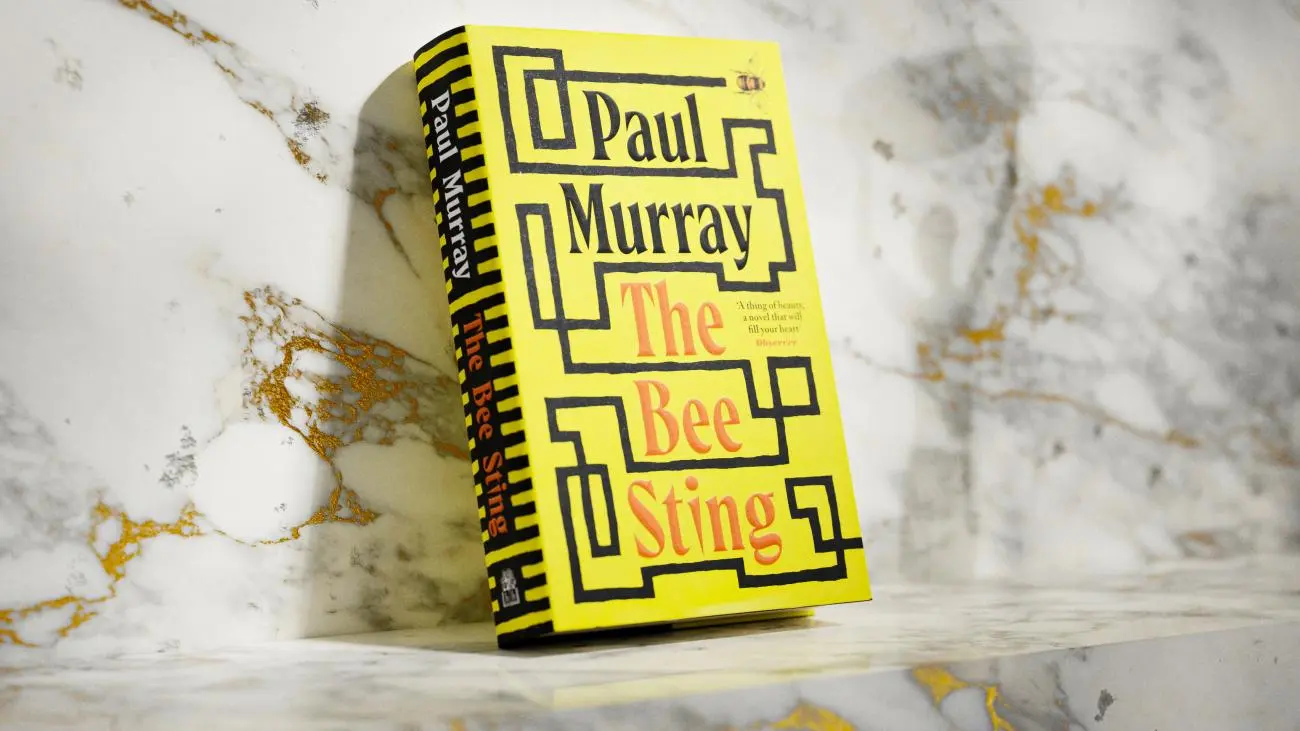
The Bee Sting by Paul Murray Review | A Family, a Collapse, and the End of Certainties


Length
In contemporary literature, few novels manage to combine psychological depth with ambitious narrative architecture as effectively as The Bee Sting by Paul Murray (2023). Often regarded as the champion of Irish tragicomedy, the author has long made a name for himself for his gift for blending pathos, humour, and emotional texture, most notably in Skippy Dies (2010). With his latest work, which was shortlisted for the Booker Prize (eventually won by Paul Lynch’s Prophet Song), he extends and deepens this mastery into an even more expansive and articulated family drama. Through a polyphony of voices and a sophisticated, character-led prose style, Murray offers a rich, layered portrait of the Barnes family, a once-wealthy Irish family, shaken by the 2008 Great Recession and by inner turmoil. At the same time, the novel reveals the fragility of human relationships and the heavy burden of unspoken desires that shape and distort intimacy.
- The Barnes Family and Post-Celtic Tiger Ireland
- A Polyphonic Family Saga: The Structure of The Bee Sting
- Secrets, Shame, and Metaphor in Paul Murray’s Novel
- Climate Anxiety and Domestic Collapse
- Endings, Trauma, and the Possibility of Renewal
The Barnes Family and Post-Celtic Tiger Ireland
Dickie Barnes manages a car dealership that he inherited from his father, Maurice. However, his behavior, far from that of a charming salesman, combined with the fallout from the crash, leads inevitably to the business’s collapse. Imelda, his wife, had grown accustomed to a life of luxury and comfort, very different from her modest upbringing. As a consequence, she becomes increasingly intolerant toward Dickie and their children, Cass and PJ.
Cass, the elder, is thoughtful and introspective. Alongside her childhood best friend, Elaine, she dreams of escaping the confines of small-town life, breaking free from her dysfunctional family, and moving to Dublin to study at Trinity College. There, she would build a life of her own, finally stepping out of the shadows of her family.
PJ, on the other hand, is the younger sibling. Although he often seems like the stereotypical annoying, video game–obsessed little brother, he feels much more deeply than he lets on. Taunted by a bully because of his father’s debts, he devises careful plans in the hopes that his family will overcome their struggles and make things right again. Together with other characters, often resurging from the past like lingering ghosts or stubborn presences, the novel traces the intricate story of a family in complete disarray, struggling to make sense of a world where everything seems to be falling apart, from climate change to economic collapse.
A Polyphonic Family Saga: The Structure of The Bee Sting
The Bee Sting unfolds as a sprawling family saga, with each section focusing in turn on the perspective of every character of the story. This rotating structure functions as a steadily widening lens, a device that Murray employs to open the family’s Pandora’s box gradually, thus revealing the secrets long buried beneath layers of silence. As each voice takes center stage, years of unresolved trauma, miscommunications, and unspoken desires surface, exposing the emotional intricacies that hold the Barnes family together even as they keep one another at arm’s length.
Although Murray’s distinctive voice permeates every section, he experiments with bold stylistic choices that mirror each character’s most intimate essence. Each narrative voice is crafted with striking precision: Cass’s chapters are marked by a more lyrical tone that captures her yearning and resignation; PJ’s sections reflect his imaginative logic and rapidly shift between fear, fantasy, and determination. Dickie’s voice conveys his subdued melancholy, shaped by years of compromise and layers of secrecy. But what stands out the most are Imelda’s sections, whose absence of punctuation and relentless flow make them one of the novel’s most daring and psychologically revealing narrative experiments. This Woolfian stream of consciousness mirrors her erratic, circling mind: forced into the archetype of the trophy wife, she spills her thoughts across the page in a breathless rush, revealing a woman haunted by her long-lost love and trapped in an inescapable present.
Despite its 600 pages, The Bee Sting maintains an increasing pace, with tension intensifying as the narrative moves toward the climax. As the story nears its conclusion, Murray carefully accelerates the unfolding of events, revealing secrets, conflicts, and emotional stakes in a way that keeps the reader engaged. Towards the end, the author begins passages with “you”, creating a cinematic effect that invites the readers to engage in an exercise of empathy. The novel’s conclusion avoids easy resolutions, leaving the audience caught between disbelief and contemplation.
Secrets, Shame, and Metaphor in Paul Murray’s Novel
It seemed she could feel the bee’s panic, its desperation to escape; she could see her mother’s hands pummelling the air, then, as the creature made its last suicidal effort to defend itself, the sting pulsating on her skin, pumping its futile poison. She felt the bee’s life ebb away. Nature was dying, the world was ending. As she fell asleep, it was her body on the floor by her mother’s silk wedding shoes, already turning to dust.
Paul Murray, The Bee Sting
A tragicomic family saga on the surface, The Bee Sting is, in fact, a complex, layered novel that grows ever richer in metaphors and allegories as the narrative unfolds.
The novel moves swiftly between the seen and the unseen, pulling the reader through deceptive outward appearances and into the secret corners where buried desires and concealed truths rise to the surface. This dualism recurs throughout the novel, emphasizing how much of life is lived in the shadows. Imelda’s wedding offers the most telling example: she refuses to lift her veil, shrouding her face, allegedly stung by a bee, as the title suggests, and erases all evidence of a day she cannot bear to confront. On a smaller scale, PJ also hides his blood-stained socks in his locker, a gesture that may seem trivial but instead reveals a quiet, instinctive empathy. Not wanting to add to his parents’ financial burden, and perhaps unconsciously clinging to the sheltered state of childhood, he refuses to admit that he needs new shoes to fit his growing feet.
Similarly, the family “bunker”, nestled in the woods surrounding the Barnes household, begins as a playful refuge where PJ and Cass can meet their friends in secret, away from adult scrutiny. Over time, it transforms into a meticulously “future-proofed shelter”, a space to hide when the day of judgment comes. These instances underscore The Bee Sting’s recurring theme: the lengths to which the characters go to shield themselves from shame, fear, and the unbearable truths of their lives.
Moreover, ghostly presences inhabit the world within the novel, serving as constant reminders of the past and making forgetting an impossible task. Rose, Imelda’s aunt, acts as a healer and something of a medium between the living and the dead, and her cryptic predictions frequently prove accurate, blurring the line between reality and ever-present memories. Frank, Dickie’s younger brother and Imelda’s first love, never truly leaves the scene; his persistent shadow looms over the Barnes in the form of heartbreak and unanswered questions.
Climate Anxiety and Domestic Collapse
Paul Murray’s mastery lies in walking the treacherous line between the personal and the universal. The Barnes family’s turmoil mirrors the broader fractures of a world in decline. Their private anxieties and fears echo global tensions that extend far beyond post-2008 Ireland, resonating just as powerfully today.
Climate change, economic instability, and social decay seep into the most intimate corners of domestic life. This motif runs steadily from the book’s title to its final pages, laying the groundwork for a novel that reads both like a manifesto and a personal diary.
As if the reader were peering through a peephole, Murray guides us through the Barnes family’s daily struggles, each one exacerbated by their chronic inability to communicate. Much like the brothers at the heart of Sally Rooney’s Intermezzo (2024) suggest, many family conflicts stem from miscommunication or a complete lack thereof. Overburdened by personal issues and mutual resentments, the characters in both novels tend to dig their own graves, collapsing under the weight of what remains unsaid and the truths they cannot face. Just as the flood has devastated the land on which their small town stands, the growing lies, secrets, and unprocessed traumas swell within each character, threatening to break the dam at any moment.
Addressing climate anxiety seemed inevitable to the author, mainly because it reinforces his message that we cannot dig into the past to explain the present but must instead surrender to it and move forward. In fact, he claimed:
Climate change relates to the past, obviously, but dwelling on its origins aren’t going to help us. We really need to find a new way of being to get through it and we haven’t found a way yet of doing that. In short what I’m interested is not so much the past coming back, but the ways it obscures the present and stops us from embracing the future.
Paul Murray, “If a book is gripping, then you don’t care about the page count,” interview by The Booker Prizes, September 22, 2023.
Paul Murray’s intent aligns somewhat with Julia Armfield, whose novels Private Rites (2024) and Our Wives Under the Sea (2022) subtly weave climate change into their narratives, granting intimate stories a distinctly global dimension.
Endings, Trauma, and the Possibility of Renewal
Maybe every era has an atrocity woven into its fabric. Maybe every society is complicit in terrible things and only afterwards gets around to pretending they didn’t know. When the kids ask, tell them that no one meant any harm.
Paul Murray, The Bee Sting
In an age marked by uncertainty and upheaval, this carefully crafted, thought-provoking work feels all the more essential. With its fatalistic outlook and yet its implicit call to break cycles of intergenerational trauma, The Bee Sting teeters between hope and despair, leaving readers to determine what lessons to take from the story.
Amidst the darkness, moments of resilience and renewal shine through. Cass herself exemplifies this. Her birth stands as a triumph over death and grief, hinting that processing loss and moving on is possible and necessary. Through its intricate narrative structure, shifting perspectives, and layered metaphors, Murray’s novel challenges readers to confront both human fragility and resilience. Ultimately, it urges us to choose whether to dwell on the past or to take an active role in shaping a better future, one built on truth rather than lies, and love rather than fear.
Tag