 Collections
  Magazine
  Exhibitions
  ITA version












The Drama Review (No Spoilers): When Love Becomes a Moral Performance


Runtime
Which would you sacrifice: your ethics for love, or love for your ethics? In The Drama (2026), Norwegian director and screenwriter Kristoffer Borgli poses this question to his characters and viewers alike. This spoiler-free review examines how the film shifts from romantic dramedy to psychological thriller, exposing the fragile boundaries between intimacy and social performance.
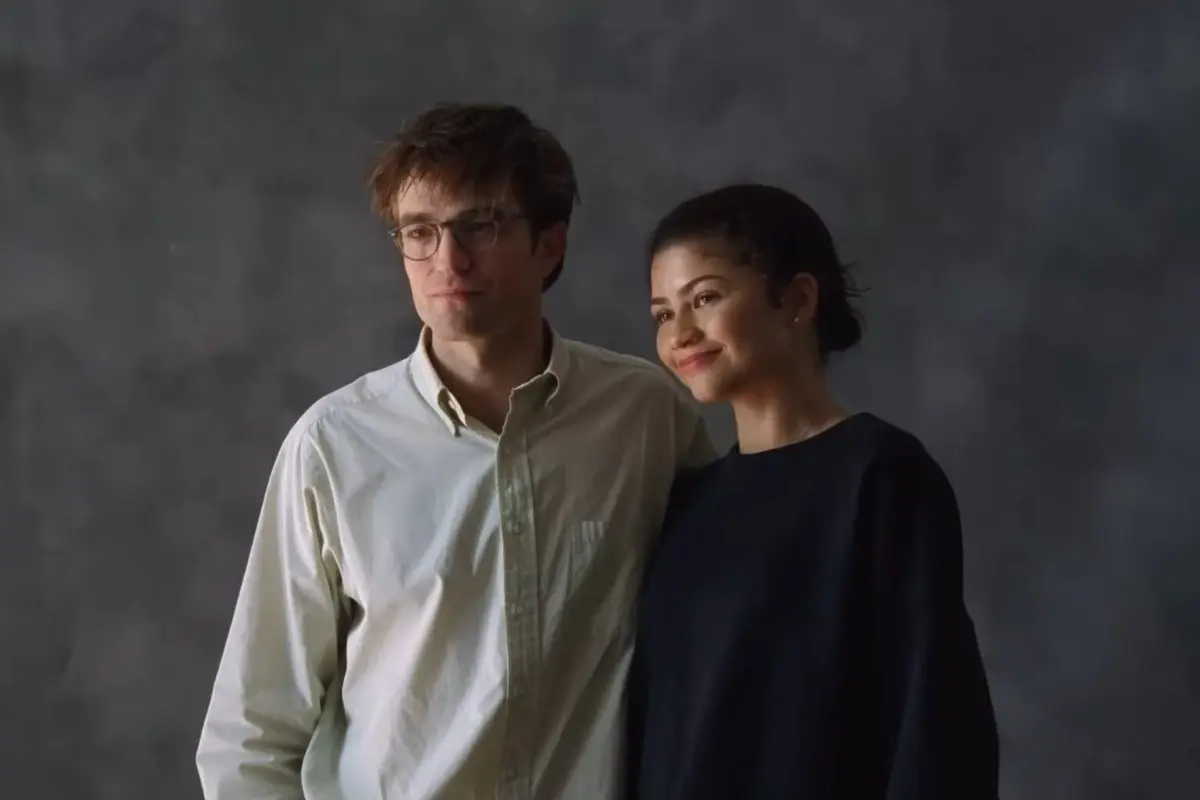
Initially marketed as a romantic dramedy, The Drama film gradually reveals its psychological thriller undertones, culminating in a dark twist. Starring Zendaya and Robert Pattinson, The Drama generated months of online speculation, particularly on Reddit, where viewers tried to decipher its meaning before watching it.
Following Sick of Myself (2022) and Dream Scenario (2023), Borgli has returned with yet another sharp, cerebral satire of conventional morality. Distributed by A24, The Drama came with high expectations and ultimately succeeded, grossing $113 million worldwide. Although generally praised by critics, the film also disappointed a large section of the public. They argued that its success relied mainly on its cast and marketing campaign and that it didn’t live up to its promise.

- What’s the Worst Thing You’ve Ever Done?
- Cancel Culture and Moral Judgment in The Drama
- Music and Costume Design: How The Drama Builds Moral Identity
- Set Design and Space: The Architecture of Emotional Control
- Editing and Memory: How The Drama Distorts the Past
- Does The Drama Deliver on Its Moral Ambition?
What’s the Worst Thing You’ve Ever Done?
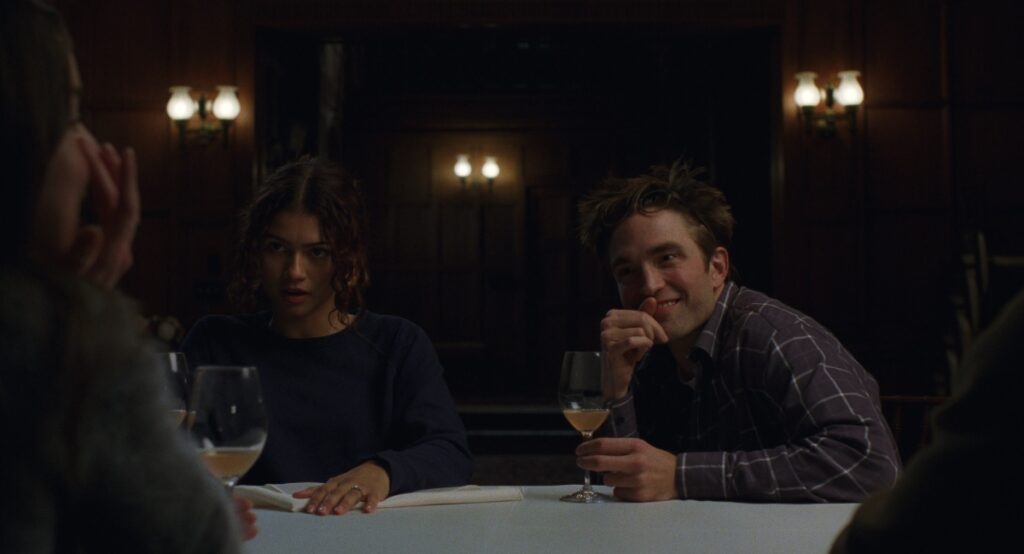
Charlie (Pattinson) and Emma (Zendaya) are a young, professional couple living in Boston. Their story seems to come straight out of a romance novel. With all the awkwardness and tenderness of first love, they appear to be sailing smoothly toward the altar. The vows are being written, and the maid of honor has been chosen. Everything is meant to be perfect, or at least carefully choreographed. However, tension rises during the rehearsal dinner when the couple and their friends, Mike (Mamoudou Athie) and Rachel (Alana Haim), play a drunken game that leads to self-destruction. Each of them takes a turn confessing the worst thing they have ever done. When Emma’s turn arrives, the room falls dead silent. Her confession about something she planned in her early teens shatters the group’s dynamic and forces Charlie to question whether he really wants to marry her.
Without revealing too much, the central scandal also addresses sociopolitical issues deeply rooted in the American context. This may explain why non-American audiences have had a harder time fully engaging with the debate.
Cancel Culture and Moral Judgment in The Drama
“We’re constantly walking on eggshells over where our moral lines are drawn in our relationships — it feels very risky today to share deep truths with anyone,” says Borgli in the press notes. What could have been a bonding moment turns into a whirlwind of anxiety and fear. At its core, the film asks a simple question: What happens when we put love to the test? Do we take the easy way out, or are we willing to compromise our values to preserve it? In an age that pushes cancel culture to extremes, we tend to forget that people can change and learn from their mistakes. The Drama makes subtle yet clever use of foreshadowing. The two accidentally encounter the DJ they hired for their wedding in a compromising situation. This sparks a conversation about the inflexibility of moral values and hints at the challenges to come.
Borgli is no stranger to this dynamic; his previous films appear to explore similar themes. Similarly, though differently, Guadagnino‘s After the Hunt delves into the weight of ethics in interpersonal relationships. What connects Borgli’s work to the film is not a shared aesthetic but a shared concern. Both films depict morality not as a fixed framework but as something unstable, constantly reshaped by intimacy. Borgli has also cited the classic The Piano Teacher (2001) by Michael Haneke as a key inspiration, reflecting his fascination with testing the limits of polite society. In Haneke’s film, Isabelle Huppert plays a piano instructor who reveals her masochistic desires to her student, thereby destabilizing their relationship. In different ways, both works reflect on how a personal confession can dismantle an entire relationship.
Music and Costume Design: How The Drama Builds Moral Identity
What factors shape moral deviance and our perception of it? Borgli tests the limits of moral elasticity, inviting an empathic response. However, he leaves little room to explore the unconscious biases that ultimately guide our moral compass.
Although the film leaves much of the characters’ social context unstated, Katina Danabassis‘s costume design effectively conveys their status.
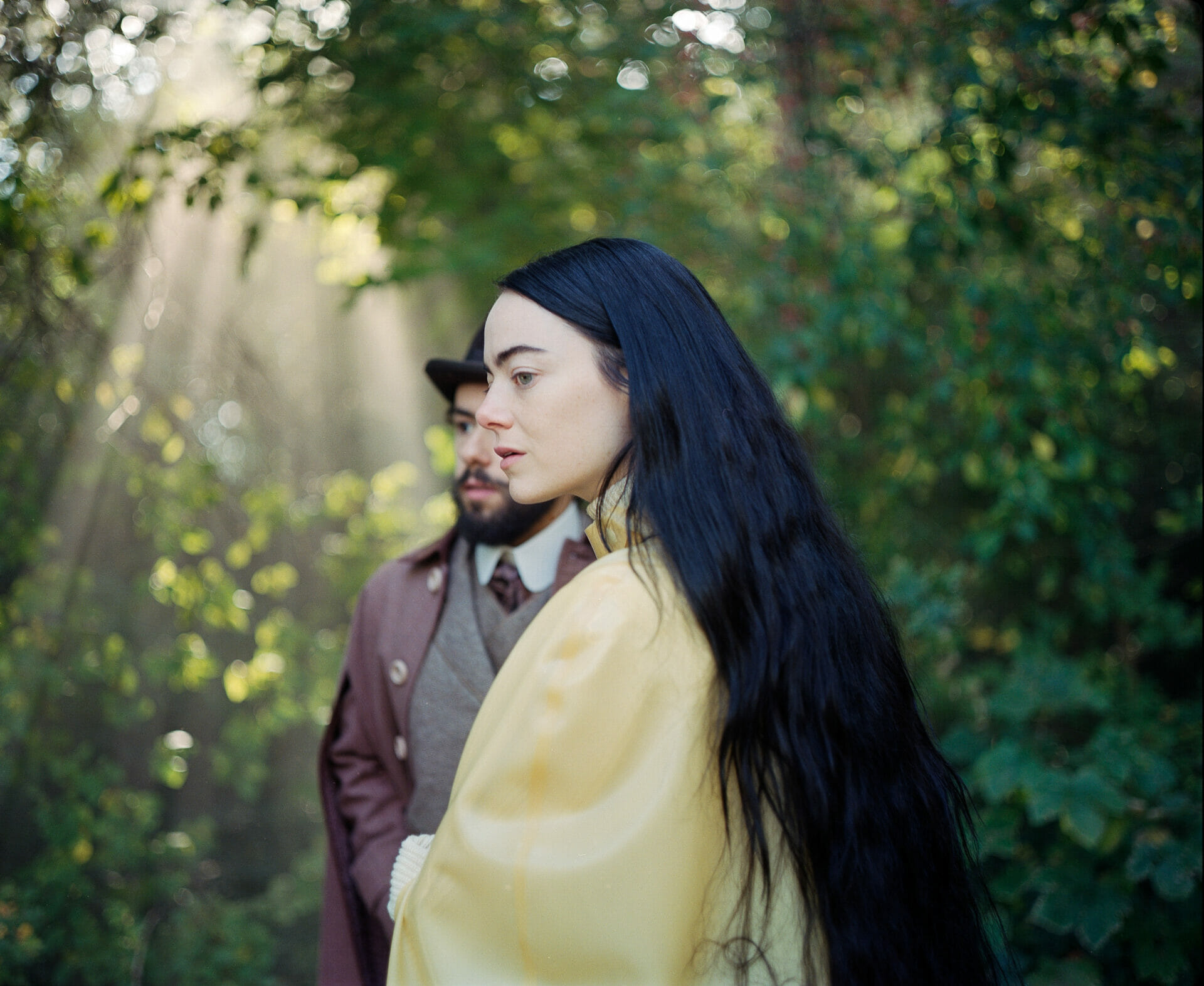
Every detail of the characters’ costumes is deliberate and contributes to their narrative identities. Despite the subtle hint of expensive jewelry, their clothing remains ordinary and repetitive yet always sophisticated and polished. This suggests that no one is exempt from having dark secrets they fear revealing. The costume designer, known for her work on A24 films such as Celine Song‘s Past Lives (2023) and Materialists (2025), adopts a contrasting aesthetic for the younger Emma. Her mall-punk-inspired clothing represents an index of the dangerous subculture she became drawn to.
In fact, the idiosyncrasies Emma displays are common to all the characters. However, she seems to be the only one who has learned from her experiences. The others unconsciously repeat the same questionable patterns from their past.
The film’s soundtrack contributes to the storytelling, too. It acts as an off-screen narrator, guiding the viewer through the story’s development. Composer and songwriter Daniel Pemberton, known for his recent work on Phil Lord and Christopher Miller‘s Project Hail Mary (2026), composed an unsettling score that heightens the tension-filled atmosphere. Music plays a vital role in the relationship from its early stages. Emma and Charlie share a refined taste in niche genres, such as funk, blues, and folk. At times, music functions as a shared language between them. For example, Emma often plays “Inside Out” by Jesse Rae after an argument or in moments of discomfort. This creates a dreamy mood that contrasts with the harsh reality the characters face. However, the soundtrack is not overbearing; it leaves ample space for silence and quiet contemplation.
Set Design and Space: The Architecture of Emotional Control
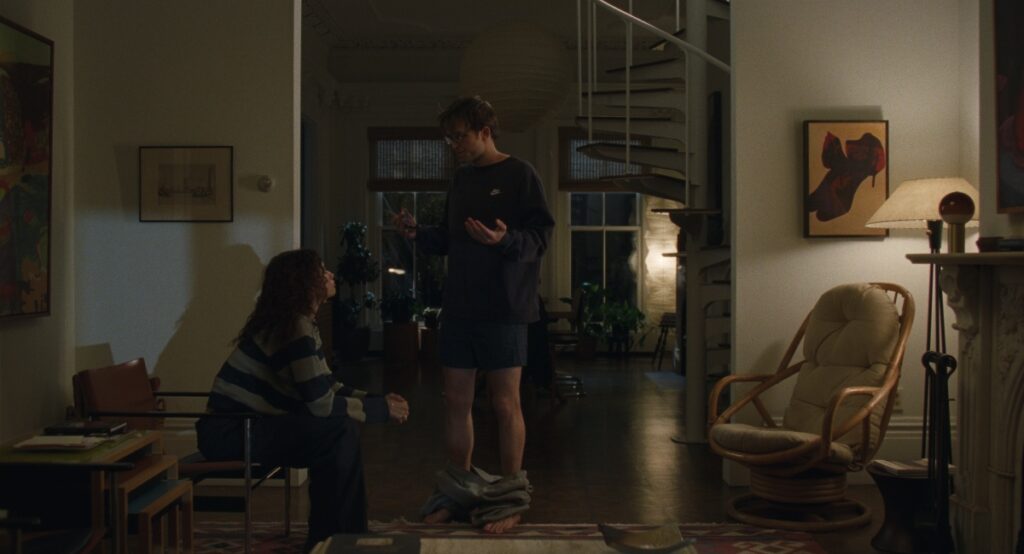
Production designer Zosia Mackenzie believes that a house is more than just a living space; it is a psychological landscape. Working closely with cinematographer Arseni Khachaturian, Mackenzie crafts settings that shape the action and provide a visual and emotional backdrop for Emma and Charlie’s evolving relationship. The late 19th-century townhouse is indeed imbued with layers of meaning. Its wide windows allow natural light in, which Khachatian prefers to artificial lighting, making the story feel more authentic, and painfully so. Large rooms and spiral staircases transform the house into a cavernous space where the echo of silence is amplified.
Thrifted design pieces sit alongside Lil Wayne posters, subtly illustrating the transformation Emma has undergone. This contrast feels deliberate, reflecting a life shaped by shifting identities. Mismatched chairs and lamps further emphasize this idea. Nothing quite aligns, and this imbalance mirrors the couple’s struggle to fully inhabit each other’s worlds.
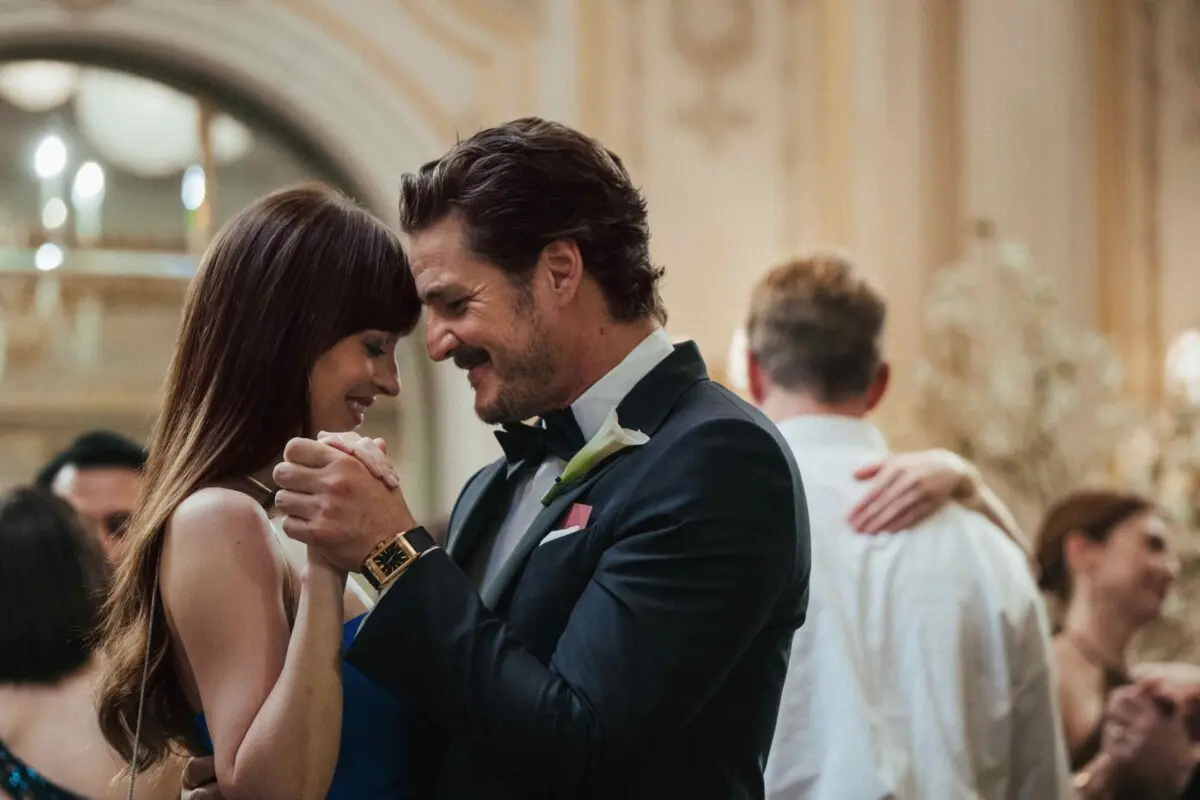
Once the setting shifts to the wedding venue, everything changes. The venue’s oakwood floors and plastered ceilings give it an elegant yet dark tone. This makes it the perfect stage for Emma and Charlie’s portrayal of their “perfect” relationship. At the same time, tensions surface in the back rooms.
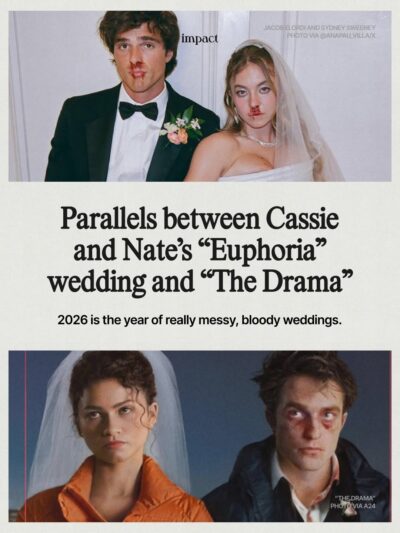
Sam Levinson stages a similar scenario in the final season of Euphoria, the controversial series starring Zendaya. Cassie and Nate’s wedding (Sydney Sweeney and Jacob Elordi), though initially lavish, quickly turns into a kind of carnival. All the characters gather in the same space, and their underlying conflicts begin to erupt. The scenes in Euphoria and The Drama share clear parallels. Most notably, there is the discomfort of the guests, the bride’s tense emotional state, and the groom’s violent breakdown into a bloody fistfight. In both cases, what should be a celebration turns into a memorable day, but for all the wrong reasons.
Editing and Memory: How The Drama Distorts the Past
Although the narrative centers on themes of forgiveness, redemption, and growth, Emma’s background remains underdeveloped. This is particularly true in relation to how her ethnicity may have made her more vulnerable to harmful paths. From a Black feminist perspective, film critic Brook Obie argues that “inclusivity in filmmaking goes beyond casting; it is about creating characters with depth who are rooted in reality.” The film avoids confronting the question of white privilege directly. Emma is swiftly judged for something she “almost did,” while the audience is encouraged to empathize with the other characters.
Overall, Emma’s character arc does not stand on its own. Instead, it serves as a means of emotional causality, shedding light on Charlie’s character and his relationship with her. It’s no coincidence that Ari Aster is one of the film’s main producers. Aster is best known for his work on Hereditary (2018) and Midsommar (2019), and he has established himself as a defining figure in the cinematic portrayal of the collapse of modern relationships. As in Midsommar, The Drama suggests that relationships are strained not only by external conflict. More often, they erode from within, due to unresolved histories and past trauma.
Emma’s story jumps quickly between the past and the present without clear transitions or explanations. The editing plays a crucial role in creating this effect. Editor Joshua Raymond Lee crafted the film’s distinctive tone, giving it a sense of discomfort laced with dark humor. Lee approached post-production with a playful sensibility, juxtaposing contrasting scenes and using abrupt cuts to modulate tension. This keeps the audience on edge, never quite sure what to expect next.
As Lee himself claimed, “Flashbacks in film can be an accurate representation of the past, but we wanted to treat them, in the edit, more like the way we move in and out of memories”. This is evident in scenes where Charlie appears in one frame with present-day Emma and in the next with her younger self. Past and present coexist, creating a deliberate temporal dissonance that is both alienating and comedic. The audience is left questioning whether they are witnessing reality or a fever dream.
Does The Drama Deliver on Its Moral Ambition?
In an era when romcoms are regaining popularity, The Drama deliberately moves against the grain. Emma and Charlie’s relationship is far from ideal. Instead, it is fragile and unstable and could fall apart at any moment. Charlie’s attempts to understand his fiancée’s motives are limited. There are gaps in her emotional history that he cannot fully interpret.
Today, it seems that there are fewer gray areas, and everything, including feelings, tends to be polarized. Borgli explores the devastating aftermath of discovering a partner’s deepest secret, prompting the audience to reflect on what they are willing to forgive in the name of love. Ultimately, the film raises questions about the hypocrisy of personal boundaries—what wrongs we choose to excuse, and what those choices reveal about us.
As a work of cinema, The Drama leaves many threads unresolved. It addresses ethical and social issues in a light, almost superficial way, sparking debate among audiences. However, this ambiguity may be intentional. Posing moral dilemmas seems to be the new frontier of modern romance, leaving much of the interpretive and emotional work to the viewer.
The film’s open ending brings the characters’ story full circle, leaving viewers to wonder: Are they truly willing to start over, or are they trapped in unresolved patterns?
Tag