 Collections
  Magazine
  Exhibitions
  ITA version












Artistic Director Antonio Cioffi and Board Member Paolo Paggi Reflect on the Festival’s New Directions
The 2026 Hangartfest, the annual international contemporary dance festival held every September in Pesaro (Italy), closed on 20 September after two weeks and 26 events, including 11 debuts and Italian premieres, spread across six venues in Pesaro and the surrounding area. The final performance, Viktor Černický’s PNEU, sold out. The story goes well beyond the numbers.
For Hangartfest, the September program is the visible part of a much longer process. It grows through residencies, co-productions, conversations with artists, work with audiences, collaborations with other disciplines and an ongoing search for places where contemporary dance can create a different relationship with the people watching it.
That makes the festival itself an evolving project.
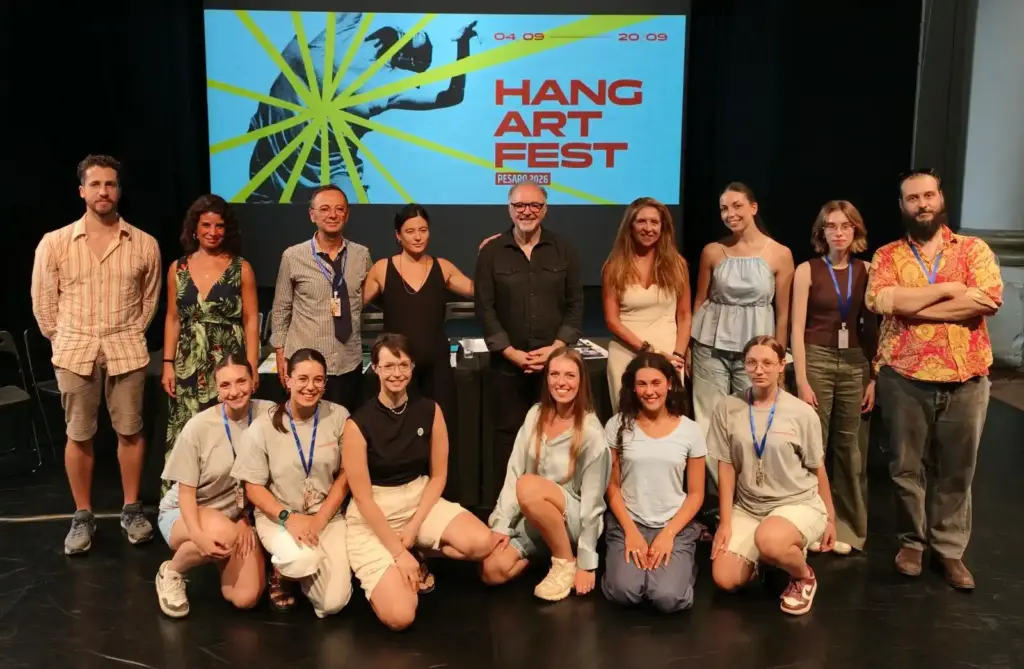
We spoke with artistic director Antonio Cioffi and his longtime collaborator Paolo Paggi, the Artistic Board Member with Masako Matsushita, about what has shaped Hangartfest over the years, what they are seeing in the new generation of artists, and where the festival is heading as it approaches its 25th anniversary.
Twenty-three years of research and protecting talents
When asked which element has remained constant since the beginning, the answer is crystal clear. Hangartfest has always made room for research and emerging artists.
In its early years, when the festival was independent, this was a necessity. Since 2018, when Hangartfest gained recognition and public support from national and local institutions, that commitment has taken on a broader responsibility. Public funding, Cioffi explains, also means creating concrete opportunities for artists working in Italian contemporary dance.
The result is a three-year model built around residencies, financial support, co-productions and performances. Artists are given time to develop their work and to return to Pesaro with new projects, allowing the festival to follow a creative journey rather than simply presenting its final result.
Among the artists who have gone through this process are Marta Bevilacqua, Pablo Rizzo, Michele Colturi and Lucia Mauri. Several of them share a background at the Paolo Grassi School in Milan, which Cioffi and Paggi describe as particularly relevant because of its broad approach to theatrical and artistic training. They also point out that the connection with Milan’s Brera Academy adds another layer. Visual artists, musicians, lighting designers and performers often meet within the same creative environments, producing collectives that naturally cross disciplinary boundaries.
That kind of exchange is central to Hangartfest’s idea of contemporary dance.
The festival welcomes different forms and aesthetics, but it is most interested in artists willing to experiment beyond choreography alone. Video, live cinema, multimedia, electronic music and other technologies have increasingly become part of the creative process.
Lucia Mauri’s work is one example. Her research involves cameras, live feedback and the relationship between the body and technological systems, bringing together movement and a visual language that extends beyond the stage.
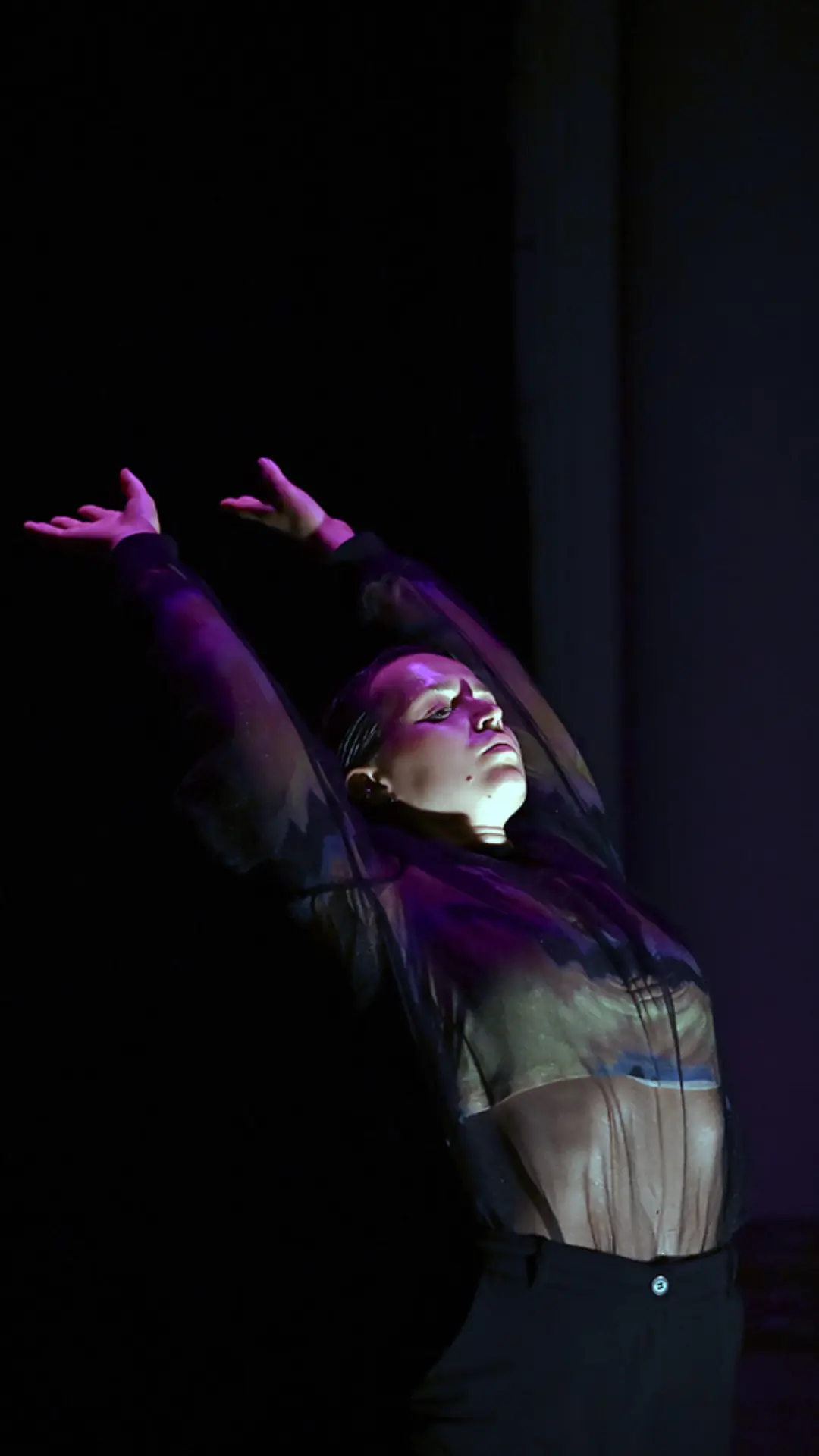
Lucia Mauri in FUORICAMPO @Hangartfest 2026
Cover image courtesy of Riccardo Cecchini
The themes of a generation living in the present
Starting from the evolution and hybridization of the project’s languages, we asked which themes are emerging in contemporary dance, and the conversation quickly moves towards identity, gender, transformation, women, the environment, and the relationship between bodies and power.
The return of myth is another recurring element.
One project developed through Hangartfest’s residency program, Michele Ifigenia Colturi’s Atteone, il Bosco, takes its starting point from the myth of Actaeon, the hunter transformed into a stag and eventually killed by his own dogs. The story becomes a way of exploring identity and gender violence.
For Cioffi and Paggi, this return to classical myths is particularly interesting because young artists are using ancient stories to address questions that belong firmly to the present. A similar phenomenon can be seen in cinema today, with Nolan’s The Odyssey.
They are living through these questions themselves, and their work reflects the contradictions and anxieties that surround them.
Gender and identity appear from different perspectives. Environmental questions emerge alongside personal experiences. The female body becomes a site of investigation. Some works are deliberately provocative, while others leave their future scenarios only partially defined.
The artists may offer an image, or a question without explaining exactly what the audience should think. The viewer is left with room to interpret and to imagine what comes next.
The same principle appears in other works presented during the festival, including a performance rooted in a ten-year research project on sexuality and motherhood. A deeply personal experience becomes material for a language that can reach beyond the individual story.
For Hangartfest, this movement from the specific to the universal is where art finds its strength.
When contemporary dance asks the audience to work
This approach inevitably changes the role of the audience: it can no longer remain comfortable.
Cioffi and Paggi suggest that contemporary dance often asks something different from the spectator than a traditional narrative performance might. There may be no immediately recognizable story, no simple sequence of events, and no single interpretation waiting to be decoded.
A viewer might leave a performance thinking they have understood very little, only to find themselves processing it later. That delayed response is part of the experience.
Hangartfest has developed specific projects to encourage this kind of active spectatorship. Since 2018, the Marziani (Martian) group has followed the artists involved in the festival’s three-year co-production programs. Its members attend open rehearsals, speak with artists and follow the development of the work over time.
They are encouraged to look beyond whether they simply liked a performance. They can discuss lighting, costumes, scenography, movement, and the decisions that shape the work.
It is a way of making spectators more attentive to the creative process.
A similar philosophy informs Territori dallo sguardo, curated by Paggi and developed throughout the year. Starting with visual art, the program creates connections among painting, sculpture, cinema, dance and contemporary life.
The underlying question is simple: what changes when we change the way we look? And that question runs through Hangartfest itself.
Cameras capturing bodies and the quiet arrival of AI
Technology has become increasingly present in contemporary performance, and Hangartfest is following that development closely.
Video projections, immersive environments, live feedback, electronic music, and surveillance imagery have all appeared in recent work. The festival has also created Videobox, a space for artists experimenting with these forms in videodance.
One example is Giulia Roversi’s immersive theatre-dance work, which uses live streaming to place the audience inside the performance environment, such as in her HOME work.
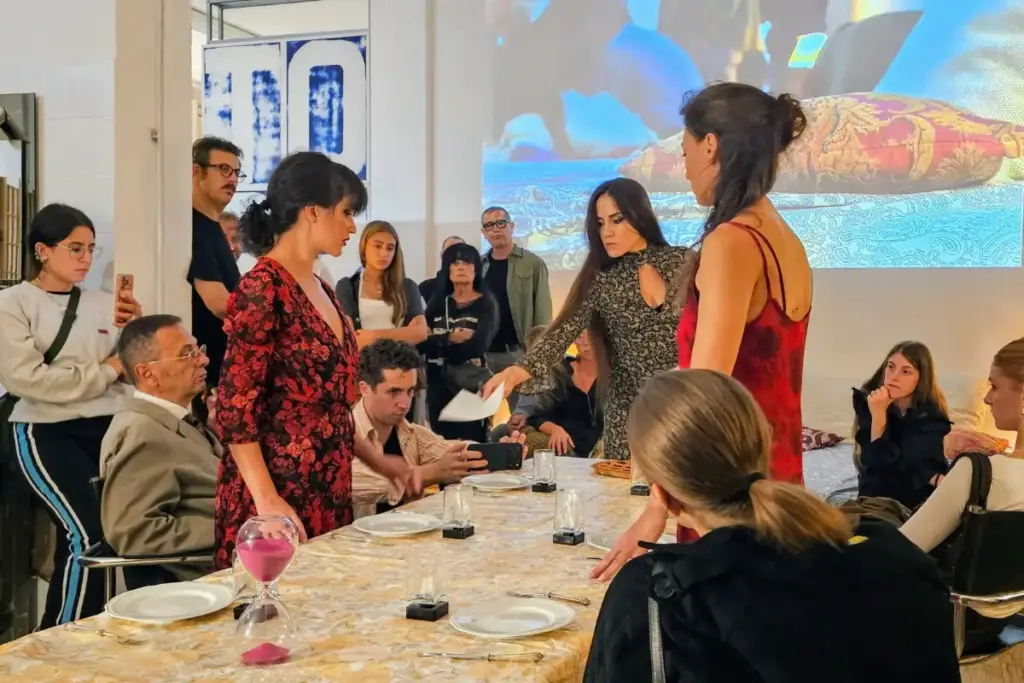
AI has not yet emerged as an explicit artistic theme within the festival’s program, but artists are already using it as a practical tool. In some cases, it can help solve technical problems or construct systems that would previously have required specialist knowledge.
The technology therefore enters the creative process. At the same time, contemporary artists respond to a world shaped by screens, social media, surveillance and technologically mediated images of the body.
Lucia Mauri’s research is particularly relevant here. Her work Fuoricampo explores the non-human alien gaze of surveillance cameras: machines continuously recording human beings without necessarily having a human observer behind the image. The effect becomes powerful when those images are placed alongside a live body. The camera records, while the performer moves, falls, breathes, and resists.
Different systems of looking begin to overlap, such as the technological gaze, the algorithmic gaze, the social gaze, and the gaze associated with power and gender.
But, here, for now, the body remains at the center of the question and of the works.
Dance meets cinema, poetry, music and fashion
Interdisciplinarity is one of Hangartfest’s defining values
Some projects are connected with poetry, such as Aïda Colmenero Díaz’s Trayectoria del polvo VII, others draw directly from cinema. There have also been experiments with small publications and self-produced fanzines, suggesting that a performance’s life can continue in editorial form.
Music has an especially important role. Some works are built around original scores, while others bring electronic music into direct conversation with classical instruments. In several projects, composers and musicians join the creative process from the beginning rather than being added once the choreography is complete.
Cinema also provides a rich source of imagery. Some performances consciously borrow from film language, including the surreal and comic atmosphere associated with Federico Fellini’s 8½.
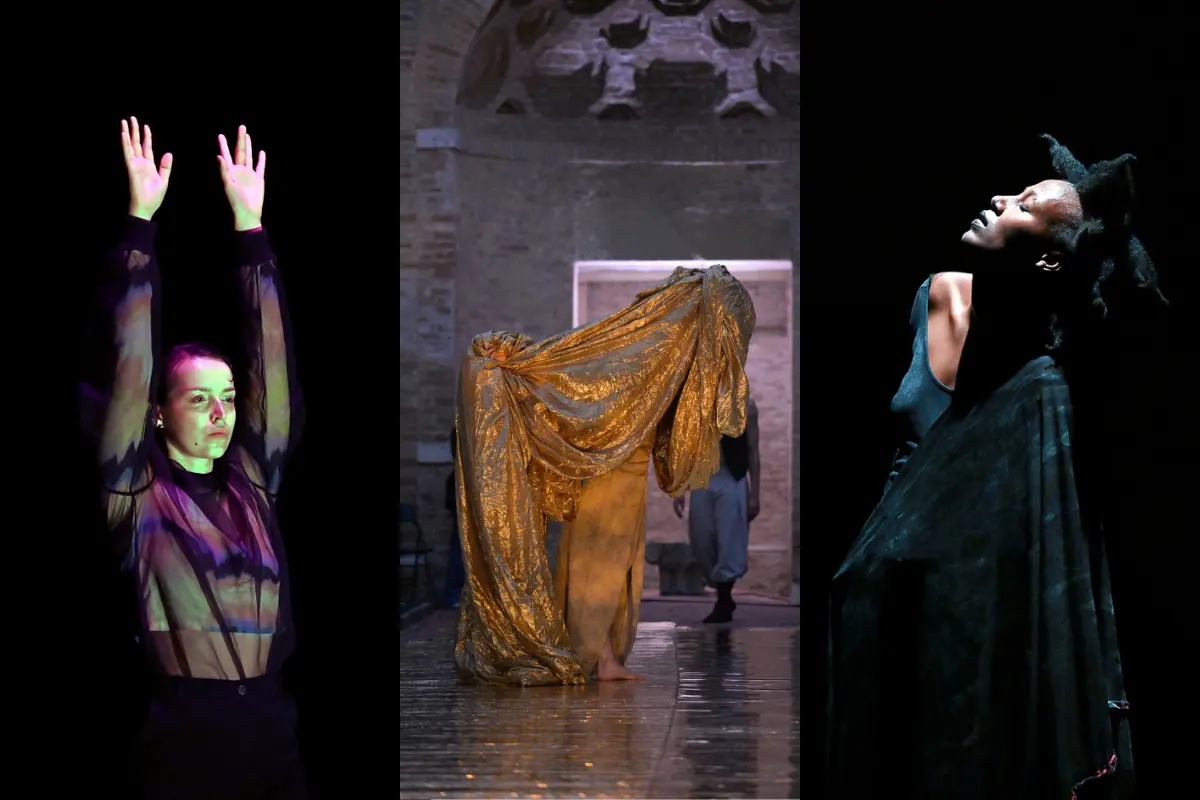
Then there is goldroom by Marco Valerio Amico e Rhuena Bracci, one of the performances that left the strongest impression on Cioffi and Paggi during the 2026 edition. The work brings together theatre, fashion and the visual language of the catwalk, while drawing on the imagery of The Shining to create a world of gold and carefully constructed appearances. The result is a performance that plays with the allure of perfection while letting something more unsettling emerge beneath it.
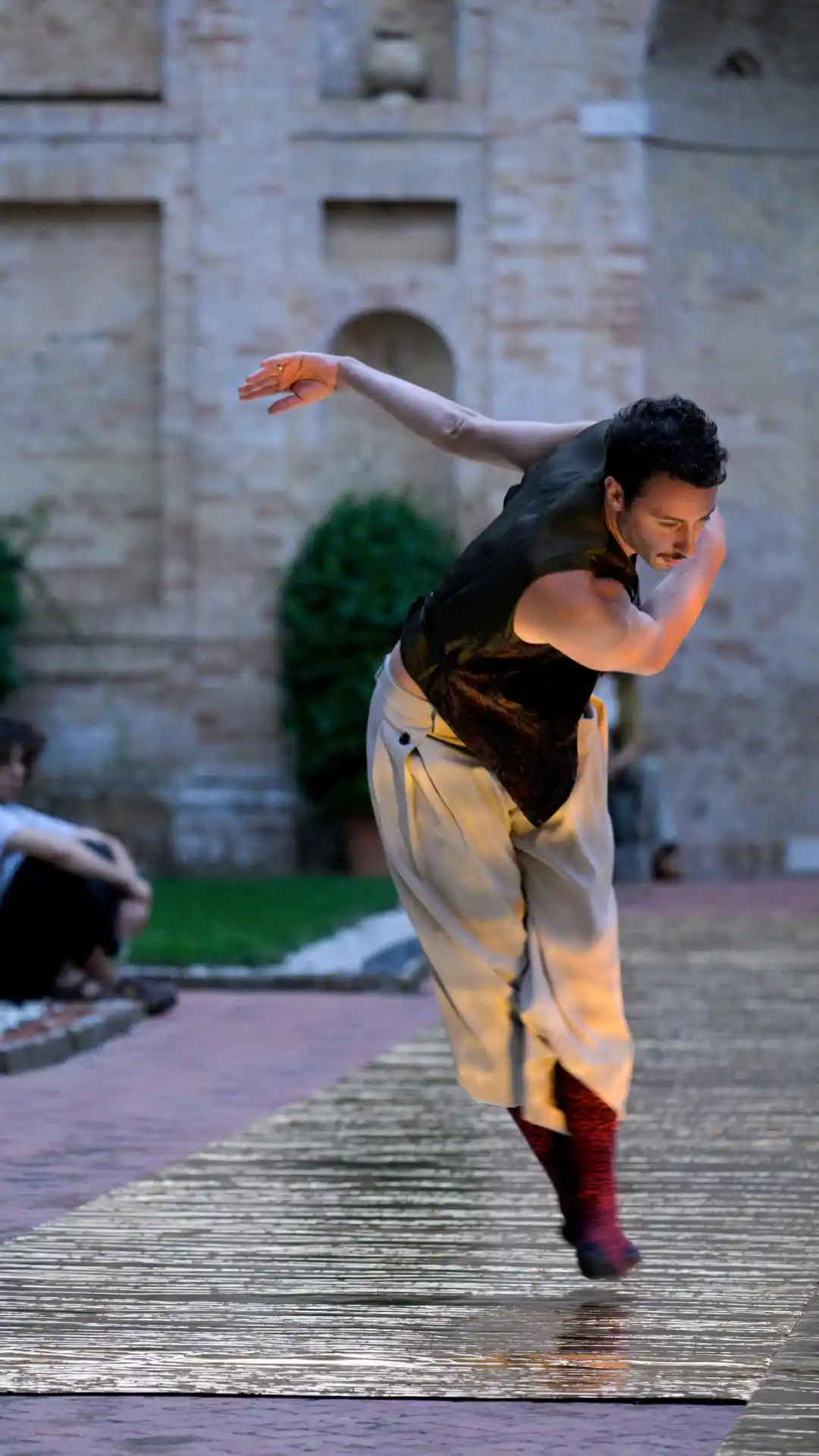
goldroom by Gruppo Nanou, performed at Villa Imperiale. Cover image courtesy of Maurizio Cocci.
The venue is a character in the performance
The festival was born in Pesaro, and La Maddalena remains its home. Its circular architecture creates an unusually close relationship between audience and performers, reducing the distance between stage and spectators, and creating a fundamental sense of proximity.
The festival has repeatedly chosen streets, courtyards, museums and intimate urban spaces where the audience can encounter the performer up close.
The relationship changes again when contemporary dance enters a historic building or landscape.
Villa Imperiale, used by the festival since 2023, offers precisely this possibility.
The enchanting Renaissance residence, with its gardens, frescoed rooms and surrounding park, creates a dialogue between contemporary performance and historical architecture. Performances can move through different areas of the complex, allowing the audience to experience both the work and the place from constantly changing perspectives.
The venue is a part of the choreography of perception.
As Cioffi explains in the festival’s closing statement, Hangartfest wants audiences to inhabit and physically feel what is happening, because changing the space, the distance, and consequently the point of view changes the relationship with the work itself.
That approach also explains the festival’s collaboration with the Fe.M Festival di Microarchitettura.
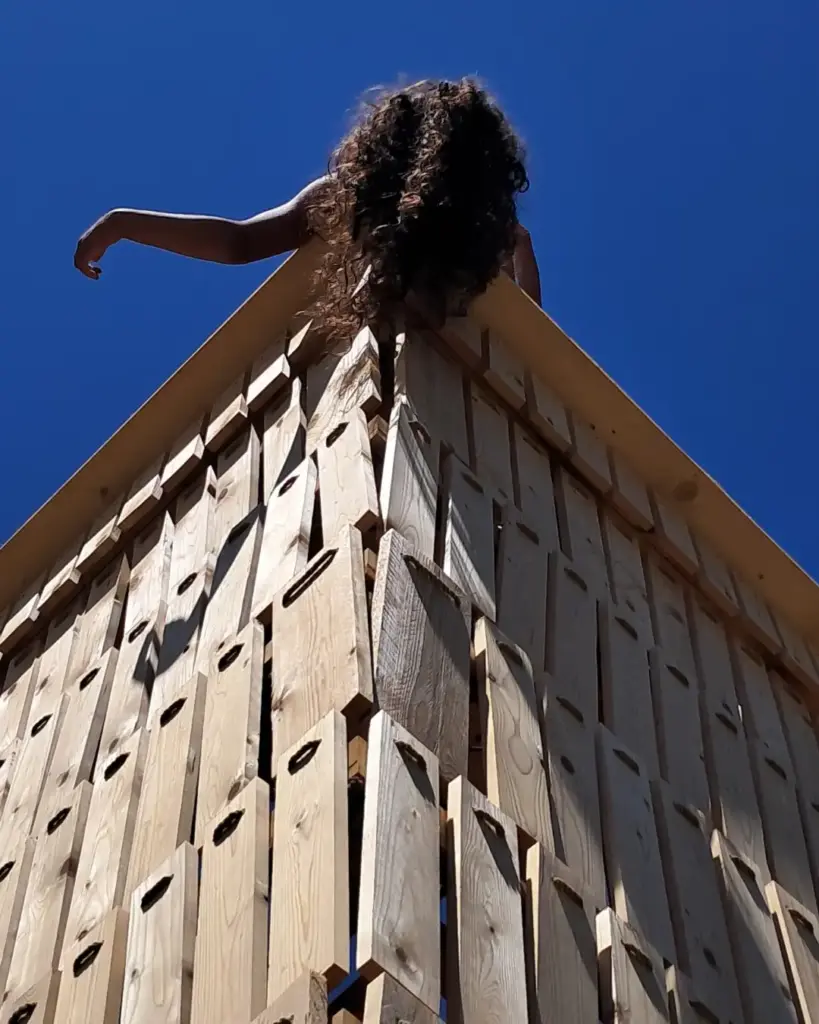
The partnership began in 2024, when Hangartfest encountered La timidezza delle chiome, a sculpture by architects Alice Cecchini and Roman Joliy, at Villa Imperiale. Inspired by the natural phenomenon known as crown shyness, the work became the starting point for a performance exploring the relationship between body and landscape.
The collaboration later extended into the surrounding territory, including Monte Illuminato in Lunano.
The connection is almost instinctive: microarchitecture is temporary, dance is temporary, while the landscape remains.
For Hangartfest, these encounters also provide a way to understand the wider territory around Pesaro as part of the festival’s identity.
From Pesaro to the villages: the next stage of Hangartfest and dance
The future of Hangartfest is already taking shape. The next edition will focus on Switzerland, exploring a country whose multilingual and multicultural identity includes Italian, French, German, and Romansh-speaking communities. The program will bring Swiss artists and related conversations into the festival, alongside roundtables and other events.
Then comes 2027, the final year of the current ministerial three-year cycle, followed in 2028 by the festival’s 25th anniversary and the beginning of a new cycle.
One of the strongest ambitions for that next phase is territorial expansion. Pesaro will remain central, but Cioffi and the Hangartfest team are increasingly interested in the province’s potential: places where artists could develop site-specific projects with local communities.
The idea is to create work specifically for a place and its people. This vision is closely connected to Hangartfest’s wider investment in artistic residencies
Through regional networks and the European GLARE project, the festival is developing new forms of collaboration around themes including gaze, inclusivity, fluidity of bodies, identity and memory. The aim is to create more opportunities for artists to work over time, with the technical and artistic support needed to experiment.
Artists and the risk
For Cioffi and Paggi, the residency allows artists to take risks. “They can try something that may not work. They can change direction. They can make mistakes before an audience ever sees the final result. That freedom is fundamental to artistic development”.
A three-year relationship also creates a particular kind of responsibility. An artist returns to the same festival and encounters an audience that remembers previous work. The relationship develops through time, and the artist has to respond to that memory.
And the festival takes a risk too. It invests in a process whose final outcome cannot be guaranteed.
One of the most distinctive aspects of Hangartfest is its willingness to embrace uncertainty as part of the creative process, protecting the artists’ freedom to experiment.
The images that remain after the festival
At the end of our conversation, we ask Antonio Cioffi and Paolo Paggi to choose one or more images from the 23rd edition to take home.
Neither hesitates for long. They both return to Lucia Mauri.
Cioffi remembers her body overshadowed by the scale of the monumental projected images: vulnerable and powerful at the same time, carrying a sense of hope and an image of the future. Paggi remembers another moment, when Mauri is on the floor, and a surveillance camera appears, showing a horse from a strange angle. The machine’s gaze and the human body suddenly occupy the same space, creating an unexpected and unsettling relationship.
Then there is goldroom.
For Cioffi, its performers seemed to belong to a time outside time: part illusionist, part juggler, part traveling performer, almost ghost-like as they moved through Villa Imperiale. They approached the audience without necessarily touching it, yet their presence felt physical.
Paggi remembers the golden world of goldroom differently, through its relationship with contemporary ideas of perfection and social media expectations. The performance creates a space that initially feels safe and seductive, almost like a fairy tale, while something more ambiguous gradually emerges beneath its surface. The live camera feedback, the golden catwalk and the carefully constructed images become part of an environment that is both reassuring and unsettling.
Another image joins these two: the central scene of Trayectoria del polvo VII. The embrace between the performer and the violinist, the union of two bodies through sound and movement.
Those three images point to where Hangartfest seems to be heading.
Vola, vola tu, dov’io vorrei volare
Verso un mondo dove è ancora tutto da fare
E dove è ancora tutto, o quasi tutto, da sbagliare
[Fly, fly away, where I would love to fly,
Towards a world where everything is still left to do,
And where everything, or almost everything, is still left to fail.]
Francesco Guccini, Culodritto.
Selected lines introducing the Hangartfest 2026 program.
It is this freedom to fail that defines the festival’s long-term vision. As Artistic Director Antonio Cioffi explains: “This is precisely what we do: we give young artists the freedom to make mistakes, because that process must be an essential part of their journey. That is why we welcome them for a three-year period to allow room for real growth and evolution, without burdening them with overwhelming expectations or responsibilities. There is a cultural risk in this approach, embraced both by the festival as a promoter of performance and culture in the region, and by the young artists themselves, who engage with the very same audience for three consecutive years”.