 Collections
  Magazine
  Exhibitions
  ITA version













Hamnet Review: How Chloé Zhao Turns Shakespeare's Tragedy Into a Meditation on Grief


Runtime
Nothing transcends the boundaries of life quite like art. Academy Award–winning director and record-holder Chloé Zhao understands this well. Following her award-winning 2020 drama Nomadland, the Asian filmmaker has returned with a new adaptation of Maggie O’Farrell‘s 2020 novel Hamnet. Zhao collaborated with O’Farrell on the screenplay, delivering a rendition that is both faithful and devastating—a cinematic reimagining of the origins of William Shakespeare‘s Hamlet.
Hamnet shifts the focus to Agnes (Jessie Buckley), William Shakespeare’s wife, whose inner life proves to be as extraordinary as her husband’s. Without the monumental aura surrounding his character, Shakespeare (Paul Mescal) is portrayed as an up-and-coming playwright and a grieving father whose loss of his son, Hamnet, inspires his work. Through this portrayal, Zhao reframes the narrative from a literary legacy to an intimate, visceral experience of grief.
Produced by Steven Spielberg (Amblin Entertainment) and Sam Mendes (Neal Street Productions), among others, Hamnet premiered at the 52nd Telluride Film Festival on August 29, 2025. The film impressed critics and audiences and is a frontrunner this awards season, having received eight nominations for the 98th Academy Awards.

- From Novel to Film: Chloé Zhao’s Adaptation of Hamnet
- Nature and Symbolism in Hamnet
- Hamnet’s Death and the Tragedy Behind Shakespeare’s Hamlet
- Grief and the Healing Power of Art in Hamnet
- Jessie Buckley and Paul Mescal in Chloé Zhao’s Hamnet
- The Making of Hamnet: Cinematography, Score, and Production
- Awards, Reception, and Critical Response to Zhao’s movie
From Novel to Film: Chloé Zhao’s Adaptation of Hamnet
As a natural extension of O’Farrell’s work, Chloé Zhao brings the audience to 16th-century Stratford-upon-Avon, William Shakespeare’s hometown. While researching her novel, O’Farrell collaborated with the Shakespeare Birthplace Trust to reconstruct Anne Hathaway‘s life using the limited historical evidence available. By naming her Agnes, the author breathes new life into a figure who has long been confined to the margins of history.
Zhao preserves and deepens this perspective. Imbued with a distinctly female gaze, the story refuses to portray Agnes solely as “the wife of the great playwright.” Instead, she is portrayed as a complex, commanding, and almost mystical presence. Rather than relegating her to a supporting role, the story highlights her strength, unapologetic individuality, and vulnerability. Zhao captures Agnes’s gestures and expressions, consistently framing her at the center of the screen, allowing this meaning to emerge. Agnes is resilient and unapologetic, never confined to the domestic space as a symbol of limitation. Instead, the framing grants her an assertive presence and reinforces her agency.
In contrast, Shakespeare’s name is never spoken in O’Farrell’s novel. Instead, he is defined by his familial roles as a husband, father, and son, which ground him in the human realm. Hamnet translates this narrative choice into a visual language that runs through almost every frame.

Hamnet has received mixed reviews. Some critics say it could become a modern cult classic of contemporary cinema, while others argue that it feels artificial and emotionally manipulative. “Crafting something designed to make you cry is not proof of expert filmmaking,” wrote The Independent film critic Patrick Sproull in a recent review. According to Sproull, Zhao has toned down the artistry shown in her debut production, crafting a film designed to appeal to a wide audience, where the acting becomes overly explicit and histrionic. In striving to elicit a deeply emotional reaction from the audience, the film risks slipping into voyeurism. However, since Hamnet is the result of a creative partnership between Zhao and O’Farrell, the film’s theatricality appears to be an intentional stylistic choice, as if they wanted the entire film to feel like a stage play.
Nature and Symbolism in Hamnet
The film opens with an overhead shot of Agnes lying among the gnarled tree roots. She appears suspended in the forest as if a hawk had caught her mid-flight. The rustling leaves and snapping twigs seem to speak to her, giving the natural surroundings a mysterious and almost sentient presence. From the outset, nature appears as a womb, a living entity with a beating heart and pulsing veins. Agnes has a reputation; people whisper that she is the daughter of a forest witch who gave her mysterious powers and an unsettling aura. After her mother’s death, a farming family raised Agnes and her brother Bartholomew (Joe Alwyn), but they always regarded her as an outsider.
She meets William in a place that feels like a timeless Eden. They run through the trees, laughing and out of breath, free to be themselves. Sheltered by the forest, their love remains untouched by their families’ disapproval. William is a struggling Latin tutor and the son of a glovemaker with a gift for writing. She is a witch who can see into a person’s soul with a mere touch.
Though Hamnet avoids the stiffness of a traditional period piece, the costumes still play a key role thanks to Malgosia Turzanska, the Academy Award–nominated costume designer. William wears mostly blue, and Agnes wears red, creating a stark contrast between civilization and nature. Zhao frames these as masculine and feminine, respectively.
As the story unfolds, the characters’ costumes help them embody their roles and hint at their emotional evolution. Agnes’s dresses become worn and nearly ragged, and her husband’s clothing bears prominent slashes. It’s as if the grief and pain they carry are slowly becoming visible.

Hamnet’s Death and the Tragedy Behind Shakespeare’s Hamlet
The couple welcomes their first child, Susanna (Bodhi Rae Breathnach). Just as her late mother had suggested in a cryptic dream, Agnes gives birth to her in the forest. She later gives birth to twins, Judith (Olivia Lynes) and Hamnet (Jacobi Jupe). Judith is much weaker than Hamnet. William moves to London to expand his father’s business and pursue a career in theater. The family’s life changes forever when Hamnet dies during a plague epidemic.
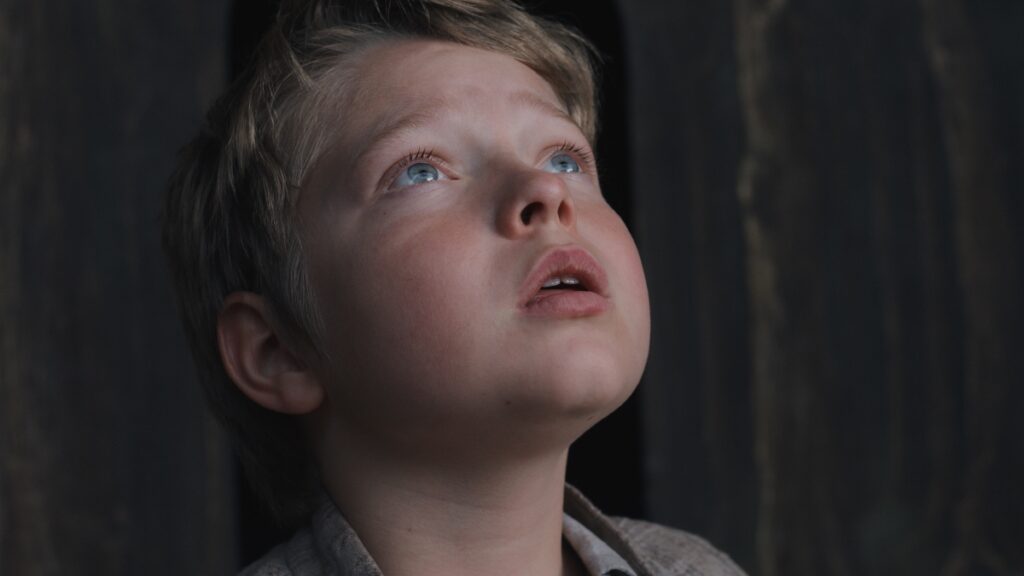
Agnes struggles to keep her son alive using the natural remedies she has always known. She feels the earth shatter beneath her feet when Hamnet falls motionless into her arms, finally succumbing to the laws of nature. In an unforgettable, unscripted moment, Jessie Buckley delivers a gut-wrenching performance, screaming in a way that feels both ancient and unbearably real. The long, close-up shot lingers on her face as the scream fades into silence, amplifying Agnes’s grief and drawing the audience into the overwhelming intensity of her pain. When we are confronted with the loss of a loved one, we are left aching and hollow. Zhao dives headfirst into this raw, chaotic grief, striving to give it meaning.
Grief and the Healing Power of Art in Hamnet
He has, Agnes sees, done what any father would wish to do, to exchange his child’s suffering for his own, to take his place, to offer himself up in his child’s stead so that the boy might live. She will say all this to her husband, later, after the play has ended, after the final silence has fallen, after the dead have sprung up to take their places in the line of players at the edge of the stage.
Maggie O’Farrell, Hamnet
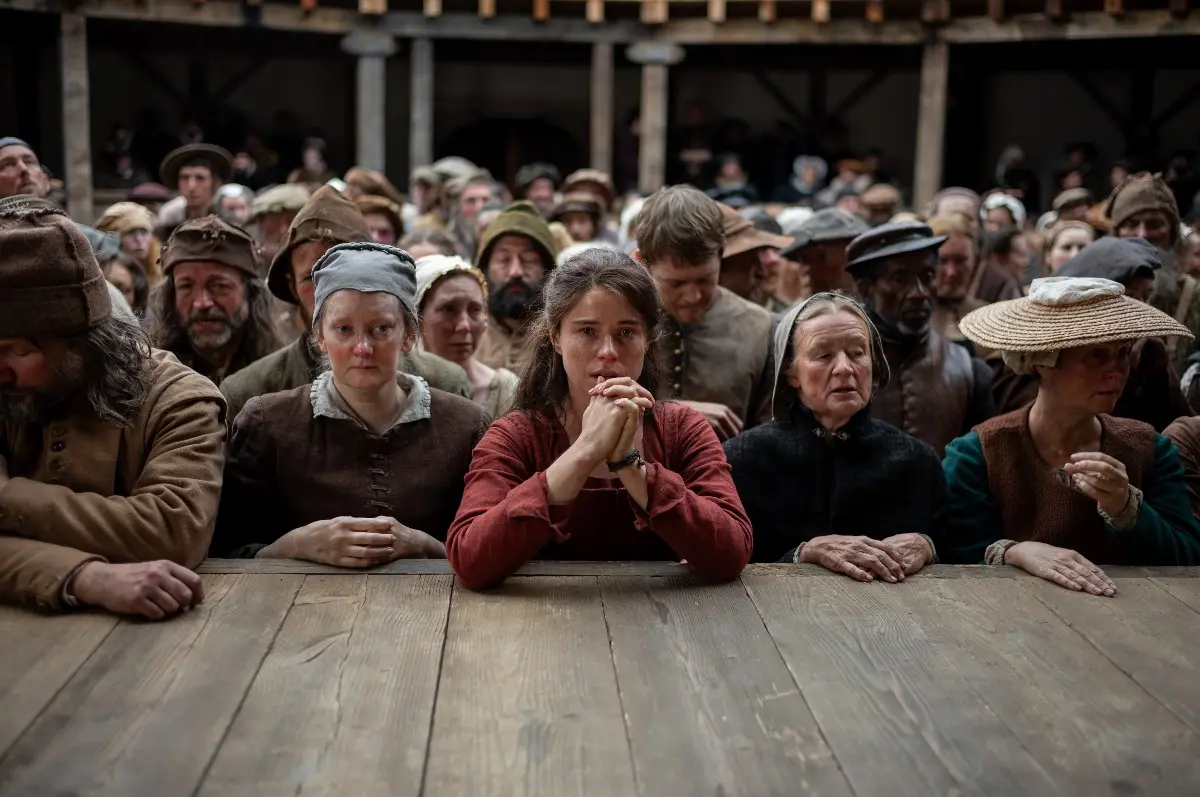
After tragedy strikes, the two live parallel lives, each grappling with grief in their own way. Once proud and fierce, Agnes stumbles through existence, unable to move forward. William, on the other hand, throws himself into his art, searching the audience for his son as if he might be there, just out of reach. The film reaches its climax when Agnes secretly attends the opening performance of Hamlet at the Globe Theatre. Initially, hearing her son’s name feels like a betrayal. Still, she eventually comes to see it as a tribute to Hamnet’s brief yet meaningful life and to the transformative, healing, and cathartic power of art.
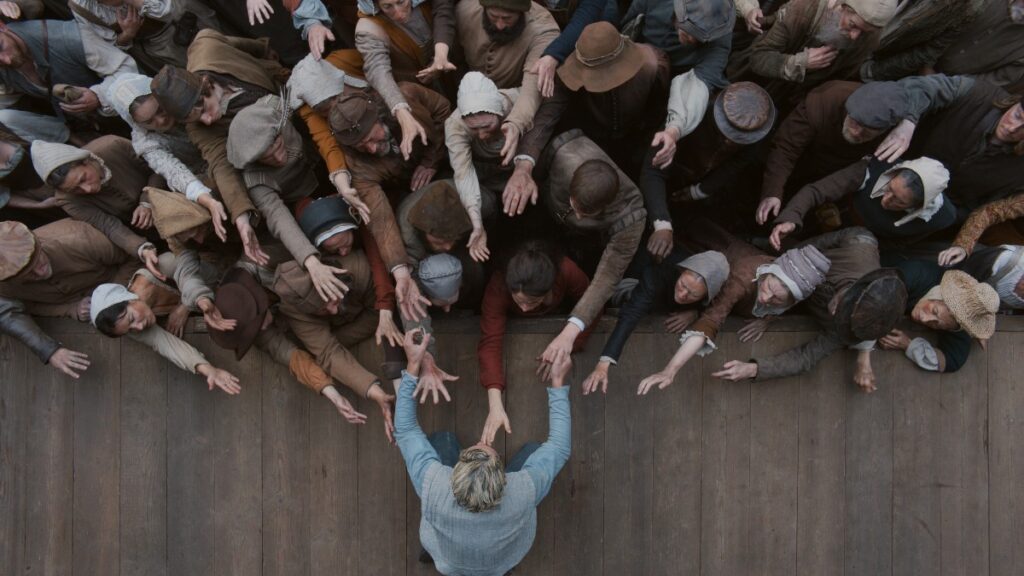
The theater piece finally unfolds as a collective experience. Jacobi’s older brother, Noah Jupe, plays Hamlet, who is overcome with emotion and staggers to the edge of the stage after being poisoned. Agnes reaches for his hand, and the entire audience gradually follows suit, even those in the upper balconies. When art vividly depicts life, the line between reality and fiction blurs. This final moment ignites an almost magical spark, transcending life and granting Agnes one last chance to say goodbye to her son.
The film retells the myth of Orpheus and Eurydice, in which a single glance conveys both profound love and inescapable parting. However, as the refrain “Look at me” is repeated by the characters, they subvert the tragic story’s destiny, revealing that loss need not be permanent and that art offers a means of coping with the grief it leaves behind.
Zhao’s direction adds another layer to the novel’s metanarrative structure. It contemplates how art can transform grief, preserve memory, and offer a space to reimagine life. This concept also emerges in Joachim Trier‘s Sentimental Value, in which the protagonist, a filmmaker, reconnects with his estranged daughter through his latest film. Struggling with love, loss, and unspoken pain, he writes a script that serves as the dialogue he lacks the courage to have in real life. Ironically, both films are contenders for the upcoming Oscars. Though they differ in style and context, both films highlight a broader cinematic fascination with how storytelling navigates memory and human connection. However, in a review for Roger Ebert, film critic Christy Lemire argued that Hamnet loses impact when compared side by side due to its overstated acting and didactic tone. She favored the subtlety and unsaid elements that dominate Trier’s film.
Jessie Buckley and Paul Mescal in Chloé Zhao’s Hamnet
With seamless talent and emotion, the cast of Hamnet brings to life a story that, despite being largely fictional and set centuries ago, feels profoundly universal. The story strikes every chord, especially the most painful ones. Despite his young age, Jacobi’s performance reveals remarkable emotional maturity. As he exits the stage and walks into the woods, he once again enters the dark, cavernous void that has haunted the film since its opening scenes. This image evokes a Mother Nature who can give and take life, inspiring both terror and solace in times of grief. Hamnet’s presence lingers there, suspended among the blossoming trees of spring.
Buckley had already proven her talent through previous performances. Yet she surprised viewers once again by tapping into something almost primordial within herself to embody Agnes. According to Buckley, playing this role felt like the performance of a lifetime. “I was like, ‘This is the woman I’ve been looking for,'” she says in the press notes. “She is untethered, free, deeply curious, like a kind of rye whiskey, mischievous, hungry, beautiful soul of a woman. I just love her.”
On screen, Agnes appears as a daughter of the forest. Through Buckley’s artistry, she seems to be an extension of the natural world around her. Her movements are organic and instinctive, and her stillness carries equal intensity. Buckley’s magnetic physical presence anchors the character, communicating her strength and defiance. Conversely, Paul Mescal approached his role by reflecting on the psychological background that may have inspired Shakespeare to write Hamlet. His performance is introspective and restrained, with few visible outbursts. This subtlety invites viewers to engage with the character’s inner struggle. Their contrasting yet complementary styles create a cinematic dialogue that reinforces the tension at the film’s heart.
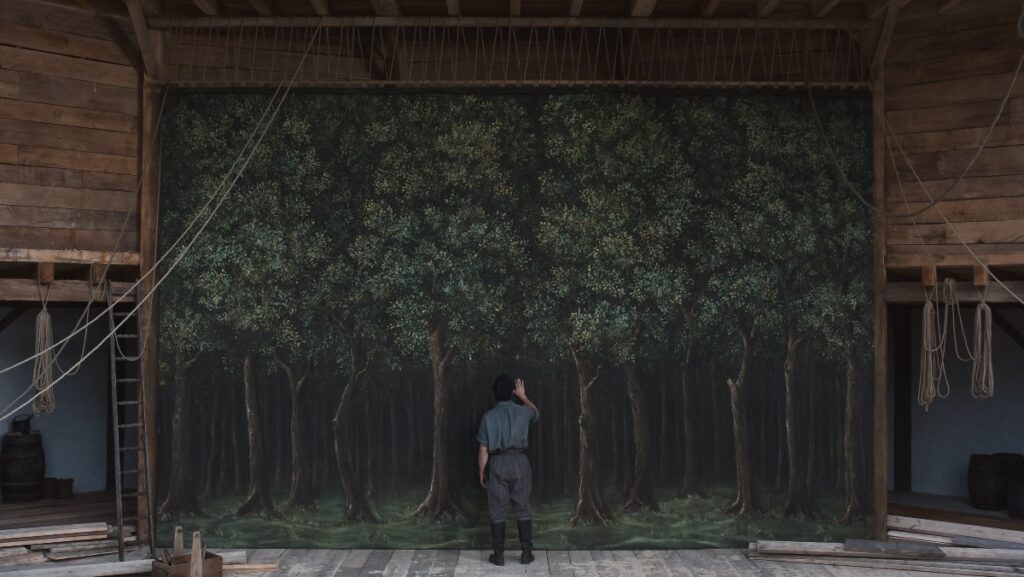
During the 46-day shoot in the UK, the cast developed a family-like bond, which contributed to the authenticity of their final performance. To celebrate, they danced together to Rihanna‘s “We Found Love” on the last day of filming. A video of the dance went viral.
The Making of Hamnet: Cinematography, Score, and Production
Zhao’s collaboration with Polish cinematographer Łukasz Żal shaped the film’s visual identity. Every element of the film is designed with symmetry and poise. The film envisions the world as a comprehensive stage where characters can enter and exit unexpectedly, all under the watchful presence of death. Żal’s lighting is simple yet evocative. He contrasts Agnes’s forest scenes, bathed in natural light, with candlelit interiors reflecting William’s overwhelming sense of suffocation. For this reason, they opted for digital filming to achieve sharper colors and amplify the film’s visual intensity.
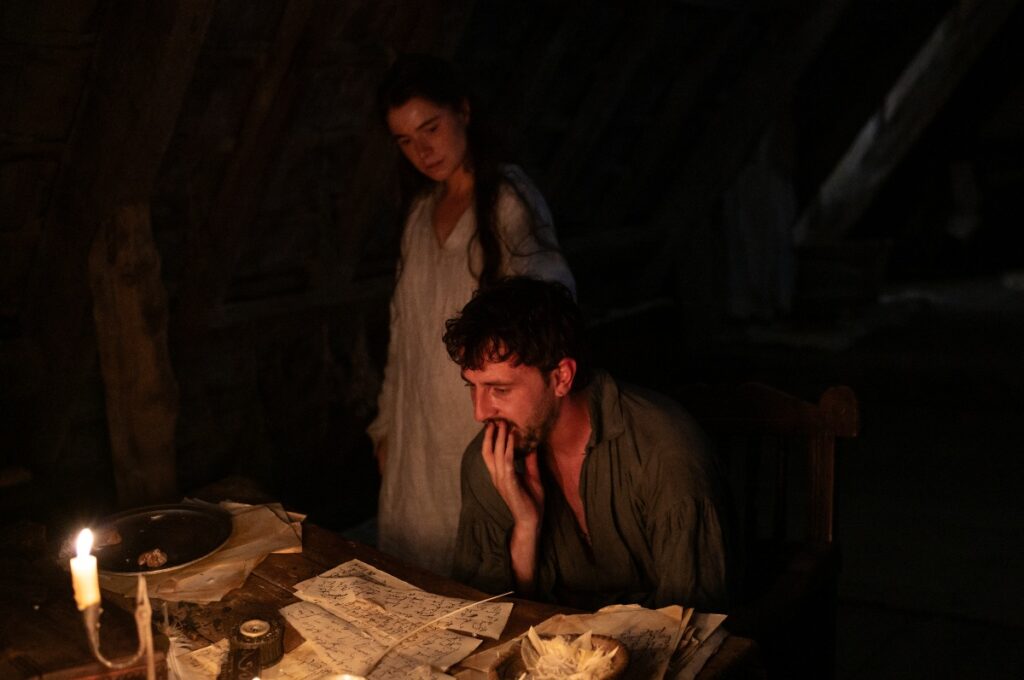
Additionally, the director collaborated with Academy Award–nominated composer Max Richter to create the haunting score for Hamnet. Drawing inspiration from the Elizabethan era, Richter composed a series of pieces he called “Color Studies.” These musical compositions accompany the story, underscoring its cycle of life and death. Zhao played the score on set to set the mood and help the actors tap into the emotional texture of their performances. The score primarily uses orchestral instruments and vocals to evoke deep, ineffable feelings that often cannot be expressed in words. Richter’s renowned track “On the Nature of Daylight” is featured in the film’s closing moments. With its quiet yet steadily intensifying crescendo, the music transforms Agnes’s grief into liberation as she lets out a bitter, aching laugh.
Awards, Reception, and Critical Response to Zhao’s movie
Hamnet received six nominations at the 83rd Golden Globe Awards, winning Best Motion Picture – Drama and Best Actress in a Motion Picture – Drama for Jessie Buckley. At the 79th British Academy Film Awards, the film won the BAFTA Award for Outstanding British Film, and Buckley won Best Actress in a Leading Role. With eight nominations, including Best Picture, Best Director, Best Adapted Screenplay, and Best Actress, the 98th Academy Awards are quickly approaching, and expectations are high.
When life feels confining, art is the perfect tool for enduring the passage of time. The film’s visuals, performances, and design come together to create a sense of magical realism. Zhao’s adaptation transports viewers to another world, guiding them on an intimate journey where pain meets beauty and life collides with death.
Art transforms private loss into a shared memory. Hamlet’s final words, “The rest is silence,” sound like a haunting plea or a curse. As the audience on both sides of the screen reaches desperately for him, they share a common grief and cross the fragile boundary between presence and absence.
Tag