 Collections
  Magazine
  Exhibitions
  ITA version













The Goldfinch by Donna Tartt | From Tragedy to the Next Generation of Lovers


Length
It’s astonishing how one small event can ripple through an entire life, altering its trajectory in ways we could never predict. Donna Tartt’s The Goldfinch (2013) illustrates this beautifully, showing how a seemingly random sequence of events can, in an instant, set off a chain reaction that irreversibly reshapes a person’s entire existence. Tartt’s masterpiece was awarded the Pulitzer Prize for Fiction in 2014, rightfully recognizing her exquisite storytelling, depth of character, and literary craftsmanship. The award cemented Tartt’s status as one of the most outstanding voices in contemporary literature. This path began with her impressive debut, The Secret History (1992), which already hinted at her inevitable success.
Like many ambitious works of art, this novel has elicited passionate and divisive responses. Some praise its emotional depth and witty prose, while others struggle with its drawn-out plot and meandering passages. Yet, following in Dickens’ footsteps, Donna Tartt’s brilliance and her talent for crafting vivid, enduring characters remain unquestioned. Since 2013, her enduring influence has kept readers both wistful and eager for her next creation.
- A Boy, a Bomb, and a Bird
- Invisible Threads: Between Belonging and Loss
- The Role of Art in The Goldfinch
- Bound Together
A Boy, a Bomb, and a Bird
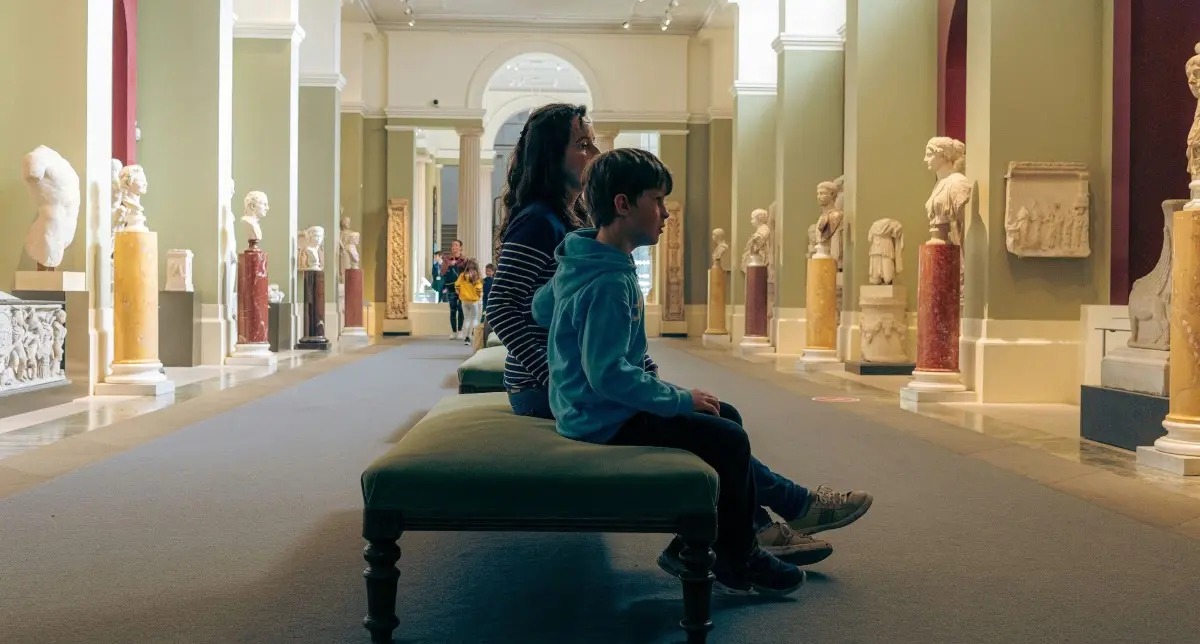
Theo Decker is only 13 when a terrorist bombing at the Metropolitan Museum of Art in New York shatters his life. This is the gripping premise of The Goldfinch by Donna Tartt, setting the stage for a page-turner from the very first chapter.
On their way to a parent-teacher meeting, Theo and his mother duck into the museum to escape the rain. There, she pauses in front of her favorite painting: Carel Fabritius’ The Goldfinch (1654, see below), a small masterpiece of a bird chained to its perch. What seems like a fleeting, ordinary moment becomes the pivotal event that will shape the rest of Theo’s life.
Amidst the crowd, Theo notices a young red-haired girl with an older man. An unspoken, magnetic connection sparks between them. Then, an explosion tears the museum apart in moments. In the chaos, Theo loses sight of the two strangers, but far more devastatingly, he loses his mother, Audrey, his anchor, and the very center of his world. While trying to escape, he stumbles upon the man he had seen before and witnesses his final moments. Before taking his last breath, the man gives him a ring and urges him to flee, taking The Goldfinch with him. Interestingly, painter Carel Fabritius died in a similar explosion, which wrecked much of his work. Among the few pieces to survive was The Goldfinch itself, lending a haunting resonance between art and reality.
The event sets in motion an odyssey that spans Theo’s lifetime, carrying him to unexpected places, both within the world around him and the depths of his own mind. With her lyrical yet subtly humorous style, Tartt ponders exquisitely human questions: How does one process grief and eventually move forward? Is blood the only bond that creates a family? Where do morality and necessity blur? And, finally, can art capture time and preserve it against the relentless passing of life?
Invisible Threads: Between Belonging and Loss
As long as I am acting out of love, I feel I am doing best I know how. But you—wrapped up in judgment, always regretting the past, cursing yourself, blaming yourself, asking ‘what if,’ ‘what if.’ ‘Life is cruel.’ ‘I wish I had died instead of.’ Well—think about this. What if all your actions and choices, good or bad, make no difference to God? What if the pattern is pre-set? No no—hang on—this is a question worth struggling with. What if our badness and mistakes are the very thing that set our fate and bring us round to good?
The Goldfinch, Donna Tartt
Son of a devoted mother and an absent father, Theo grapples with what family truly means. In the wake of loss, the foundations of his childhood crumble, forcing him to search for belonging in unlikely places. Friends become brothers, strangers stand in for parents. Affection and circumstance, more than blood, lay the foundation of a home.
From living with the Barbours, a dysfunctional family, Theo drifts from home to home like skipping stones, leaving behind the city he loves, New York, and the lingering, ghostly presence of his mother. Eventually, he moves to Las Vegas to live with his father, his younger girlfriend Xandra, and their dog, Popper, whose name foreshadows the dissolute lifestyle they lead.
A man absorbed in his own indulgences, Theo’s father offers him little guidance or stability. This period of Theo’s life is marked by displacement and a yearning for connection as he navigates a household that is both chaotic and hollow. It is during this time that Boris enters his world in a transformative way. Brash, fearless, and morally ambiguous, Boris is a stark contrast to Theo’s cautious, introspective nature.
Much like the characters in A Little Life by Hanya Yanagihara (2015), Theo quickly learns the dangers of growing up, and yet, the quiet comfort of having someone he can count on. Their friendship is intense and complicated, forged through mischief, rebellion, and a shared understanding of loss and trauma. Although Boris can be quite reckless and destructive, he also provides Theo with a sense of safety and connection that he cannot find in his fractured family life.
The Role of Art in The Goldfinch
How can I see so clearly that everything I love or care about is an illusion, and yet – for me, anyway – all that’s worth living for lies in that charm?
The Goldfinch, Donna Tartt
In Donna Tartt’s The Goldfinch, art is never merely decoration, but a witness to life, memory, and loss. Through the delicate goldfinch, Tartt explores how beauty can endure even amid tragedy, reflecting the fleeting yet extraordinary quality of existence. In one of her rare interviews, Donna Tartt herself reveals that art can serve as a powerful tool for understanding both ourselves and the world around us, offering a lens through which we can examine our inner lives and the meaning we attach to our lived experiences.
It is no coincidence that much of Theo’s life revolves around art and people who have made it their profession. By a strange twist of fate, Theo’s path leads him back to Hobie, a furniture restorer and antiques dealer. Somewhat of a mythical figure, with encyclopedic knowledge of all things artistic, Hobie welcomes him warmly into his home. There, Theo steps into a mesmerizing world crafted from wood and imbued with old objects that, under Hobie’s touch, seem to come alive once more. It is also in Hobie’s house that Theo remains close to Pippa, the red-haired girl who, like him, survived the explosion. For Theo, she becomes both a mirror of his own grief and a distant, unattainable ideal of love.
Bound Together
Despite the numerous twists and turns the story takes, Fabritius’ painting remains a constant: the North Star that weighs on Theo yet also propels him forward, guiding his every step. It becomes a mirror of his own trauma, a silent depiction of the profound grief he has yet to overcome, a symbol at once of eternity and of confinement. The little bird, bound to its perch, reflects Theo himself: still chained to the day of the explosion, clinging desperately to the memory of his mother.
That tragic event reshaped the course of his entire life, and every tentative step he takes forward pulls him ten steps back, trapping him in an endless circle that always returns him to his childhood. The cased painting is lost, recovered, nearly destroyed, then found and lost again, a chase that feels both endless and unpredictable, yet one Theo follows with unquestioning devotion. He has forged his identity around it and will do anything to protect it, as if losing it would strip his life of all meaning.
A Mirror of Life and Art
And I add my own love to the history of people who have loved beautiful things, and looked out for them, and pulled them from the fire, and sought them when they were lost, and tried to preserve them and save them while passing them along literally from hand to hand, singing out brilliantly from the wreck of time to the next generation of lovers, and the next.
The Goldfinch, Donna Tartt
Donna Tartt tells a story so unique that it speaks to the soul of every reader. With characters who feel vividly real, readers inevitably form an empathetic bond and genuinely hope that fate will reward Theo for the trauma he has endured. Through Tartt’s exquisite prose, we witness how beauty can survive chaos, how human connection offers solace even in the darkest moments, and how art itself becomes a vessel for both memory and hope.

The novel’s impact extended to its 2019 film adaptation directed by John Crowley, which brought the story and the iconic painting to the screen, inviting a broader audience to experience Theo’s journey. Tartt teaches us that, as much as we strive to find meaning in the events of our lives, sometimes we must surrender to the inexplicable and embrace every ray of sunlight that comes our way, rather than be constrained by what we believe should define us. Ultimately, she reminds us that life, like the goldfinch, is at once delicate and resilient, imprisoned, yet capable of soaring.
Tag