 Collections
  Magazine
  Exhibitions
  ITA version













Paul Thomas Anderson’s One Battle After Another | An Atlas of American Discord


Runtime
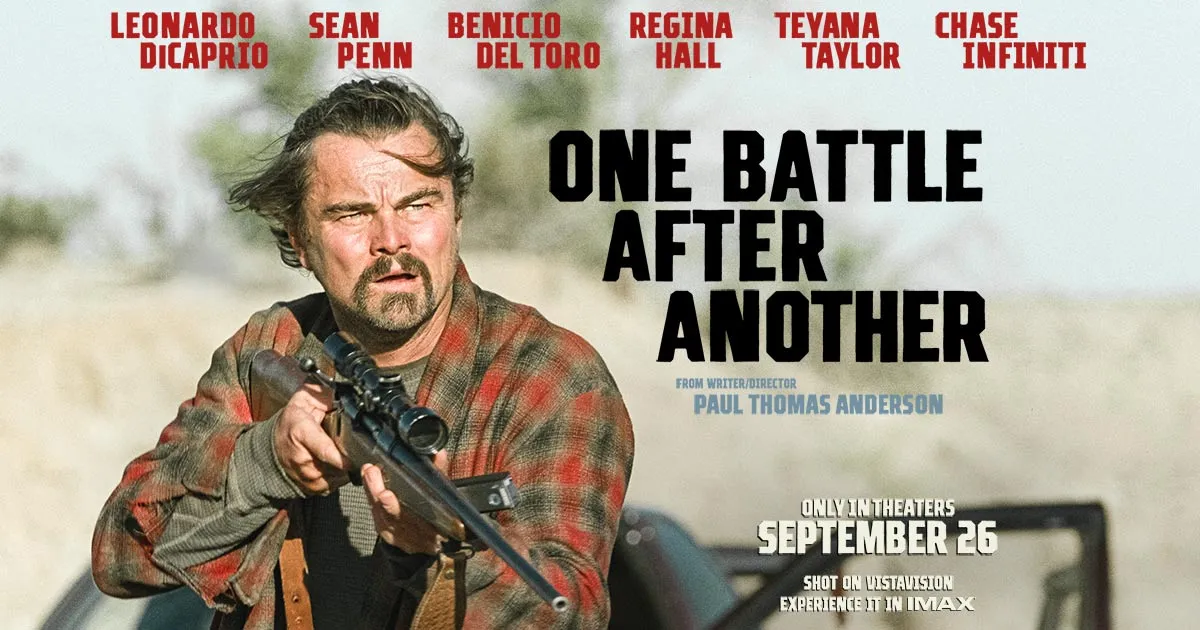
Titles are often promising and catchy, but sometimes merely allusive. However, none is more direct than the title of Paul Thomas Anderson‘s latest film, One Battle After Another. It clearly states its purpose: action, action, and more action. A massive budget and a parade of stars support this intent. Distributed by Warner Bros. Pictures, the film stars Leonardo DiCaprio, Sean Penn, Teyana Taylor, Chase Infiniti, Regina Hall, and Benicio del Toro.
However, One Battle After Another is far from a simple, nonstop, action-packed film. Beneath the explosions lies a blend of political satire and dark comedy with a bruised family drama at its core. Paul Thomas Anderson’s postmodern streak is still very much alive, and it’s no coincidence that this is his second foray into the world of American novelist Thomas Pynchon, following 2014’s Inherent Vice. This time, the source is Pynchon’s 1990 novel, Vineland.
The result is a dense, compelling film that pits two facets of America’s unrest against each other: the resurgence of white supremacist fanaticism and the desperate idealism of those who are still fighting against it, even resorting to violence. Within this framework, the film reveals the challenges of communication and the tension between the differences that exist within our inner and outer worlds.

- A Transgenerational War in One Battle After Another
- Gender and Power in One Battle After Another: The Trouble with Inverted Roles
- Visual and Sonic Tensions in Paul Thomas Anderson’s One Battle After Another
- Thought in Motion: The Meaning Behind the Final Chase in One Battle After Another
A Transgenerational War in One Battle After Another
The title One Battle After Another suggests a distrust in the possibility of a fully peaceful society. Political battles and dissent are intrinsic to human relationships and societies. As such, they are passed from one generation to the next, continually taking on new motives and forms. In this sense, one battle seamlessly follows another: there is no final clash because there is no overarching narrative.
The story opens quite symbolically in medias res with an act of sabotage by the revolutionary group French 75. Here, we meet three of the main characters for the first time: Bob Ferguson (Leonardo DiCaprio), a stoner and explosive device expert; Perfidia Beverly Hills (Teyana Taylor), a fierce, seductive, and cynical militant with a love affair with Ferguson; and Colonel Steven J. Lockjaw (Sean Penn), a stereotypical embodiment of chauvinism obsessed with Black women.
The first third of the film follows the group’s actions against violent immigration policies and restrictions on women’s rights. The rest of the film deals with the aftermath of Perfidia’s arrest. Years later, Bob has become a depressed and paranoid man, primarily concerned with his daughter’s safety. In one pivotal scene, he argues with her about a school party and becomes angry when she corrects his use of pronouns. This moment reveals his disconnect from the political sensibilities of a new generation.

Gender and Power in One Battle After Another: The Trouble with Inverted Roles
One of the most compelling aspects of One Battle After Another is how Anderson reconfigures gender roles. For example, he assigns the figure of the avant-garde revolutionary, traditionally coded as masculine, to Perfidia, a Black woman. Instead, after his partner’s disappearance, Bob takes on the caregiving role typically associated with femininity. By inverting these roles, Anderson makes his characters more eccentric, unpredictable, and engaging.
Along these lines, it’s no coincidence that Steven J. Lockjaw emerges as the film’s main villain. He embodies the rigidity of traditional masculinity, blending brutality and farce into a concentrated form of repressive power. Given the character’s inherent banality and repugnance, Lockjaw was likely the most challenging role. However, Sean Penn’s remarkable performance makes that difficulty almost invisible. Penn dominates the screen with feral, precise intensity; each gesture and glance amplifies Lockjaw’s violent authoritarianism. Beneath the menace, his racism and cruelty take on a darkly parodic edge, transforming the character into a grotesque and almost absurd embodiment of power.
Lockjaw’s obsession with Perfidia exposes and interrogates the violence inherent in the male gaze. However, it should be noted that Perfidia’s oversexualization extends beyond Lockjaw’s perspective and retains its own degree of problematic nature. Her behavior, as well as the way Anderson’s camera captures it, evokes strongly eroticized imagery. Since the early days of colonial ventures, this type of imagery has shaped how Black women’s physical exuberance is interpreted. In this regard, Anderson’s reconfiguration of gender roles is ambiguous because it reproduces the same racialized and gendered dynamics it critiques.
Visual and Sonic Tensions in Paul Thomas Anderson’s One Battle After Another
Anderson’s visual choices do more than illustrate the narrative; they enact conflict on a sensory level. His use of the VistaVision 35mm camera lingers on bodies with an almost tactile fascination, tracking, zooming, and reframing with a restlessness that blurs the lines between admiration and domination.
Cinematographer Michael Bauman‘s highly saturated color palette and the abrupt cuts intensify the sense of instability, transforming the act of looking into a battleground. Anderson also uses wide-angle lenses to immerse viewers in the action, emphasizing spatial dynamics and amplifying tension. This technique renders characters grotesque and imposing, reinforcing One Battle After Another’s satirical edge.

Jonny Greenwood‘s score, recorded with the London Contemporary Orchestra, acts as a kind of glue, binding the film’s two registers — the intimate and the spectacular, action-oriented — together. Moreover, Greenwood’s orchestration highlights contrasts within the narrative. Intimate piano lines or solo strings often emerge amidst full orchestral swells, reflecting fragile human moments amidst chaos. The result is a cohesive audiovisual architecture where the score and cinematography work together. This creates a constant negotiation between observation and immersion, control and surrender, and calm and eruption.
Thought in Motion: The Meaning Behind the Final Chase in One Battle After Another
Despite its length, One Battle After Another passes in the blink of an eye. The film’s spell over its audience is rooted in its relentless, almost hypnotic rhythm, a fact that’s easy to see. If we had to select a single scene that encapsulates it all, it would undoubtedly be the final chase scene, poised to enter the canon of cinema’s most iconic sequences. As the climax’s main event, the scene reveals as much about the plot as it does about Paul Thomas Anderson’s cinema.
Filmed in the California desert and on a winding road, the chase unfolds at a steady, unhurried pace, keeping viewers fully engaged. Anderson resists the typical acceleration of action cinema, allowing the landscape to dictate the pace. Each rise and dip in the road mirrors the film itself, which is a series of sudden shifts that prevent any pause to anticipate what comes next—literally one battle after another. The camera’s composure contrasts with the chaos it captures, maintaining suspense at every turn. What emerges is not just a race, but also a meditation on movement itself. Even the plot is original: where one would expect a conventional chase among three contenders — a victim, an aggressor, and a savior — we instead witness an intergenerational handoff.
In conclusion, One Battle After Another delights and excites while maintaining an incisive view of society. It is a film for everyone and no one in particular, resonating with audiences of all generations. While retaining some dissonance and problematic elements, it effectively illustrates the contrasts shaping contemporary U.S. society and the wider Western world. Proof of this lies in the film’s huge box-office success and numerous awards. It won four awards at the 83rd Golden Globes: Best Motion Picture – Musical or Comedy, Best Director, Best Screenplay, and Best Supporting Actress for Teyana Taylor. One Battle After Another dominated the 79th British Academy Film Awards, receiving fourteen nominations and winning six awards, including Best Film and Best Director. The film is in the running with thirteen nominations at the upcoming 98th Academy Awards.
Tag