 Collections
 Magazine
 Exhibitions
 ITA version




Learning that even a brief existence can leave a permanent mark is somewhat refreshing. That’s the impression you get at Keith Haring‘s retrospective in Rome, open until April 11th, 2027, at Museo di Roma (Palazzo Braschi). The exhibition is a great place to visit if you feel downbeat or overwhelmed by everything going on in the world. It also helps put things in perspective: if, even in the 80s and 90s, with poverty, nuclear threats, and the AIDS epidemic, a soul could conceive such energetic, life-affirming artwork, can contemporary artists respond the same way to today’s challenges?
Maybe the key to understanding Haring’s influence lies in the very place where his art was born and reached his audience: the street.
Keith Haring in Rome: Which artworks are on display?
Curated by Kaoru Yanase, Ilaria Miarelli Mariani, and Claudio Zambianchi, the Keith Haring Exhibition in Rome features more than 140 artworks, lent by the Nakamura Keith Haring Collection, the largest collection dedicated to the artist, as well as other public institutions and private owners. It includes prints, posters, works on paper, works on plastic tarpaulins, sculptures, and even a portion of the original mural painted along the FDR motorway in Manhattan.
The setup is original and immersive, helping the audience plunge into the dazzling 80s and 90s, even recreating the sounds and atmosphere of New York’s nightlife and workers’ commute.
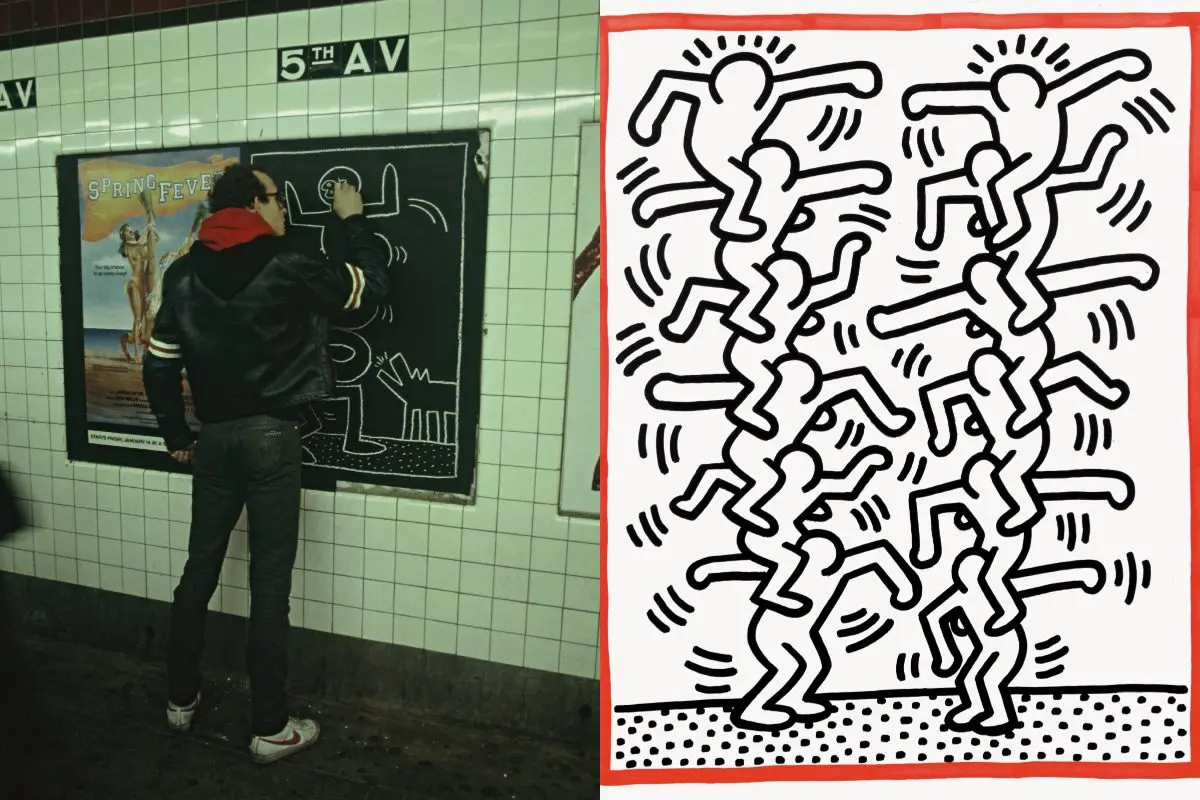
The exhibition introduces visitors to Keith Haring’s visual grammar, made of apparently simple, colorful, and accessible forms. But how much thought and work did he put into creating universal icons like the radiant baby, the barking dog, the angel, or the flying man? Their message still speaks to people today, across generations and cultures. After all, Haring himself said: “The public has a right to art… Art is for everybody.”
Keith Haring’s life: early works and Subway Drawings
Born in 1958 in Reading, Pennsylvania, Haring developed a love for drawing at a very early age, learning basic cartooning skills from his father and from the popular culture around him, such as Dr. Seuss and Walt Disney. After dropping out of a commercial arts school in Pittsburgh, he moved to New York and enrolled at the School of Visual Arts (SVA). However, he was more drawn to the thriving alternative art community developing outside the gallery and museum system, in downtown streets, subways, and former dance halls.
In a New York still marked by poverty and violence, the city itself became his canvas. Rome’s exhibition includes strong testimony about his more than 5,000 Subway Drawings: spontaneous figures he traced between 1980 and 1985 with chalk on black advertising spaces before jumping on the next train. His audience was the thousands of commuters who traveled across New York every day, including people unlikely to ever set foot in a museum or gallery.
New York: the artists community and nightlife
In New York, Keith Haring became friends with fellow artists Kenny Scharf, Jean-Michel Basquiat, and Andy Warhol, as well as the musicians, performance artists, and graffiti writers. He then began organizing and participating in exhibitions and performances at Club 57 and other alternative venues.
Music was integral to his art: the exhibition in Rome features posters, stage and record designs, often created in direct response to the rhythm and energy of a particular song, performance, or scene. His icons are perpetually moving, jumping or dancing, conveying vitality and dynamism to the viewer.
Haring’s body of work expresses total freedom, embracing the body and sexuality as essential expressions of life. Amid the AIDS crisis and a period of growing social conservatism, he celebrated love as an act of resistance and hope, as seen in his Radiant Eros series, showcased in Rome.
“I’m glad I’m different – he wrote in his diary in 1987 – I’m proud to be gay. I’m proud to have friends and lovers of every color. I am ashamed of my forefathers. I am not like them.”
Keith Haring in Italy: a special relationship
The exhibition focuses on Haring’s love for Italy. The artist first visited Milan and Naples in May 1983 and completed two landmark projects. First, the iconic Fiorucci flagship store, painted during a 13-hour live performance, encouraged by Andy Warhol. In Naples, he presented his first Italian solo exhibition, Italia ‘83, at Galleria Lucio Amelio, where he also created a work for Terrae Motus, Amelio’s landmark exhibition inviting international artists to respond to the devastating 1980 earthquake in Irpinia and Basilicata.
Haring returned to Italy several times. In 1984, he presented a solo exhibition at Galleria
Salvatore Ala in Milan and was selected for the Venice Biennale. During Arte di Frontiera: New York Graffiti at the Palazzo delle Esposizioni in Rome, curated by Francesca Alinovi, Haring created a mural on the museum’s exterior staircase, which later was lost.
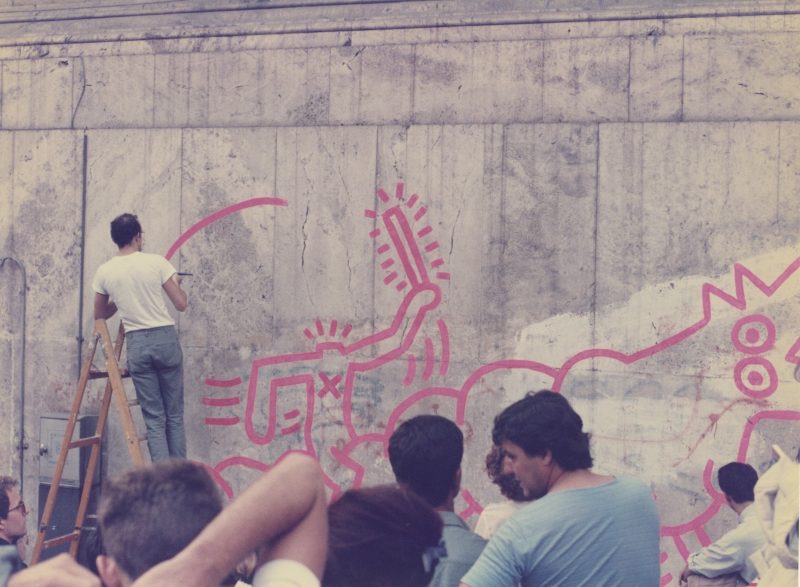
The artist’s relationship with Italy culminated in 1989 with Tuttomondo in Pisa. Painted on the rear
wall of the Convent of Sant’Antonio Abate, this monumental mural, completed just months
before his death, remains his last permanent public mural and one of his greatest artistic legacies.
Social issues addressed in Haring’s art
Aware of art’s social value, Keith Haring didn’t hesitate to support the causes he believed in. He left his mark on posters for anti-nuclear marches, AIDS-prevention awareness campaigns, anti-apartheid movements, and peace.
Through paintings, posters, and graphic works, he turned art into a direct, accessible form of communication, using his images to inspire awareness and action rather than decorate or provoke. For Haring, art was never only personal expression: it was also a tool for dialogue, education, and social change, a way to speak directly to power and the public at the same time.
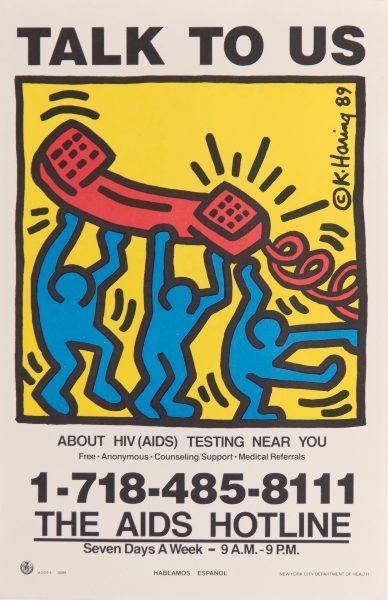
For this very reason, until his death at the age of 31 from AIDS complications, children always held a special place in his art. Unguarded, curious, and immediately responsive to his direct visual language, he devoted considerable time and resources to art created specifically for them, from hospital wards to public playgrounds.
“Children are the bearers of life in its simplest and most joyous form. Children are color-blind and still free of all the complications, greed, and hatred that will slowly be instilled in them through life,” he wrote in his diary on July 7, 1986.
Keith Haring in Rome: when and where to visit
Venue: Museo di Roma, Palazzo Braschi
Dates: October 6, 2026 – April 11, 2027
Opening hours: Tuesday to Sunday, 10 am – 7 pm
December 24 and 31: 10 am – 2 pm
Last admission: one hour before closing.
Closed: Mondays and December 25.
Tickets (exhibition only):
- Full price: €17
- Reduced: €15
- Family tickets available:
- €22 for two adults and their children under 18
- €11 for one adult and their children under 18
Online booking: Fixed-date tickets