 Collections
  Magazine
  Exhibitions
  ITA version












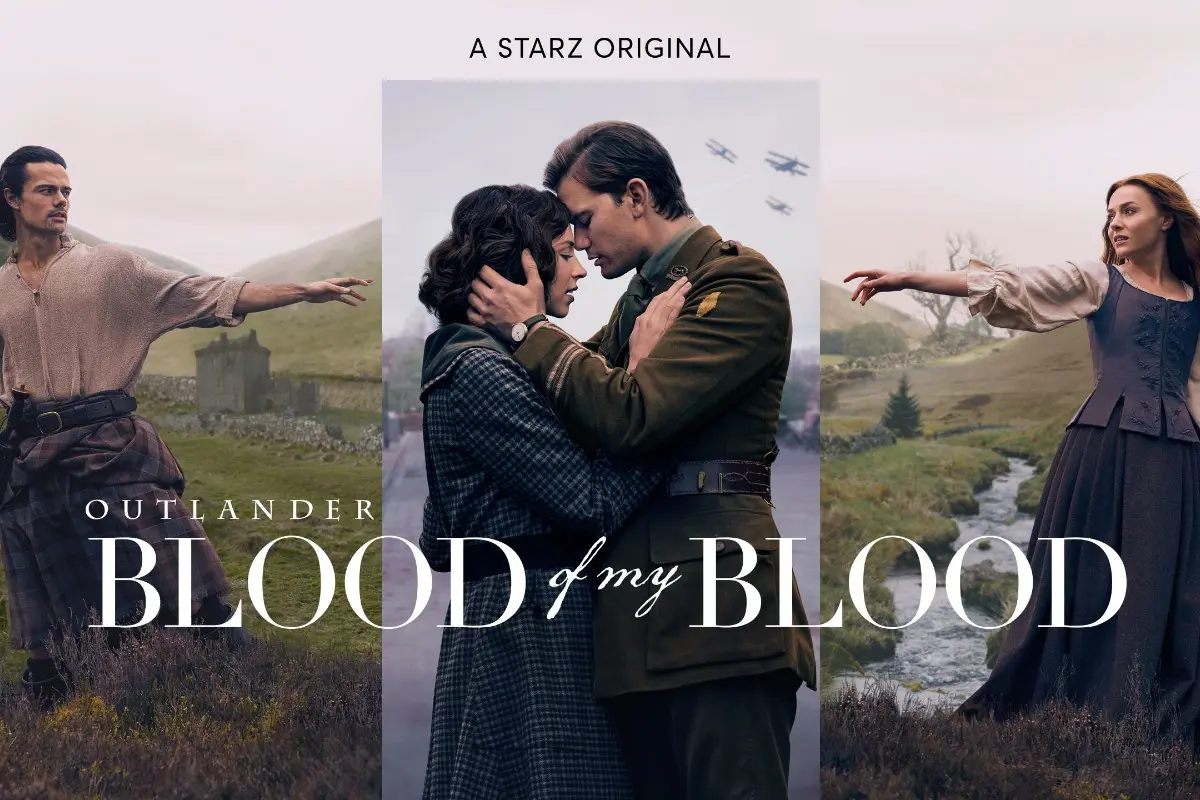
Outlander: Blood of My Blood Review | Endless Love and the Return of War


Ye are blood of my blood. And bone of my bone. I give ye my body, that we two might be one. I give you my spirit till our life shall be done.
From episode 5×01
Evoking ancestral oaths and physical connection, Outlander: Blood of My Blood owes its title to an ancient Scottish wedding vow. The show is a historical romance drama prequel to Outlander and, as the main series, takes place in Scotland in two different centuries. The story follows the love stories between James Fraser and Claire Beauchamp‘s parents, creating a backstory that is also filled with overwhelming love for Diana Gabaldon‘s protagonists.

Created by Matthew B. Roberts, Outlander: Blood of My Blood premiered on Starz on August 8, 2025, and received praise from both critics and audiences. Although the narrative follows paths traced by the original show, it is not merely fan service. On the contrary, it emphasizes the development of two timelines and how the main characters connect across the ages. A second season was announced ahead of the premiere, confirming the appreciation.
A Reason to Fight For: Clan Politics, Love, and Power in 18th-Century Scotland
Scottish Highlands, early 1700s. After the death of Lord MacKenzie, his clan meets up to elect their new leader. Neither his children fit the role: Colum (Séamus McLean Ross) is strong and determined, yet too impulsive and hot-blooded, while Dougal (Sam Retford) would be totally unable to lead his men into battle, both because of his insecure, meditative temperament and his lame leg. In the attempt to secure an alliance, they promise their sister’s hand to Malcom Grant (John Lumsden). Yet, Ellen (Harriet Slater) isn’t the kind of woman who peacefully accepts the fate of a man determined for her. Especially after she met the charming Brian Fraser (Jamie Roy); would she know his name, she’d be aware he’s son of her clan worst enemy.
England, shortly before 1920. In a Europe that struggles to survive WW1, Julia Moristonthe (Hermione Corfield) sorts war letters, while soldier Henry Beauchamp (Jeremy Irvine) fights in the trenches. She runs into his desperate words and decides to give him an answer. Letter after letter, they become each other’s reason to live, and after the War ends, they marry. Despite the scars of war, they build a lovely family and welcome a sweet girl, Claire. But during a trip in Scotland, Julia goes a bit too close to an ancient stone circle and disappears. Henry desperately looks for her, but she’s too far away… in the Scotland of the 18th Century.
Although Blood of My Blood stands as an autonomous story, Outlander‘s fans can easily spot references to the main story, already since the opening title. On a bagpipes-and-drums melody that recalls folk songs and echoes the sounds of battle, warm images intertwine war scenes with romantic moments, resulting in credits very similar to Outlander‘s. However, none of this is essential to understanding the plot, as it’s more of a wink to the fandom. The show put a lot of care into historical reconstruction, especially in its costumes and folk traditions. The camera accurately follows the gestures to wear a kilt, and highlights grief and terror in soldiers’ eyes. A choice that results in a stress on small details that enhance involvement and sense of reality.
Back to the Past, Same Lives: Time Travel and Narrative Circularity in Blood of My Blood
Blood of My Blood follows a circular structure, though it shifts the viewpoint among different characters and ages. Both the first and the final episodes are set in ancient Scotland, keeping a strong anchor in the charming past. Yet the incipit places great emphasis on the lives of soldiers in the trenches and on their sense of duty, while the final scene focuses on Scottish men summoned to battle by the fires. Both scenes follow the same scheme: different ages, different men, and different women who decide to stand by their side.
Interweaving different historical eras, supported by Julia’s voice-over, the story delves into Jaime and Claire’s backstory, revealing a part they couldn’t know: their parents met in an unbelievable way, back into a past that seems to make any love stronger and more worth risking anything for.

The double historical setting results in both fascinating and cruel. If ancient Scotland, as cruel as it was, underscores the legendary side, “modern” times take on a more realistic cast. The portrayal of life in the trenches is extremely rough, as in 1917 and All Quiet on the Western Front. So as the scars left on soldiers’ minds, damage with panic attacks and nightmares. What makes the exploration of different ages possible is a time journey (which explains Claire’s parents’ disappearance).
This device also underscores how, despite the passage of time, some things never change. The same unrivalled feeling that pushes Ellen far from her family, and keeps Julia and Andrew’s hope alive. The same battle still has to be fought by women to achieve their rights, even centuries later. Details that hint at the eternal return of an unchanging human nature, in good times and bad.
Love as Risk, Not Freedom: Emotional Inheritance Across Generations
In Blood of My Blood, love isn’t something intimate or reassuring, but as a force that moves through time and binds people together even beyond their will. The show places great emphasis on the idea of emotional inheritance: what passes from one generation to the next isn’t just blood, but above all, the choices made, the unfulfilled desires, and the wounds that continue to be felt.
In this sense, love is never a refuge or a promise of happiness, as it is in other TV shows, such as Bridgerton. Here, love means taking on a responsibility, often painful, and accepting that certain decisions have consequences that go beyond the person making them.
What emerges is that freedom isn’t about doing what you want, but about choosing, knowing that every choice has a cost. Love, therefore, isn’t an impulsive impulse, but a conscious gesture.
Another central aspect is the continuity between lives. The characters never seem truly isolated, because the past remains ever-present and active. Blood of My Blood doesn’t suggest that destiny is predetermined; instead, it indicates that it’s built over time through imperfect, repeated, and necessary acts of love.
Where Nothing Has Changed: Prequel Logic and the Weight of the Outlander Legacy
Despite being a prequel, Blood of My Blood remains enjoyable even if ignoring the original story. The show uses one of fairy tales’ most straightforward techniques: telling a story, remembering something already heard, changing details, and adding or removing something. A device capable of attracting a stable audience who know where the plot will lead them. The main narrative follows the path traced by Outlander, telling a (double) story of a feeling stronger than time. Brian and Ellen, like Julia and Andrew, fall in love at first sight, and are ready to do anything to preserve their love. Nothing can stop them from finding a way to be together, giving again to fans a romantic, and passionate story they long for.
Another engagement device stays in the time journey. Most stories about it, from Groundhog Day to Time After Time, focus on the effects of past actions on the present, as Julia and Andrew do. Yet this expedient also allows us to highlight how not only feelings but also some battles have survived time. Indeed, both Julia and Ellen fight for female emancipation: the first through the right to study, the second by refusing to submit to men’s will. Actually, the shift between two ages highlights both the legendary allure of ancient times, without ignoring their most brutal sides, and the realism embedded in the reconstruction of post-WW1 life. Different lands and ages, joined by the possibility of finding a reason to survive the most hopeless events.
Created to ride the wave of Outlander‘s success, Blood of My Blood owes its success to the ability to keep its freshness. Bonding two carefully crafted, passionate, and engaging love stories with history, adventure, and a hint of true-to-life violence, the show underscores parallels between two very different, yet captivating, ages. Another proof that “everything must change for everything to remain the same”, as the Leopard would have said.
Tag