 Collections
  Magazine
  Exhibitions
  ITA version













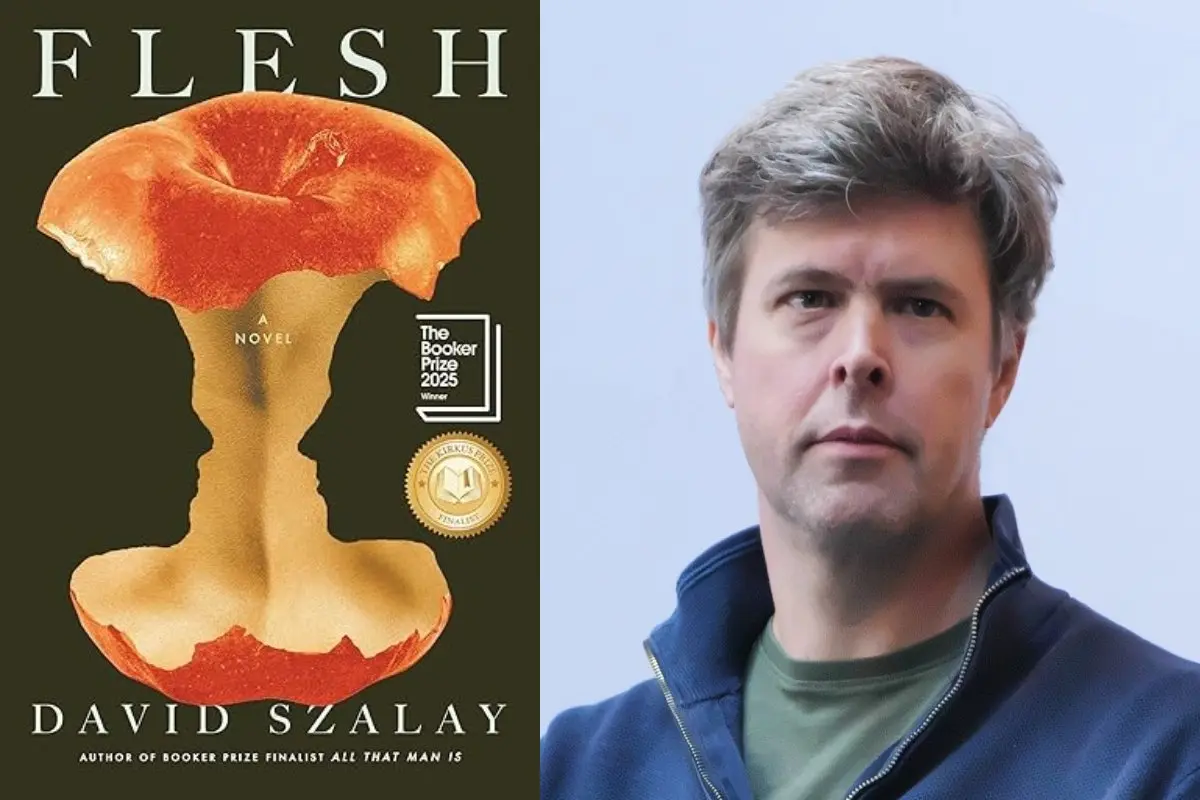
David Szalay’s Flesh: When the Body Speaks Before the Mind


Length
Parataxis and ellipses: in his novel Flesh, winner of the 2025 Booker Prize, David Szalay’s writing unfolds through halting rhythms and profound voids. The author follows a man who understands the world through his body before he can make sense of it through language. From its opening pages, the novel follows existence at its most physical, where instinct consistently outruns reflection and action arrives before interpretation.
We meet the protagonist immediately, as a teenager. His name is István, he is Hungarian, he lives with his mother in a working-class neighborhood of a small town to which he has recently moved, and he does not seem to know quite how to behave towards a girl introduced to him by a schoolmate.
- István’s Adolescence and the Illusion of Choice
- Literary Brutalism in David Szalay’s Flesh
- How David Szalay Uses Language in Flesh
- István Silence in Flesh
- When the Body Thinks Before the Mind
- Why Flesh Became a Book Club Favorite
- Can a Novel Be Too Readable?
- The Power of Ellipsis in Flesh
- Is István a Passive Character?
- Beyond the Crisis of Masculinity
- Virility and the Replacement of Fathers
- Absent Fathers and Patriarchal Power
- In the Name of the Father
- Why David Szalay’s Flesh Stays With the Reader
István’s Adolescence and the Illusion of Choice
This episode, the novel’s first, evokes a certain tenderness. Instead, it poignantly highlights certain recurring themes in István’s story. This awkward adolescence is simply the first of a long series of turning points that the boy crosses without ever quite choosing to do so. Or, perhaps, always choosing: in such an inert way, so far removed from any manifestation of will that it makes it seem like fate.
A few pages later, fifteen-year-old István begins a relationship with his neighbor, a forty-two-year-old woman who seduces him and introduces him to sex. He doesn’t look at her. He stares at the floor and the frayed edge of the carpet. If he looked at her, he would see that she is smiling at him. But he doesn’t look at her. He doesn’t want to see her. He feels shame and even a kind of horror at the thought of having done what he did with an old, ugly woman like her.
So we read, yet when she asks him if she can kiss him, he always replies with a simple ‘okay’. A two-syllable consent that serves as the leitmotif of an existence marked by the rhythms of a syncopated narrative, driven by rapid-fire dialogue and suspended in silences.
Something in him seems to want it.
Yet the novel suggests something more unsettling. István does indeed allow himself to be taken by his neighbor, letting his uncertain and untrained body mould itself to hers. Until the fateful ‘I love you’, which she rejects and which spills over into murder. Violence becomes the last available form of expression when the soul has been left unfed. The tragedy is followed by reform school, then Iraq, as a soldier.
Literary Brutalism in David Szalay’s Flesh
Returning to Szalay’s prose, there is no accidental affinity between his style and the world in which the novel begins. The Hungarian chapters of Flesh possess the same starkness that seems to emanate from the final years of the Eastern Bloc. The prose is dry and abrasive. Dialogue falls into place like concrete panels and exposed steel pipes. Sentences are short and functional. Characters move through narrow corridors lined with faded wallpaper and potted plants left on landings. Windows struggle to admit light.
For a couple of minutes he feels completely at ease sitting there, looking at the tidy living room and the balcony with sunlight shining through the green glass panels.
Outside, in the sun, there is a large jar full of pickled cucumbers floating in a cloudy liquid. Wedged into the mouth of the jar is something that looks like wet bread.
The result is a kind of literary brutalism whose austerity mirrors the environment it depicts.
Yet this style also becomes an expression of István himself. He enters the novel as a rough physical presence, repeatedly shaped by contact with the other and by different forms of decay. First, his neighbor, with her worn, grotesque physicality; later, Helen’s husband Karl, weakened by illness. Both men occupy positions that, from the perspective of a young protagonist raised within conventional notions of masculinity, may appear diminished or obsolete.
How David Szalay Uses Language in Flesh
In Flesh, literary style is never merely decorative: form and content remain inseparable throughout the novel.
In an interview, Szalay remarked that the title initially appealed to him because it sounded “vulgar” and “obscene”. It lacked elegance and literary refinement. Ultimately, that was precisely why it felt right.
The novel, after all, is concerned with what a body does in the world.
Like the world Szalay depicts, István’s language. Objects are frequently described in approximate terms rather than with precise terminology. A bottle is removed from “that thing it’s in.” Marijuana becomes “that stuff.” Hospital equipment is referred to as “that transparent plastic thing.”
Vocabulary itself appears stripped down to its bare essentials.
István Silence in Flesh
What István lacks is language, more than desire or agency.
He struggles to form genuine friendships. He can’t speak about himself in therapy. His dialogue with his son Jacob is extremely difficult. Again and again, he finds himself unable to articulate what he feels or what he wants.
Sex remains the only language he seems capable of speaking fluently.
Yet his reticence never appears entirely anomalous. Few people in Flesh are particularly articulate. István may be more withdrawn than most, but his mother, Helen, and even his neighbor are hardly given expansive monologues. Communication is limited throughout the novel.
His silence, therefore, functions less as an individual pathology than as an intensified version of a broader condition. Everyone speaks a little. István speaks the least.
When the Body Thinks Before the Mind
Where words fail, flesh takes over.
István grows up treating the body as a tool of knowledge before it becomes a means of expression. Even trauma rarely produces introspection. After developing post-traumatic stress disorder, his response is not self-analysis but movement: he relocates and adapts, less interested in interpreting his life than in navigating it.
When he yields to Helen’s kiss despite having insisted he does not want it, the gesture feels less like weakness than instinct. It is not a surrender of will so much as an act performed before conscious thought can catch up.
Szalay has explained that he wanted to portray human beings not as minds trapped inside bodies, but as bodies that think. Seen from this perspective, István becomes the novel’s most complete embodiment of that idea. His life unfolds through impulses and physical encounters long before it acquires narrative coherence.
In a sense, Flesh stages a quiet revenge for the unconscious. If István repeatedly surrenders to something, it is not fate alone but the obscure force of desire itself.
Why Flesh Became a Book Club Favorite
The novel’s formal economy also helps explain another aspect of its extraordinary success. In an age increasingly shaped by messaging apps and fragmented forms of communication – an age defined by ellipses and paratactic speech – Szalay’s novel hardly feels resistant to contemporary reading habits. On the contrary, its prose often mirrors them. Short sentences, suggestive gaps, dialogue reduced to its essentials: Flesh speaks a language that is strikingly familiar to the twenty-first-century reader.
It is therefore unsurprising that both the novel and its author have reached a remarkably broad international audience. The book has become a staple of reading groups and benefited from enthusiastic online recommendations.

Can a Novel Be Too Readable?
One of the most common – and perhaps most revealing – responses to Flesh is that readers describe having “devoured” it. The novel is often said to be consumed in a matter of days, sometimes even hours. Such remarks are typically intended as praise. Yet they also raise an intriguing question. What happens when literary value becomes increasingly associated with the speed of consumption?
The danger reflects a broader cultural tendency to evaluate reading through the logic of efficiency and performance. A book’s quality risks becoming intertwined with how quickly it can be finished.
None of this diminishes the novel’s achievements. Yet the novel’s extraordinary readability remains a feature worth examining alongside its literary ambitions.
The Power of Ellipsis in Flesh
Critics have described one of Szalay’s central narrative techniques as a form of knife-plunge storytelling.
The comparison is apt. Like a horror film that cuts away at the precise moment a knife is about to strike, Flesh repeatedly withholds decisive scenes. Events occur offstage. Climactic moments are displaced into ellipses. Readers are asked to reconstruct what happened from fragments and consequences.
Szalay himself has openly embraced this approach:
I enjoy books made of free-standing units of writing that are somehow in dialogue with one another, where what happens in the gaps is as important as the chapters themselves.
The result can be remarkably effective. By refusing to show everything, the novel actively recruits the reader’s imagination. Part of what distinguishes Flesh from the great social novels of the twentieth century is precisely its preference for subtraction over accumulation. Yet there are moments when one wonders whether the narrative becomes not merely suggestive, but elusive. Whether certain emotional or psychological developments are left so far beyond the frame that the novel occasionally sacrifices depth for ambiguity.
The gaps are undoubtedly productive. They are also, at times, frustrating. Perhaps that tension is part of the novel’s design.
Is István a Passive Character?
The question of omission connects to another recurring observation about the novel: István’s supposed passivity.
Many readers have interpreted him as a man who simply allows life to happen to him. With his endlessly repeated “okay” – a word that appears roughly 184 times throughout the novel – he has frequently been compared to figures such as Kubrick‘s Barry Lyndon or Camus‘s Meursault.
Certainly, his habitual response can feel defensive, even evasive. It often seems to signal a desire to avoid conflict, to surrender to circumstances rather than confront them. Yet this reading risks oversimplifying both the character and the novel.
There are numerous occasions on which István demonstrates a clear sense of purpose. Once he gains access to the Nymans’ fortune, for example, he proves surprisingly decisive in matters of business and investment. Earlier in life, he appears perfectly capable of recognizing and pursuing his impulse, as his attraction to Noémi makes clear.
To describe him simply as passive, therefore, feels inadequate. More fundamentally, the category itself becomes questionable in a world so thoroughly shaped by contingency and historical forces beyond personal control.
What Flesh repeatedly suggests is that agency occupies a far smaller place in human life than we often like to believe. István’s ‘okay’ may express resignation. It may equally express recognition of a reality that exceeds individual intention. In this sense, István is less a passive man than a profoundly exposed one: someone continually confronted with the limits of his own capacity to shape events.
Beyond the Crisis of Masculinity
Much has been said about Flesh as a novel concerned with a contemporary crisis of masculinity.
It is certainly a story about a man and a male body. As the years pass, István becomes increasingly imposing, and he often benefits from it. Helen herself describes him as possessing a kind of primitive masculinity.
Yet there is a risk of mistaking what the novel seeks to explore for what, in the current cultural moment, is most useful – or most marketable – to discuss. István’s story is first and foremost the phenomenology of an existence. It unfolds within a specific historical period, through a specific body, and according to a set of deeply rooted cultural paradigms. To read the novel primarily through the lens of “toxic masculinity” or “male incommunicability” would be to reduce its vision of reality to a single interpretative framework, however important that framework may be.
Szalay himself addressed this issue in an interview with The Irish Times on 14 November 2025:
“No, I wasn’t trying to put forward a certain vision of maleness. There was absolutely no agenda, in that respect.”
He later added:
“The book is about other things for me: time, and fate, and the physicality of experience, which isn’t only a masculine thing.”
Virility and the Replacement of Fathers
There is, however, another aspect worth considering. As a teenager, István begins a relationship with a married woman whose husband, a factory worker, has been severely injured in an accident. Years later, he becomes Helen’s lover while her husband Karl is dying of pancreatic cancer.
The pattern appears strikingly similar.
In both cases, István replaces husbands whose bodies have been weakened by illness or injury. From the limited and deeply masculine perspective through which the young protagonist understands the world, these men appear diminished: impotent and therefore useless.
István, by contrast, is young and physically strong. His presence enters these households as a force of substitution. One might therefore argue that he acts according to a deeply primordial conception of virility.
Absent Fathers and Patriarchal Power
What makes this pattern even more intriguing is that István’s father is never truly present in the novel.
The replacement of these older husbands – hierarchically superior paternal figures – by a young man whose own father remains absent can hardly be accidental. István is, in a sense, a parricide in absentia.
Indeed, it is precisely this paternal absence that may have driven him towards an unconscious desire for fulfillment, whose trajectory ultimately converges with a system of masculine power.
Unlike these aging husband-fathers, István embodies youth and vitality. He becomes the archetypal expression of physical presence and security. It is as though, by replacing these weakened paternal figures and appropriating their power through possession, István sought to affirm his own accession to the roles of husband and father. This pattern invites a patriarchal and even Freudian interpretation.
In the Name of the Father
Taken together, the murder of the first husband and the gradual appropriation of Karl Nyman’s social position take on the unmistakable shape of a desired parricide.
Both men, moreover, had shown István a mixture of authority and generosity. The first invited him to share a drink at a moment when genuine social connections were rare in his life. Karl introduced him to affluent English society and gradually integrated him into the Nymans’ domestic and familial world.
They function, in many respects, as welcoming and initiatory father figures. Having won the first man’s wife – a woman only slightly older than his own mother – and eventually inherited Karl’s position, property, and family, István is finally able to reclaim the missing paternal role by becoming himself both husband and father.
Even his relationship with his mother begins to acquire a different resonance. Particularly in adulthood, it occasionally assumes the contours of an alternative marriage, one that quietly parallels the life he later builds with Helen Nyman.
Why David Szalay’s Flesh Stays With the Reader
One could describe Flesh as the trajectory of a young man growing up in a particular historical moment, in a reality that decays and absorbs every residue, offering no genuine possibility of purification.
It is, above all, a profoundly human story. A tragic one, perhaps, if we choose to see it as the story of a life repeatedly surrendered to fate.
What remains after finishing the novel is the sensation that it extends beyond its printed pages. Perhaps this hermeneutic openness is one of the sources of its success: both within a mainstream publishing industry increasingly eager for novels that invite interpretation and among readers who recognize in Szalay’s silences the mark of a literary voice capable of enduring.
As the novel reminds us:
There is something terrible in the way normality insists upon itself. In the way summer keeps returning. In the way the chestnut trees blossom. In the way Wimbledon arrives.