 Collections
  Magazine
  Exhibitions
  ITA version














The Art of Joy Book Review | The heretical epic of Goliarda Sapienza


Length
Uncontrollable and swirling – a river overflowing and flooding pavements, streets, churches, and shops, a volcano erupting after centuries of inactivity – fertile and insatiable is the life of Modesta, born from the pen of Goliarda Sapienza and protagonist of The Art of Joy. The novel, written over a period of about nine years, has a troubled publishing history. Finished in 1976, it was rejected by publishers of the time for about twenty years. Considered to be scabrous, immoral, and anticlerical, the text was published in Italy two years after Sapienza’s death, in 1998. Scabrous, immoral and anticlerical: indeed, these very qualities are part of why The Art of Joy, today, is recognised as one of the most vital and experimental expressions of 20th-century Italian fiction, as well as a brazenly feminist work.
A Four-Act Journey
The Art of Joy is a novel structured in four parts, each dedicated to a specific phase of Modesta’s life. Rather than a single narrative thread, the novel unfolds as a constellation of accounts. Especially from the middle of the second part, the evolution of an intimate and personal story opens up to a choral epic, marked by time and animated by characters and contexts in constant movement.
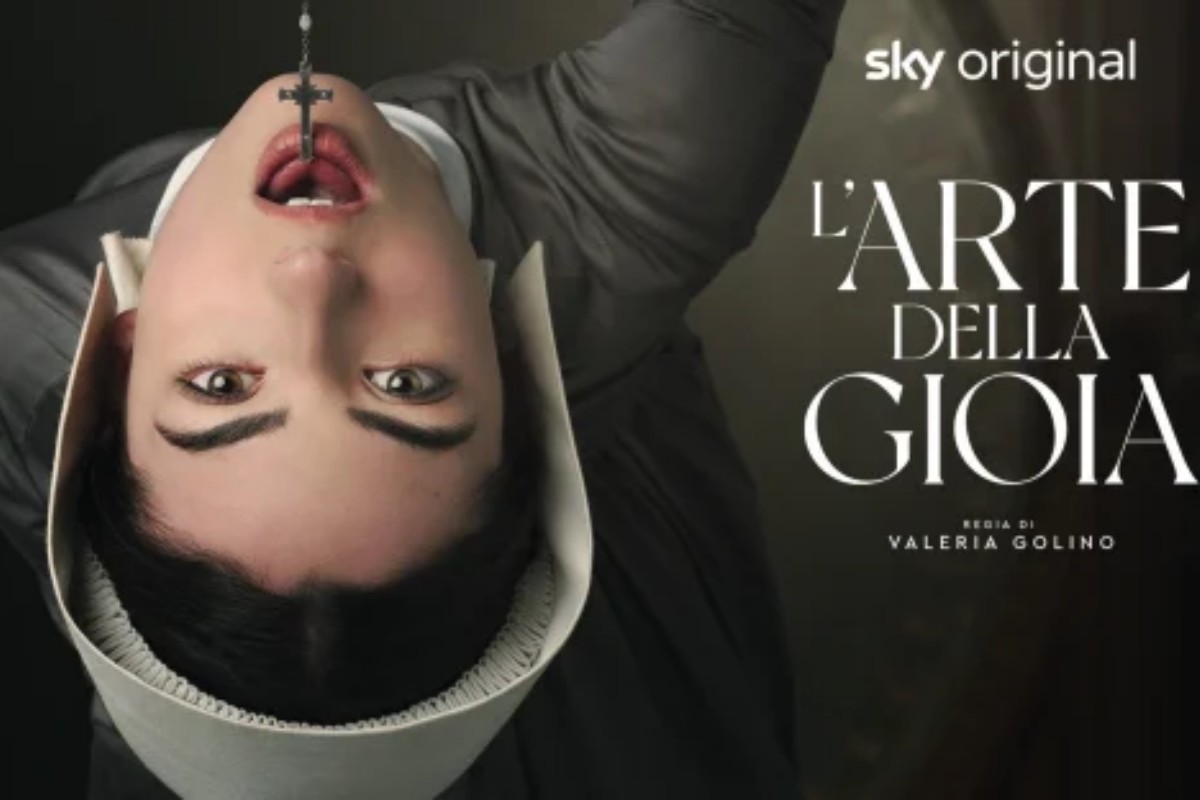
From the Sicilian countryside, with the willful death of her mother and sister and the violence suffered by her father, the narrative shifts to the monastic convent to which Modesta is entrusted. Then, ten years later, the scenery shifts to the villa of the Brandiforti family. An aristocratic family that Modesta enters thanks to the will of the convent’s regent, Mother Leonora, who has been the young protagonist’s guardian since her early years in the institute. In the ancient palace of the Brandiforti, Modesta manages to introduce herself and stand out, to the point of transforming its deepest dynamics from the inside. The TV series, directed by Valeria Golino, also focuses on the first two parts of the novel, with a remarkable performance by Tecla Insolia in the role of Modesta.
The Daughter of the Century
Thus, during the 1920s and 1930s, while Italy succumbed to fascism, Modesta moved between worldly relationships, free of all ties, most notably the one with Carmine, as well as a long and tormented affair with the young revolutionary Joyce, and a growing political awareness. The Brandiforti family home, once the stronghold of a Leopardesque aristocracy, became a place of rethinking the social and political structures of the time, as well as a refuge for the politically persecuted. Modesta raises children that are not her own, overturns gender roles, encourages love free of all moral conventions, and reaffirms the need for resistance to fascism.
After the war, she joined the Communist Party, but soon she clashed with the dogmatic and patriarchal logic inherent in it. Modesta also experiences prison, being arrested months before the Liberation. Imprisonment for Modesta is a moment to reaffirm her loyalty to an ideal of joy that has been pursued over time. An ideal that is also political, existential, and artistic. Within these pages of The Art of Joy, we also find the first-person experience of the writer, who recounted her few days spent in the Rebibbia prison in the autobiographical novel L’università di Rebibbia, published in Italy in 1983.
In an increasingly complex narrative, in which faces, names, and ideas overlap until they blend, the novel concludes with a Modesta who is now elderly but still lucid and deeply attached to life. Proud of the peace she has achieved, the protagonist concludes thus:
I find myself thinking bizarrely that death will be but a full orgasm like this.
The Art of Joy, Goliarda Sapienza
Muddy and Sweaty: A Sicilian Childhood
And here I am, four or five years old, in a muddy space, dragging an enormous piece of wood. There are no trees or houses around, just the sweat from the effort of dragging that heavy thing, and the sharp sting in my palms wounded by the wood. I sink into the mud up to my ankles, but I have to pull; I don’t know why, but I just have to. Let’s leave this first memory of mine as it is: I don’t want to make assumptions or invent anything. I want to tell you what it was really like without changing a thing.
The Art of Joy
Muddy and sweaty, Modesta introduces herself to the world. She returns home after putting down a large wooden stick, and she does not know where to leave it. Her mother silently cooks in the same room, her motionless sister watches, lying on the floor like a starving animal. Flies and dust drift between them. There is little color, and even less air, in this incipit. We catch a glimpse of the misery of early 20th-century southern Italy: the stark contrast between the light of the scorching sun and the damp earth—mud and sweat, indeed—and the darkness of the cantone, where the mother bakes bread with onions and olives on Sundays, evokes the Sicilian countryside of that time.
Of that eastern Sicily which, in addition to the sea and the expanses of sand, also knows the arid heights of the mountains, the steep slopes, and the gullies that give way to moon-like plains. Vast expanses of black earth impregnated with the scents of sulphur and orange blossom, and deserts stained by greenish shrubs dried up by Etna’s lava flows. For it is between the slopes of the volcano and the Catanese countryside that Modesta was born. Just as her creator, Goliarda Sapienza, born in Catania on 10 May 1924, also lived in the shadow of the volcano. A mother, Goliarda, who is also the daughter and younger sister of Modesta, born twenty-four years earlier on January 1, 1900, the first day of the century. Or so it seems.
The Art of Discovery
The personal data, however, is relevant. The protagonist’s life is rooted in the century, just as The Art of Joy allows itself to be swept along by the billows of history, until it amalgamates with them to recognize, criticize, deconstruct, and re-travel them with vital momentum. Therefore, Modesta is the daughter of a century that she cannot identify.

The countryside of the Catania area immediately appears cramped to the young protagonist’s energy, reluctant to the events of history, and any knowledge beyond her gaze. What little she knows, Modesta owes to her slightly older friend, Tuzzu. The sea is a discovery, a boundary foreign to the imagination of the child who has had only countryside around her. The body is also a discovery. The body and its forms, its nerve endings: boundaries to be crossed to plunge elsewhere. There is always something more beyond appearances.
Only time in those places seems to possess no boundaries, until death looms. Orphaned now, the daughter of the century approaches the threshold of history through the antechamber of a monastic convent: another non-place of history. But life marches on, and blood boils. Modesta studies, and from each discovery, the sea seen through Tuzzu’s eyes resurfaces: the pleasure of the first experience and its repetition, until it soon becomes systematic and conscious.
Modesta the Heretic
Thus Modesta, chained to the balustrades of monastic life and its moral and intellectual rules, begins to grasp the timeless dimension in which she lives, and the even more serious—and hypocritical—imprisonment of a body overflowing with life. The words with which he expresses her condition in the convent are therefore rebellious and fierce:
Those women made no sound when they passed by you or entered and left their cells: they had no bodies. I didn’t want to become transparent like them. […] I had that word to fight with. And with my health exercise—as I had come to call it to myself—sitting in the chapel with the rosary between my fingers, I would repeat: I hate. Bent over the loom under Sister Angelica’s lifeless gaze, I would repeat: I hate. At night before falling asleep: I hate. From that day on, this became my new pray.
The Art of Joy
From this bottleneck, the death of Mother Leonora—the protagonist’s putative mother—becomes a viaticum to salvation. Orphaned for the second time, with the disappearance of the nun who had raised her, Modesta faces with small and prudent steps a new time: that of the Brandiforti family. A period that, while marked by the decadence of a noble family, grants her the privilege of free will and access to an open, multifaceted destiny.
Modesta the Revolutionary
Modesta is taken to the old country residence of the Brandiforti, where the few survivors of the noble family had taken refuge to escape the bombings as the war threatened urban centers.
Once again, the protagonist finds herself immersed in a suspended time, in a dwelling where the empty rooms of the dead speak louder than the voices of the living. It is among those voids that echoes the heretical thirst for knowledge of Jacopo Brandiforti, Beatrice’s deceased uncle. In his library, Modesta discovers scientific literature and theories that are far removed from the Catholic dogmas she had been accustomed to until then.
With the death of Gaia Brandiforti—the head of the family and a symbol of a declining aristocratic world—and thanks to her friendship with Carlo, a young doctor who had arrived from Turin, the writings of Karl Marx, the socialist ideas of Antonio Gramsci, and the echoes of peasant and workers’ protests from the countryside and the cities, along with accounts of the violence of fascist squadrism, begin to circulate through the palace. Thus, Modesta, discussing with Carlo, says:
You’re sad, Carlo. You joke around, but you’re sad.
Well, let’s just say the general situation isn’t very reassuring.
Because of that Mussolini? But everyone says it’s just a farce. Modesta, you heard that too down in Catania, didn’t you?
Yes, but I also saw a few broken heads down there, and they didn’t look like any kind of farce to me.
The Art of Joy
Modesta’s Art of Joy
Thus, what appeared to be yet another form of confinement becomes the place where Modesta can rethink a world she does not belong to—and no longer wants to. Far removed from bourgeois hypocrisies, from blind Catholicism, and from the proletarian mysticism invoked by her fellow party members, what emerges at the center is a life that refuses to be tamed by any pre-established order. Her clashes with Carlo first, and with Joyce later, illustrate her growing impatience with a Marxism trapped in dogmatism or reformism. In these passages, the protagonist’s voice lends form to Sapienza’s thoughts, which are rooted in the revolutionary socialism of early 20th-century Italy.
Modesta’s worldview could be described as a feminist anarchy that transcends its historical context. It does not ignore history, but interprets and tames it. For wherever life expands, there is always an existence to be revolutionized. Goliarda Sapienza’s The Art of Joy, written over nine years, is a relentless, river-like novel of a humanity both rooted—and uprooted—in time. The symbolic murder of fathers—and, in this case, of mothers—becomes a vindication of a freedom to be sought and conquered in the name of both individual and collective fulfillment.
Thus, the voice of Goliarda Sapienza, for too long unheard, invites us to join Modesta in the revolutionary, sacrilegious, immoral, and anticlerical practice of the art of joy.
Tag