 Collections
  Magazine
  Exhibitions
  ITA version













Pontormo's unconventional Deposition From the Cross


Material/Technique
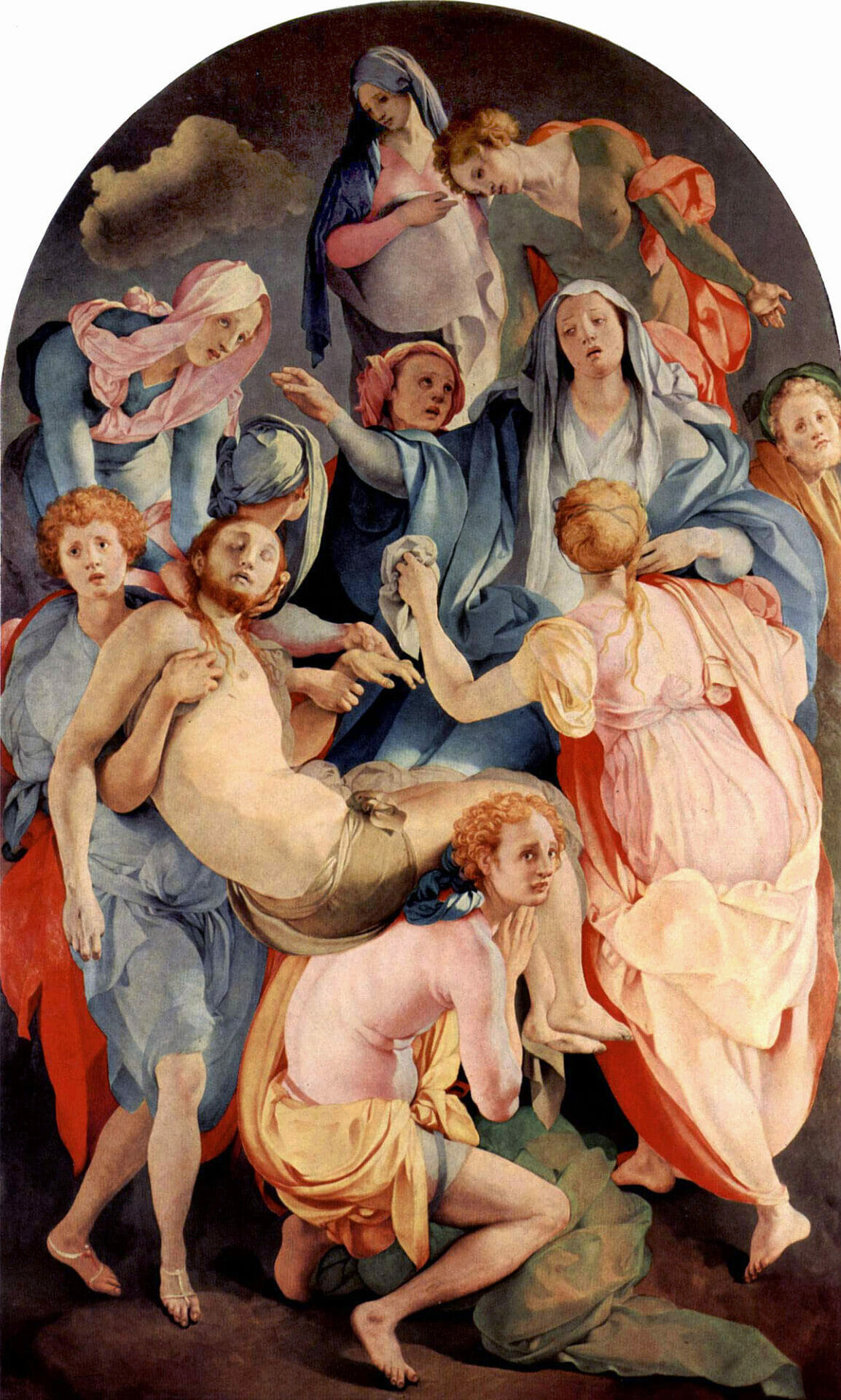
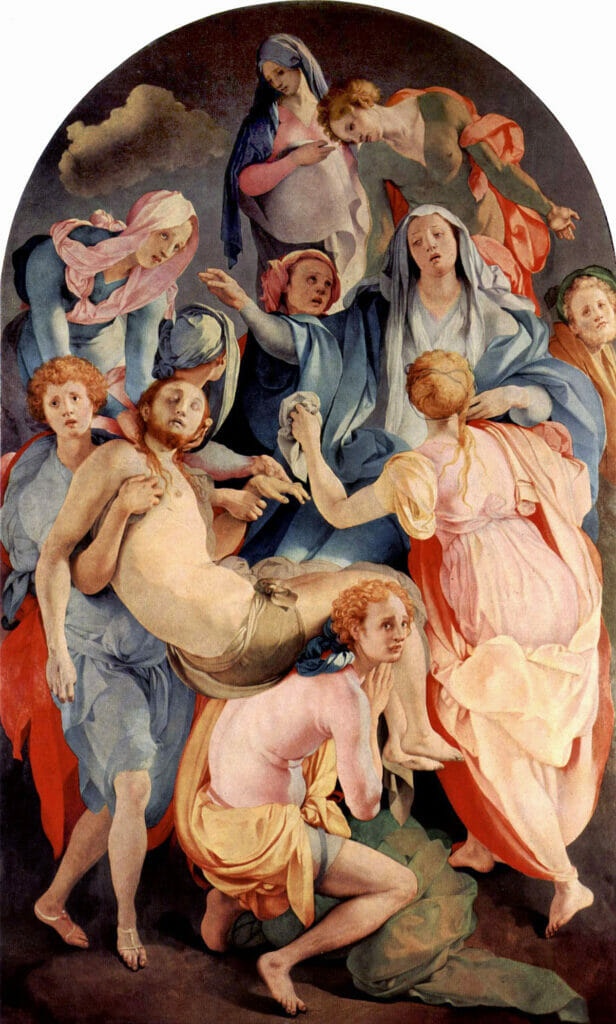
A vividly unconventional Deposition: colourful, devoid of the Cross, and populated by wingless angels. Pontormo’s iridescent palette is the unmistakable signature of his time: the early decades of the sixteenth century, when painters not only embraced a broadened chromatic range but also challenged the viewer’s eye with deliberately contrasting hues, often leaning toward acidic tones. Pink clashes boldly with bright green and violet, one of the trendiest colours of the era.
A Chromatic and Emotional Crescendo
The painting unfolds with a breathless rhythm, intensified by the dynamic poses and tense expressions. From a compositional standpoint, the artist arranged the bodies in a pyramidal structure, though only at first glance. Every figure twists or bends; none stands in a classical, frontal pose. The supposed pyramid reveals itself instead as a spiralling ascent toward the heavens, culminating in a cloud on the upper left.
The Virgin’s outstretched hand toward her son is fragmented and trembling, exposing her condition on the verge of fainting. The other figures blur into one another—not only because of their contorted stances but also because they lack the iconographic attributes that would allow for clear identification.
Pontormo’s Twisted Figures and Mannerist Innovation
Critics have often compared Pontormo’s torsioned bodies to those of Giambologna’s Rape of the Sabine Women. Researchers saw these twisted, almost gymnast-like poses as true exercises in style: showcases of human variety in posture and emotion, but above all of the artist’s technical mastery in rendering disruption and imbalance while preserving believability.
Such choices boldly defied Renaissance conventions, long upheld until that point, and even embraced a certain intentional deformation of nature.
The Importance of the Original Setting in Santa Felicita
Today, the public can still admire the work in its original location: the church of Santa Felicita in Florence, exactly where Pontormo conceived it. This aspect is crucial to fully understanding and appreciating the painting. By experiencing it in the place for which the artist designed it, we observe it from the proper height and under the precise light conditions he intended—privileges we would inevitably lose in a relocation to a museum space.
Tag