 Collections
  Magazine
  Exhibitions
  ITA version













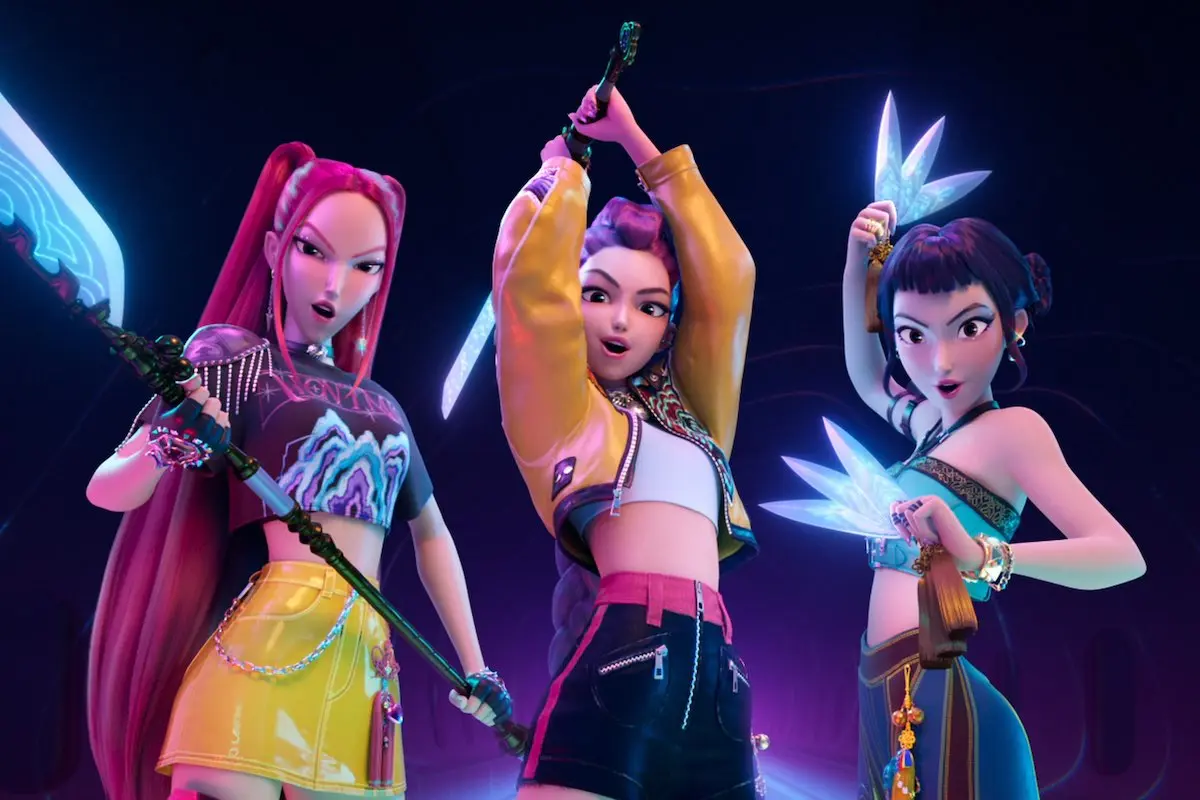
KPop Demon Hunters: How Netflix Brings Korean Folklore to Life in Neon Colors


Runtime
Digging under the surface, KPop Demon Hunters isn’t just an animated fantasy musical. It features ancient legends and contemporary Eastern culture, a strong cult classic structure, catchy songs, and a hundred shades of fluorescence. The film is a carefully crafted cultural hybrid that introduces Korean folklore and pop culture using a Western technique. While this choice allows for widespread appreciation, it also weakens many strong themes, making them fully understandable only to an audience already familiar with the subject matter.
Maggie Kang, a South Korean and Canadian, along with American illustrator Chris Appelhans, co-wrote and directed KPop Demon Hunters. Sony Pictures Animation produced the film for Netflix, and Sony Pictures Imageworks animated it. The film centers on a K-pop girl group that secretly hunts demons and is the latest in a long line of guardians protecting humanity from evil spirits.
Released in June 2025, KPop Demon Hunters became Netflix’s most-watched original production to date. It earned 325.1 million views in its first 91 days. The film garnered substantial praise from viewers and critics alike and took home multiple awards. These include Best Animated Feature and Best Original Song for “Golden” at the 31st Critics’ Choice Awards and the 83rd Golden Globe Awards. It is in the running for the same categories at the upcoming 98th Academy Awards.
Though KPop Demon Hunters may seem like an easygoing musical comedy for the whole family at first, it actually delves into the intersection of Eastern and Western cultures. Its structure and themes reflect the blending of these two worlds by spreading Korean folklore and K-pop culture.

Huntrix vs Saja Boys: Rivalry and Hidden Truths
A long time ago, demons threatened humans by stealing their souls to feed their ruler. One day, a woman’s singing created a barrier against the evil forces called the Honmoon. Centuries later, her female descendants still sing to maintain the barrier, aiming to strengthen it and banish the demons once and for all. This is the goal the K-pop girl band Huntrix was trained for. Rumi, Mira, and Zoey (voiced by Arden Cho, May Hong, and Ji-young Yoo, respectively) are the last hunters who protect humans through their shows. However, Rumi hides a secret: she’s half demon, and demonic patterns are becoming increasingly evident on her skin.
Things go from bad to worse when a new boy band starts to attract their fans. They are the Saja Boys, led by Jinu (Ahn Hyo-seop), a demon who was once a human. As the conflict between the groups intensifies, Rumi and Jinu have many opportunities to get to know each other. Their tender relationship leads them to discover that they are each other’s nemesis and mirror image. Only by examining themselves and what they have done can they overcome the evil within and around them.
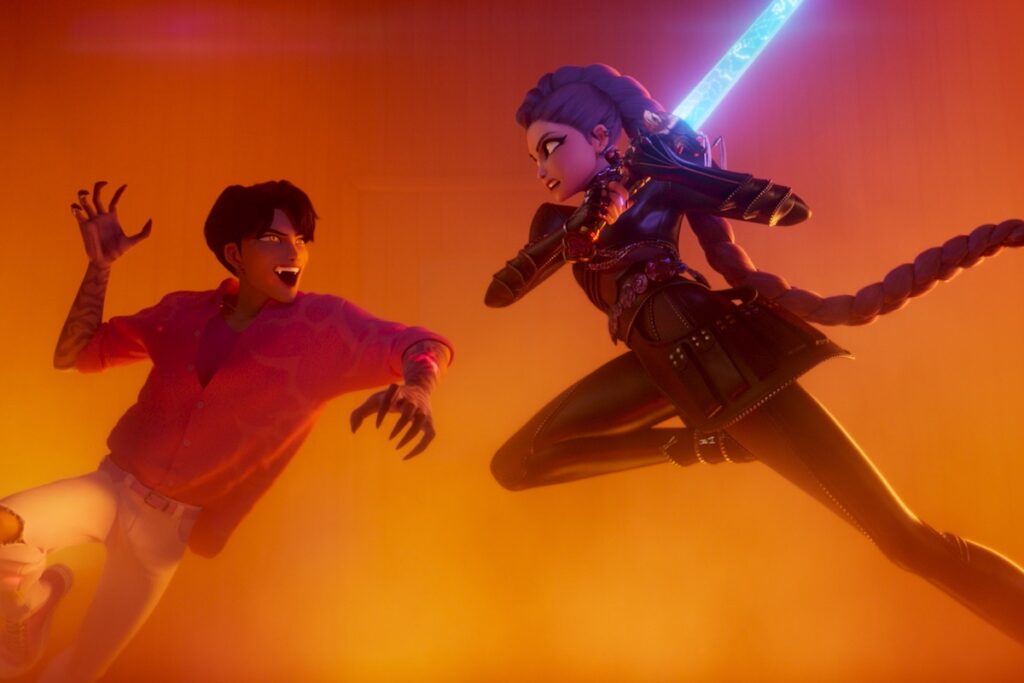
As opposite protagonists, Rumi and Jinu embody two of the film’s most important themes. The girl represents the intersection of two worlds, a fascinating hybrid of two species… and two cultures. The shame and stigma she experiences because of her nature are Jinu’s curse. He must fight the darkest shadows of his spirit. More than anything, however, they share the essence of embodying the marvel of possible coexistence.
Beyond the Neon: Folklore, Identity and Culture
I wanted to just make a movie that was set in Korean culture, so I delved into mythology and demonology for something that could be visually unique from what we’ve seen in mainstream media. I’ve also always wanted to do a group of amazing kick-ass women.
Director Maggie Kang for Animation Magazine
Maggie King dreamed up the original concept of KPop Demon Hunters. Raised in Canada, she wanted to pay homage to her Korean heritage by creating something that went beyond mainstream representations.
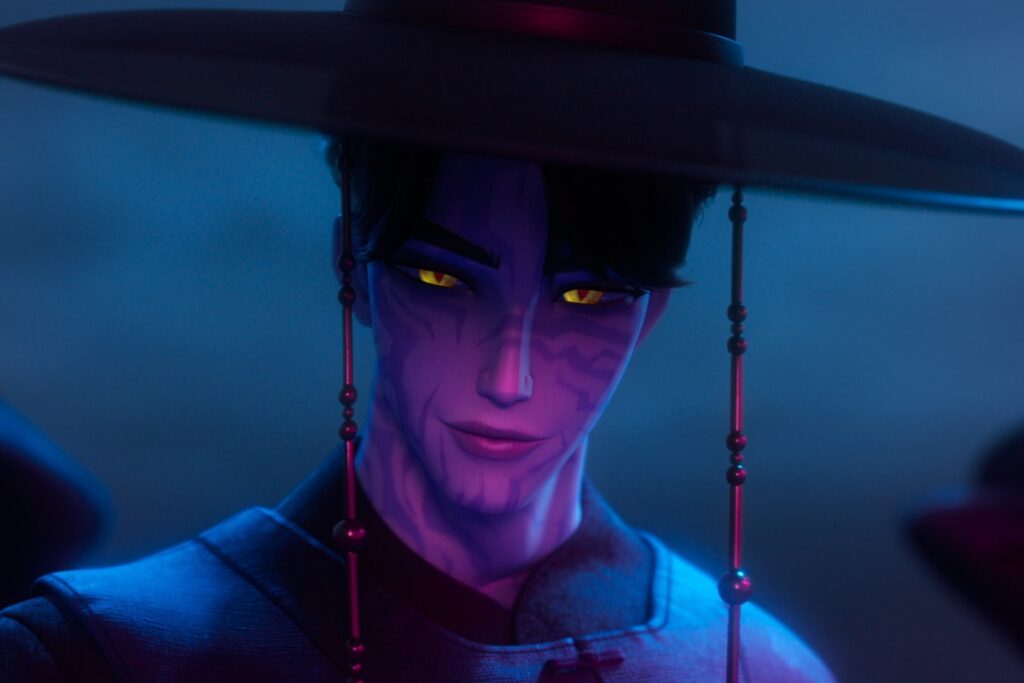
Indeed, scratching the surface, the film incorporates many elements from Korean folklore. Demons and spirits have always played important roles in legends and myths. It was only natural, then, to give them proper representation in the film. For example, the tiger and the magpie that accompany Jinu and deliver his messages to Rumi recall traditional Minhwa art. However, these animals were also believed to be messengers between the demonic and human worlds. Similarly, the Saja Boys wear black hanboks and large hats reminiscent of Jeoseung Saja, the Korean folk representation of death. The Huntrix seem like the heirs of ancient female shamans who sang to protect villages from demons.
Music plays a very significant role in the story, serving both as a technical element and a theme. In KPop Demon Hunters, songs often interrupt the narrative to express the characters’ inner thoughts and reflections. At other times, music blends with the story, as in the Huntrix and Saja Boys shows. While the former puts the film on the trail of Disney’s cult-classic animations, the latter turns the film into an animated musical. Moreover, it highlights the role and importance of music, particularly singing, in past and present Korean culture, offering insight into Eastern folklore.
Like many other aspects of the film, music isn’t just a technical aspect of the production; it’s a real narrative theme. Besides instilling emotion and supporting the storyline, each piece represents a brick in an enchanted barrier and serves as a mirror to ancient legends that have become modern trends. Brazilian pianist and composer Marcelo Zarvos composed the soundtrack, which features various K-pop tracks by Korean artists. The soundtrack became the first to have four songs simultaneously in the top 10 of the Billboard Hot 100, and the song “Golden” became the first K-pop song to win a Grammy Award (for Best Song Written for Visual Media).
Between Two Worlds: Eastern Myth Meets Pop Culture
KPop Demon Hunters sheds light on many aspects of contemporary Korean culture. The most evident example is probably the connection between K-pop music and its fandom. The Huntrix perform in front of huge, enchanted audiences. They’re the heirs of protective priestesses, but fans see the stars as substitutes for old gods. Not coincidentally, they’re called “idols,” as they stand in the middle of a new religion. Fans idolize the Huntrix, live to see them perform, and aspire to be like them, as if they had supernatural powers. However, there is also a dark side to this: the Huntrix nearly disappear as soon as another group takes the stage.
K-pop fans are well known for their extreme power: they can create or destroy a career in the blink of an eye. Therefore, fans control their idols, owning the power to shape and consume them. K-pop stars (and their agents) know they must give fans what they want, and they are selected and molded accordingly. As portrayed in the film, there’s a lot of pressure on these young stars, who must coexist with external forces telling them how to be. When the Saja Boys threaten the Huntrix’s position, they do so as evil spirits, but they also embody the invisible, huge pressure of the collective cult. In turn, they have a powerful influence on teenagers and society. With their mastery of the media, K-pop stars set trends and are seen as perfect role models.
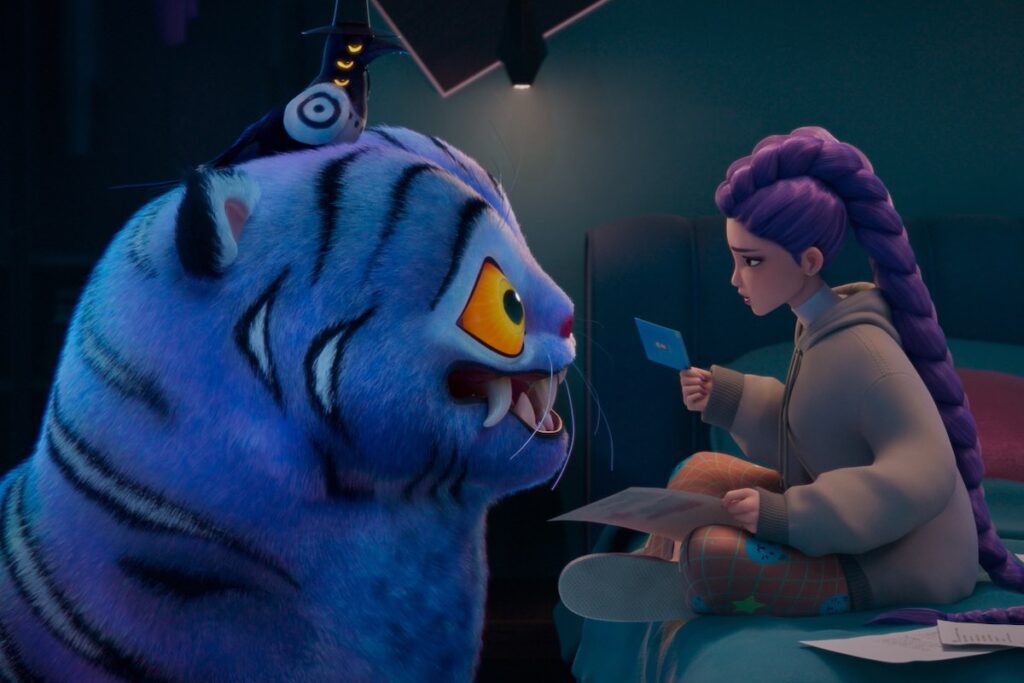
Through this theme, KPop Demon Hunters also addresses the acceptance of one’s origins and flaws, balancing shame and forgiveness. It underlines how even the “most perfect” idols are just common humans. While Rumi belongs to the world she was born to fight, Jinu betrayed his family for success and ease. Despite what most people believe, demons have feelings, and Jinu lives with guilt. They both lead spotless lives while hiding blemishes and guilt. However, they will both discover that real heroes aren’t perfect; they are the ones who can turn their mistakes into strengths.
A Cultural Fusion: Anime Style and Western Animation
Digital art in an anime style with neon colors and funny gags reminiscent of Looney Tunes. KPop Demon Hunters melds two worlds into a distinctive animated mix. Director Kang stated that she aspired to create female protagonists unlike Marvel’s superheroines. Rather than being powerful and sexy, they should be silly, spontaneous, and fun, true-to-life teenagers. Therefore, not only do they eat junk food and laugh for no reason, but they also wear comfortable, childish pajamas that contrast with their fancy show costumes. Furthermore, they have huge eyes, strange hairstyles, and exaggerated gestures that recall manga style, sometimes even physically impossible ones, especially during fights.

By incorporating typical anime traits into a traditional American (and Disney-like) structure and language, the film serves as a meeting point between Western and Eastern cultures, reflecting the intention to introduce a lesser-known culture through its themes and animation style. It is a community where folklore and pop culture coexist in everyday life and seek new expressions of ancient myths. The story is also a hymn to altruism, self-acceptance, and forgiveness. However, it seems to shy away from delving deeply into many important aspects of past and present culture, including its traditions, issues, and moral themes. Even the most interesting aspects of Korean traditions are not easily understood by those without prior knowledge.
Ultimately, Kang and Appelhans’ effort to introduce something novel to the realm of animation was quite enjoyable and appealing. The film attracted a wide audience worldwide by sounding familiar, fun, and captivating in both the East and the West. Unfortunately, it leaves a bittersweet feeling at the end. If you dig just a bit deeper, you can see how good and deep the story could have been. If only it had taken one more step forward.
Tag