 Collections
  Magazine
  Exhibitions
  ITA version












Paper Girls | Vaughan and Chiang’s Time-Travel Comic About Friendship and Identity


Year
Length
Paper Girls revolves around four 12-year-olds, whose faithful meeting will change the direction of their lives forever. A comic book series first published in 2015 by Image Comics, it captivated readers with its engaging plot and stunning artwork. What makes Paper Girls stand out is its use of the sci-fi genre to convey a personal narrative.
Moreover, it does not rely on 80s nostalgia in the way that similar franchises, such as Back to the Future before and Stranger Things after, do. Instead, the comic features a well-thought-out setting that avoids apparent stereotypes of the era. The fashion, cultural references, and even the political scene are distinctly characteristic of the year 1988. It includes them in a way that feels both recognisable to readers who have lived through those years and unique to those who have not.
Of Paper Girls, time jumps, and war
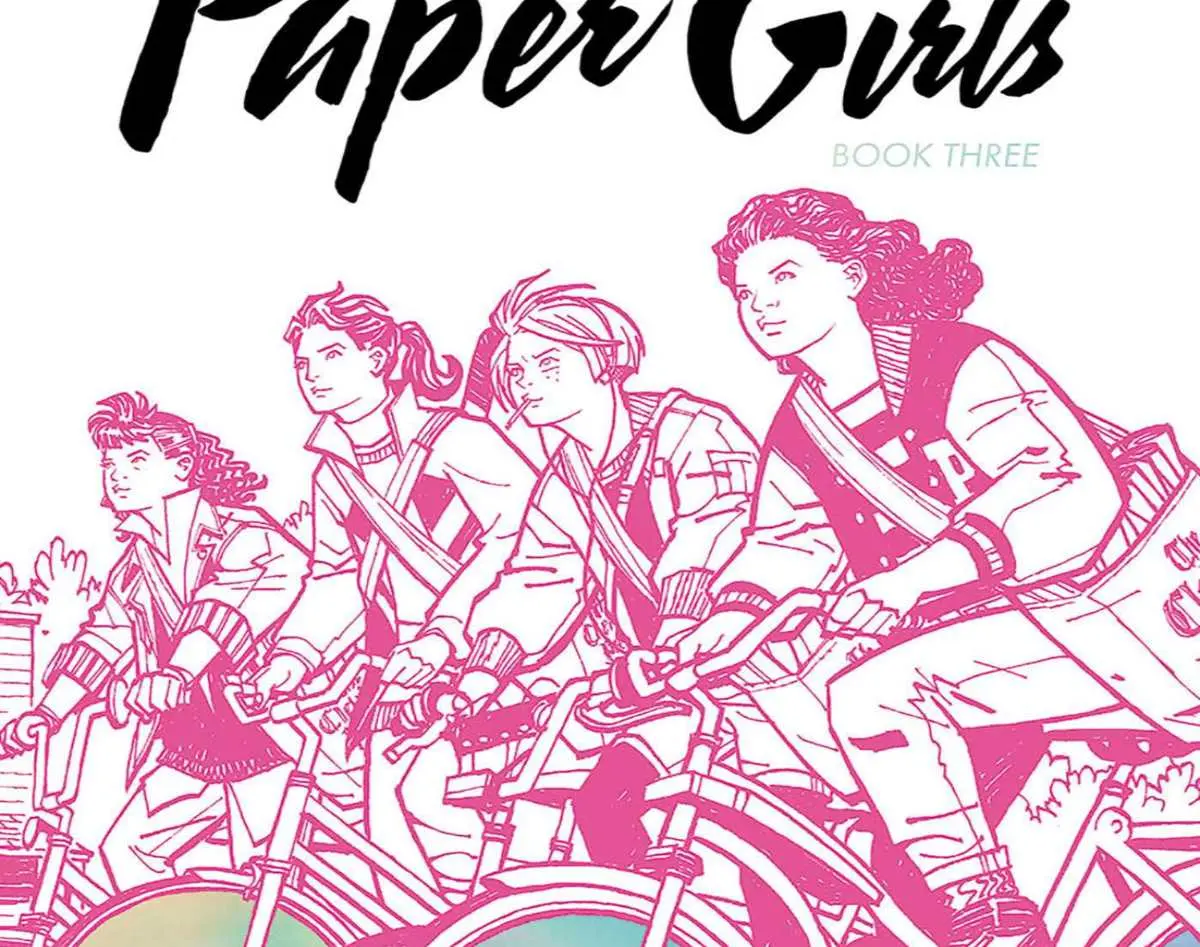
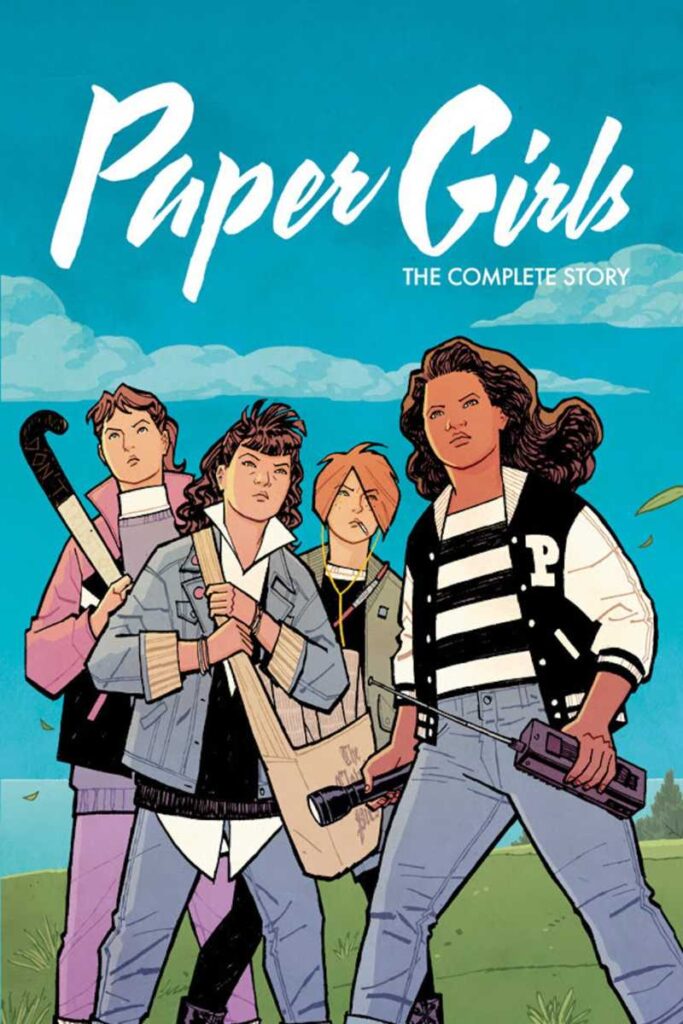
In the early morning of November 1st, 1988, Erin Tieng hops on her bike to deliver newspapers. The town of Stony Stream is still deep asleep, aside from the remaining trick-or-treaters. So when some bullies corner her, it is the other Paper Girls who come to the rescue. But what Erin, MacKenzie, KJ, and Tiffany do not know is that something much stranger is about to happen.
After a run-in with a mysterious group of teenagers leads to the discovery of a time machine, Stony Stream becomes the battleground of a literal intergenerational war. On one side are the Old-Timers, time travelers who oppose any alteration of the past. On the other hand, there are their descendants, the Teenagers, who wish to rewrite the past to ensure a better future. The girls are caught in the middle, ripped away from their timeline and left with a sole goal: return home.
An all-girls adventure
The events of Paper Girls unfold during a pivotal moment in the protagonists’ lives. Erin is a Chinese-American who has just moved to Stony Stream. MacKenzie is the first papergirl of the town, who dreams of escaping her life alongside an alcoholic mother. KJ is a Jewish girl from a wealthy family, and Tiffany is an African American gamer. Despite their differences, they are united by their shared role as paper girls and, in particular, by their age of twelve. At the end of childhood, but not yet at the beginning of adolescence, they stand at a crossroads of possibilities. It is a moment of suspension – similar to Kamala’s situation in Ms. Marvel. But as they time-travel and meet their future selves, they will be given the unique chance to actually witness the result of their choices, and claim a future that is not yet their own.
Aside from some of the Teenagers and the Grandfather, the leader of the Old-Timers, the entire cast of the series is almost entirely female. That is because Paper Girls focuses on female bonds and the growing kinship that the protagonists develop. Much like in the graphic novel Are You listening?, where a no less fantastical journey brings two young women together. There are also essential side characters who act as catalysts on their journey. There is Wari, a young woman from the Prehistoric era, whose son the girls help save from a sacrifice. And then there is Doctor Quanta Braunstein, the inventor of time traveling herself, coming from a distant future. Each of them offers guidance in an otherwise unfamiliar time, as well as returning to help the girls in their most dire moments.
Paper Girls is a time-traveling chase
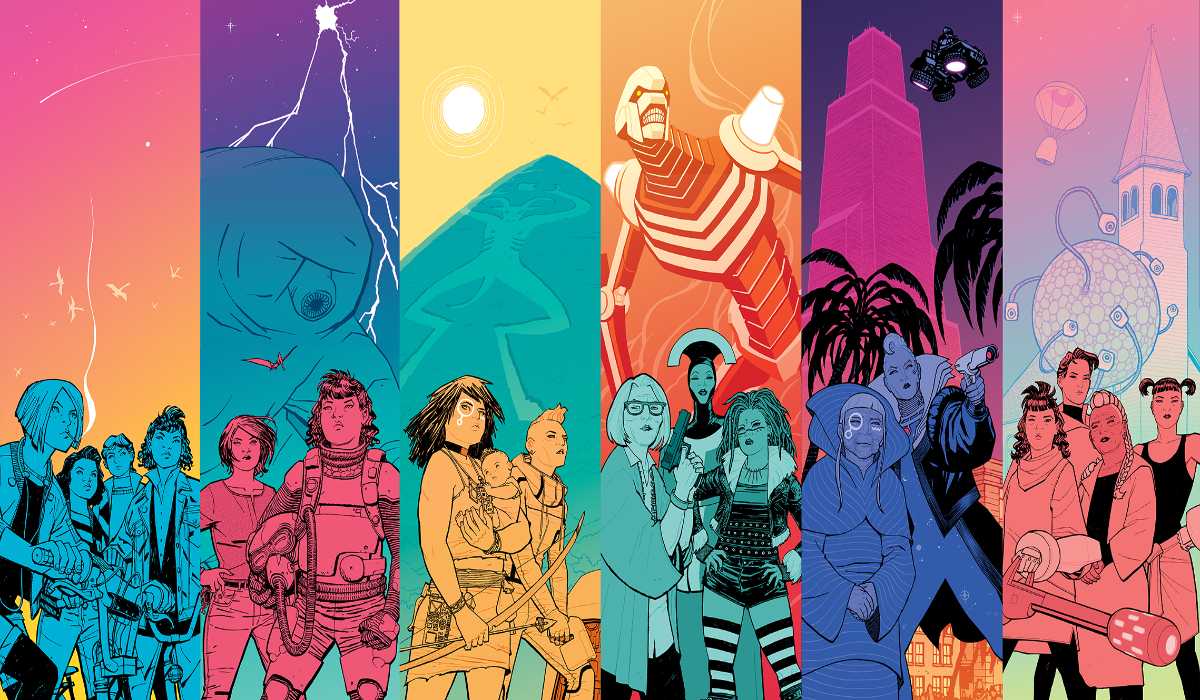
The graphic novel spans across 30 issues, divided into five arcs. The first opens with Erin’s dream, where the Devil kills her sister as punishment for eating the apple of knowledge. A surreal beginning that sets the tone of the novel and foreshadows the strange events to come. In fact, every arc features recurring elements, such as dreams and visions, new characters, a different era, and a final transition into the next one. As such, the narrative transports the girls from 1988 to 2016, then to 11,706 BC, 2000, and finally to 2171 AD. The last arc sees the protagonists scattered through different times, now not only needing to find their way back to the 80s but their way back to one another.
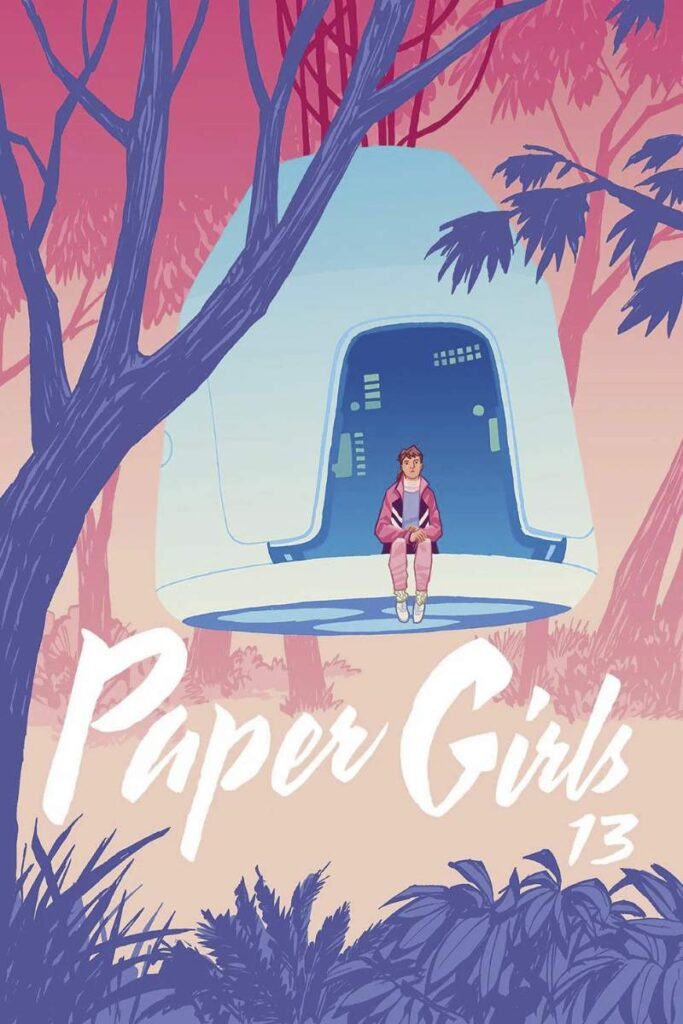
Paper Girl‘s art style serves as a leitmotif throughout, consistent yet unique in every setting. For example, Stony Stream appears as a sleepy town, characterized by a duller palette and the blue hues of night. Meanwhile, the future is a cacophony of neon colors and abstract silhouettes, a place so distant it feels unfamiliar. An almost opposite use to the one that Richard McGuire employs in Here, where the reader witnesses the passage of time through a singular room. In Paper Girls, each travel offers a new perspective. And it does so not only on the girls’ lives, but also on one’s own present. By witnessing how even small choices can impact the future, the readers must reflect on the value that their own experiences hold in the grand scheme of things.
“The amount of time we are each given is irrelevant. It is what we choose to do with every second that counts.”
– Doctor Quanta Braunstein
A project born from a collaboration of artists
Paper Girls works so well as a whole thanks to the harmonious union of its parts. Brian K. Vaughan’s writing handles a complex storyline by dedicating its own time to each narrative thread. Combined with a rhythm that keeps the reader engaged without feeling overwhelming, it makes the graphic novel a fluid read. Each issue concludes with a cliffhanger that draws the reader into the next arc, all the way to the end. And even then, it warrants a second read to appreciate the way each piece falls into place within the narrative. Cliff Chiang’s art is the vector that brings the narrative to life. Through their looks, behaviors, and physical language alone, he defines each girl in a way that makes them immediately recognizable.
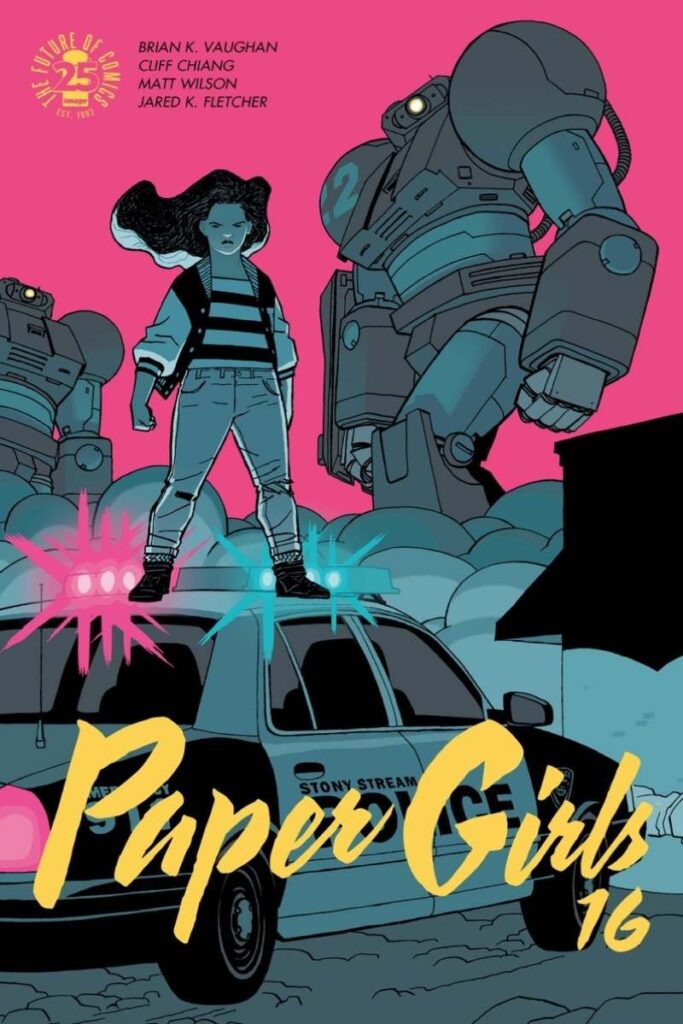
This aids the story’s flow, as it immediately jumps into the action rather than getting bogged down in an overly long presentation of each protagonist and the world around them. This is where Matt Wilson’s vibrant coloring steps in. It features bold colors that explode alongside the arrival of time travelers and rifts in space. His choice of palette gives a retro feeling that well matches the 80s setting. However, he manages to adapt to each changing setting, conveying the atmosphere of the moment. Last but not least, Jared K. Fletcher’s lettering completes the picture. He developed an original, alien-like alphabet for the time travelers’ language—a cypher for readers to solve at will—as well as employing fonts that reference the 1980s era.
The comic series won two Eisner Awards in 2016, as well as the Best New Series prize during the 2017 Harvey Awards. In 2022, a television adaptation debuted on Prime Video but was cancelled after the first season.
Tag