 Collections
 Magazine
 Exhibitions
 ITA version






East of Eden: How Netflix's Adaptation Explores Free Will and Social Expectations


Several reasons make East of Eden a family saga, chief among them that Netflix miniseries creator Zoe Kazan is Elia Kazan‘s grandchild. In 1955, Elia directed the homonymous film starring James Dean, and both works are based on Steinbeck‘s 1952 novel. While the movie focuses just on the final part of the book, the series embraces the whole plot.
This new adaptation, aired on October 1st, 2026, on Netflix, gives much more space to the character of Cathy (Florence Pugh), who acquires depth and facets. Yet, more than a portrayal of a feminist icon, Kazan realizes a moral parable that intertwines American history with a family saga to pose one of philosophy’s major questions once again: are humans children of a written destiny, or the result of their own choices?

- East of Eden and the Biblical Story of Cain and Abel
- Timshel: Can We Escape the Roles We Are Born Into?
- The American Dream and the Limits of Social Mobility
- Cathy Trask: Rejecting the Expected Role of Wife and Mother
- East of Eden: Cinematography, Production Design and Visual Symbolism
- Cathy Trask: Florence Pugh’s Transformation Through Costumes
- East of Eden: Identity and the Freedom to Choose
East of Eden and the Biblical Story of Cain and Abel
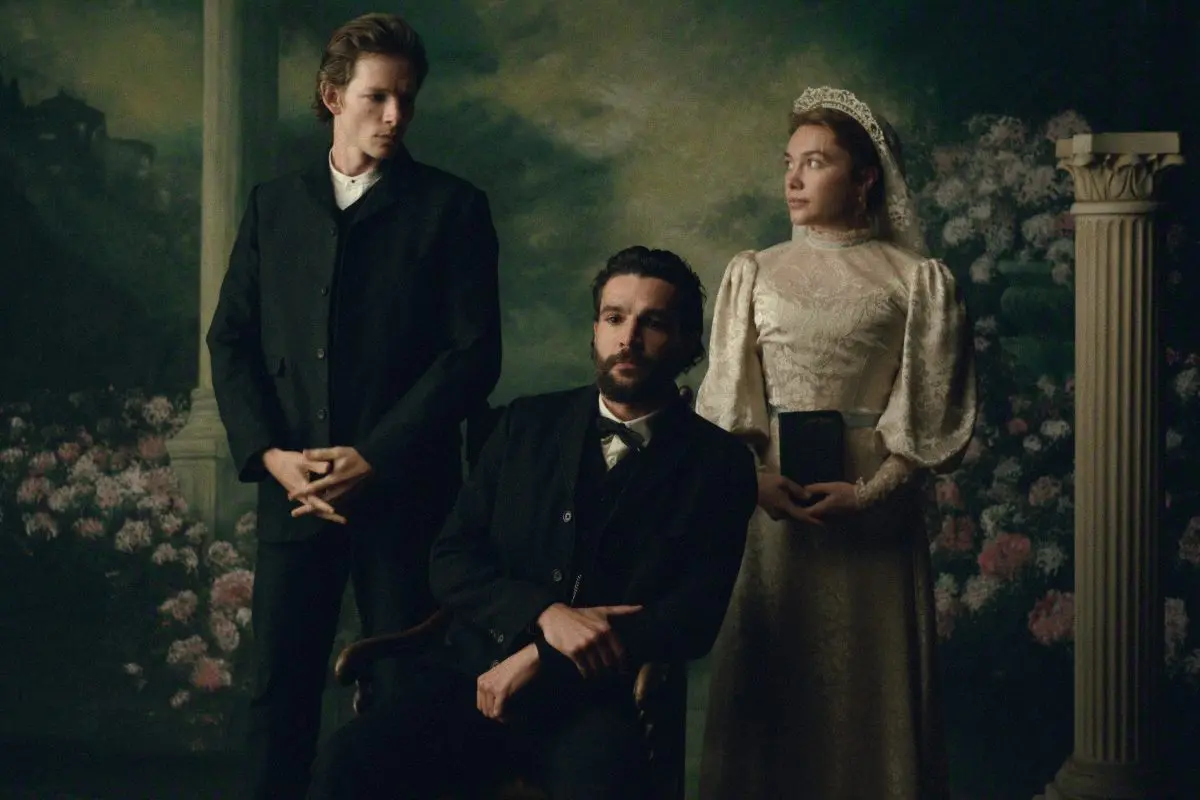
A beaten woman, covered with her own blood, crawls from the fields to a farm’s door. The farm belongs to Charles (Mike Faist) and Adam (Christopher Abbott), sons of the Civil War hero Cyrus Trask (Tracy Letts). Their reactions differ: “Call the doctor,” Adam screams; “It’s a mistake,” Charles answers. And they can’t even imagine how high the risk is.
The girl’s name is Cathy, and her wounds in body and spirit are so deep that she can’t speak. Under his brother’s pressure, Charles allows her to stay until she recovers. That’s enough for Adam to fall in love with her, ask her to marry him, and start a new life in California. He’s heard about the West, and like many Americans, he’s sure it’s a dreamland. He also begs Charles to join them, but he refuses, saying he must take care of their family’s land.
Yet, soon after the marriage, it becomes clear that Cathy doesn’t aspire to be the good wife she was raised to become. Nor does she want to be a good mother, even though she’s pregnant with their first child, as society would expect. When she leaves the man with their twins, she never looks back. On the contrary, even when Adam finds her in a brothel, she reaffirms she won’t be his wife anymore. And it’s just the beginning of her attempt to gain more and more power.
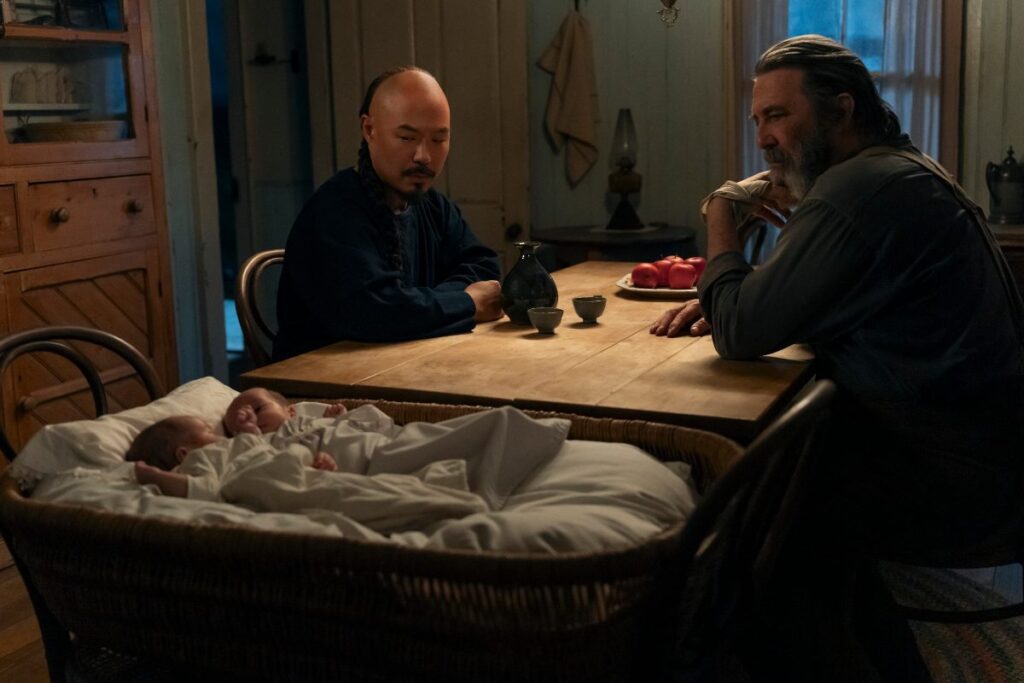
Adam thus finds himself a single father to Cal and Aron. Devastated by his loss, he raises them with the help of Lee (Hoon Lee), his loyal friend and servant. Meanwhile, as he wanders through life feeling lost, his children seem destined to retrace the same path he and Charles once followed: one marked by fraternal rivalry, the weight of paternal legacy, and the struggle between personal choice and destiny. From Charles and Adam to Cal and Aron, the conflict echoes the biblical story of Cain and Abel, its original archetype. Generation after generation, the brothers seem condemned to repeat the same pattern.
Timshel: Can We Escape the Roles We Are Born Into?
One of the narrative’s major strengths lies in its adaptation of a biblical parable. From the title on, the show (as well as the novel) retells the story of Cain and Abel from Genesis through two generations. Like the brothers in the Bible, Adam and Charles and Cal and Aron are bound by a partially rivalrous relationship that repeatedly forces them to choose whether to forget one another. Besides, the title itself is a reference, as Cain settles in East of Eden after killing Abel. However, compared with the novel, the show stresses the theme of “timshel” and its relevance over destiny.
The word “timshel” comes from Hebrew and can be translated as “thou mayest.” In opposition to the strong sense of predestination that looms over the family, the thimshel introduces the real possibility of self-determination. In the Bible, God pronounces this term to Cain, referring to his possibility to triumph over sin. Yet, he fails. Like him, the Trask brothers, generation after generation, seem stuck in a cycle of conflict, expectation, dreams, and grief. But the Timeless Shell offers a chance to break the cycle.
Cain surrenders to temptation and is exiled to the East of Eden. Adam Trask tries to escape and choose his land of exile. Yet they share the same destiny: coming from a pure existence, they face a new condition of being lost in a harsh land, which makes it easier to err. In this new condition, the fight between destiny and self-determination becomes urgent: an honest life is easy in comfort; it’s much harder when things get harder. It becomes even harder when the line between good and evil blurs, and one must understand what’s right and what isn’t.
The collision between written destiny and free will emerges in another renowned family saga: García Márquez’s A Hundred Years of Solitude. The Buendía family tries to avoid inherited patterns and reckon with their past. Even if they lead to different results, these attempts seem to renew the moral debate. As free, hard choices were the only possible ones, to become who one was born to be.
The American Dream and the Limits of Social Mobility
Adam’s decision to leave for the West is a physical attempt to distance himself from a written destiny as a soldier and the chosen son. After he contributed to the extermination of Native Americans, still wrongly considered a plague, he hopes for a new beginning. Like him, many others left hunger and poverty to reach a land where, apparently, everything grows miraculously.
With its wild, unexplored lands, West appears as the quintessence of the American Dream. Yet East of Eden shows how the dream can turn into a nightmare. West was also harsh, and some people couldn’t reach the fortune they hoped for. Furthermore, new inhabitants came from other countries, enriching the country with their cultures but also creating tensions.
Lee’s character, in particular, highlights the condition of immigrants, considered second-class citizens. He speaks with a very strong accent, but when he trusts Adam enough, he admits he wasn’t just born in America; he also studied philosophy, graduated, and speaks fluent, elegant English. Despite that, Americans still consider him a foreigner, and he can’t really feel like an equal in their society.
So he decides to act as they expect, building a character for himself. Though, doing so, he definitely renounces being seen for who he really is: a proponent of new American citizens. The ones (or, in his case, the children of the ones) arrived in America seeking the promised freedom of a new life, as new people in a land still being created, but faced a reality that judged them before they could prove who they could become. He embodies one of the American Dream’s greatest contradictions: he can’t really choose who to be. The others, who promised this possibility, will never see him as an American, so he can’t feel Chinese anymore. As a result, he becomes an outcast among outcasts.
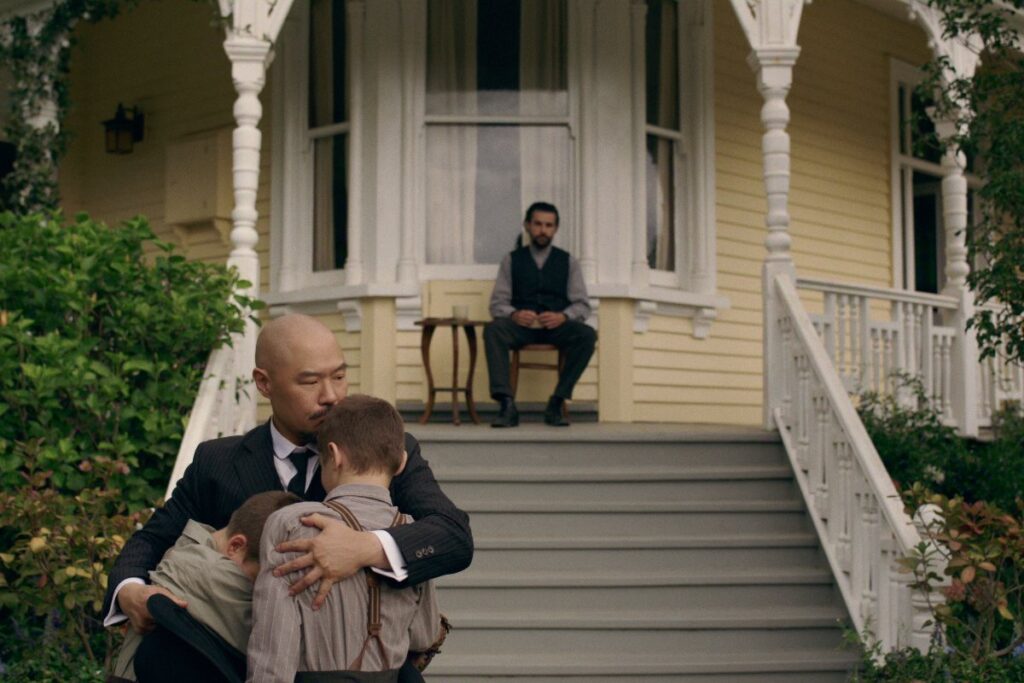
The show enacts the well-known contradictions of the myth of the American Dream, including excessive enthusiasm for impossible hopes and what happens when they crumble. The family story intertwines with that of a rising nation: still marked by the Civil War, yet already projecting toward the Great War, America seems like a character in its own right, doomed to eternal recurrence. The promise of a new beginning that draws people West is accompanied by the belief that the nation itself is destined for greatness. Patriotism becomes part of this collective identity, turning military service into an expression of duty and belonging.
Aron’s enthusiastic enlistment reflects this idealized vision of America. For him, joining the army is a chance to become part of something greater than himself and prove his worth. Yet the promise of self-determination that defines the American Dream is not always enough to overcome the limits society and history impose. This contradiction recalls F. Scott Fitzgerald‘s The Great Gatsby, where the possibility of reinventing oneself collides with the invisible barriers of social class. Both works question the idea that America offers everyone the same opportunity to pursue their own destiny, revealing the distance between the promise of freedom and the reality of those who try to claim it.
Cathy Trask: Rejecting the Expected Role of Wife and Mother
The collision between free will and determined destiny comes out most clearly in Cathy’s storyline.
I believe there are monsters born in this world to human parents. A monster is a variation from the accepted normal, to a greater or less degree… Still, you must not forget, everyone is normal to himself. And to a monster, the norm must seem monstrous.
John Steinbeck’s introduction of Cathy, used by Kazan, too
In the author’s original vision, Cathy was a completely negative character, the absolute negation of the timshel. She’s a sociopathic monster, unable to do any good action due to her indefatigable nature that conditioned her whole life. This trait also defines her in the show. Yet in the show, Cathy is much more multifaceted and gains depth: the horrible things she went through shape her character, but she chooses agency over pity. A conscious will to become the manipulative, dark anti-heroine drives all of her deeds.
Cathy is really the character that stayed with me, that I carried around and puzzled over. It was really important to me to stay rooted in the text of the book when it came to exploring who Cathy is. I wanted to make sure that she was a person and not just an archetype, and I think that really required me to do some unfolding rather than inventing.
Zoe Kazan in an interview for Tudum
As a woman in the late 19th Century, Cathy is among those who didn’t have access to the American Dream. Aspiring to gain independence in a male-dominated society, she soon realizes her appearance helps her earn others’ trust, and she starts using it to manipulate them. She was herself a manipulated victim of an older man, yet doesn’t hesitate to do the same with her husband. He’s just the first of many people she destroys to increase her power.
This behavior seems like a justified reaction to strict social roles, and because she wants to become independent, some see her as a feminist icon. Yet this interpretation seems too simple, as her decisions follow her personal interest rather than a moral or social ideal. Something similar happens in Monster: The Lizzie Borden Story, where the butcher immediately becomes a victim because of what she went through. The show aimed to portray a feminist icon, a victim who reacted to what she suffered. Though Lizzie’s actions are so insignificant, and whatever she does receives justification on behalf of her trauma, she turns into a mere caricature.
Cathy, on the other hand, appears as a complex, multilayered character, more than a victim. She’s not a mirror of what she went through, but what she chose to become after those events. Nevertheless, her interests are purely personal, and she never aims to improve the society that hurt her or to fix injustices. She embodies selfishness, so she never becomes a feminist heroine. Yet, her character paves the way to relevant reflection upon society. In East of Eden, Kazan stresses that a woman should receive the same human understanding as men (which doesn’t always happen), while still remaining faithful to Steinbeck’s creature, even though she’s not pure determinism. Cathy doesn’t become a model of emancipation, but she still emerges as a fully developed result of her free choices.
East of Eden: Cinematography, Production Design and Visual Symbolism
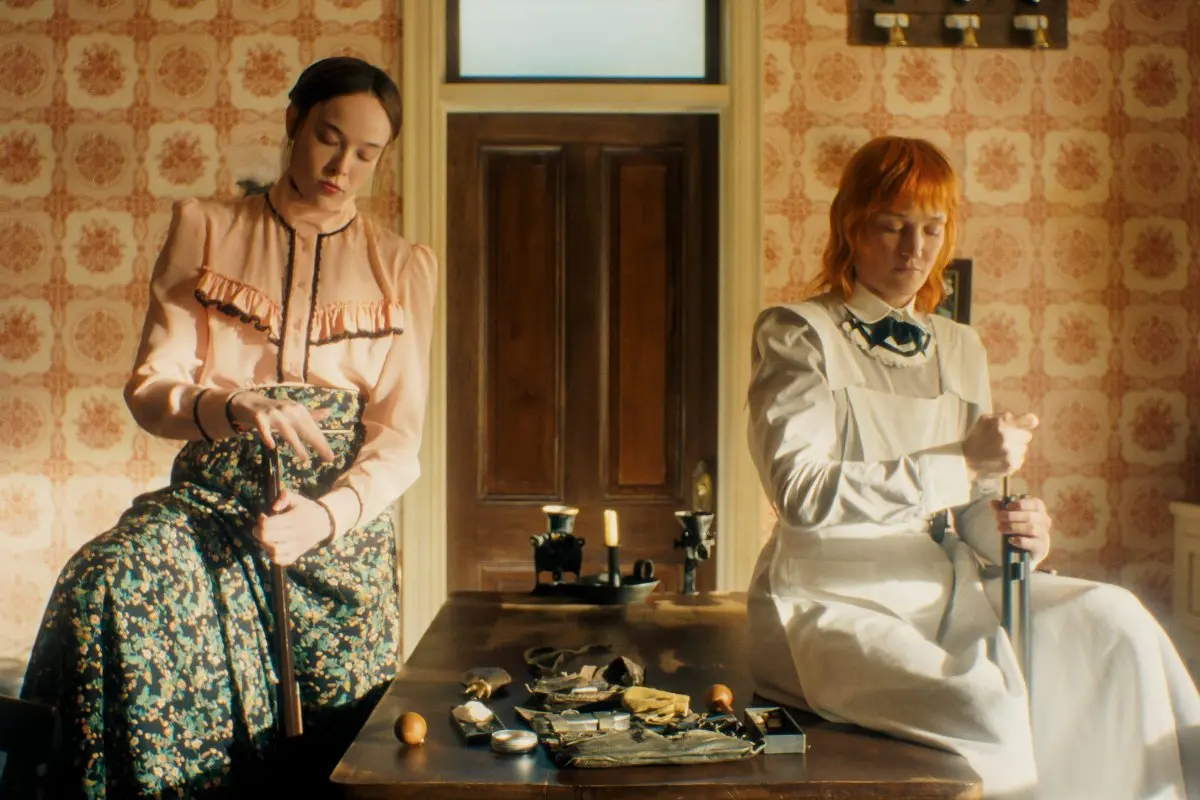
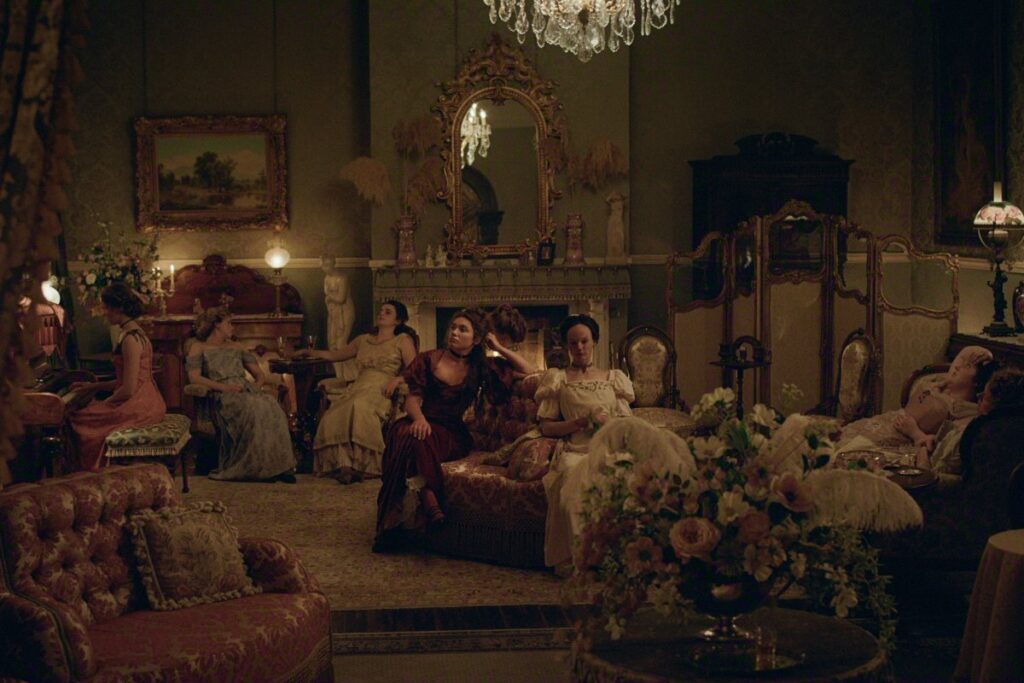
Despite being set in California, the Old West of East of Eden is reconstructed in New Zealand. Grant Major, who had already worked there (and won an Academy Award) for The Lord of the Rings, was responsible for the set. In an interview with The Set Set, he explained how they shaped different locations to reflect the characters, particularly Cathy’s personality and mood. In her childhood home and the one she shares with Adam, everything is extremely neutral and classic, mirroring the life she should lead as an angel of the hearth. But whenever she can truly inhabit a room, decorations and details that reflect her tastes enrich it.
Cinematographers Stuart Dryburgh and Sam Chiplin helped create the atmosphere with a distinctive use of light and color. They opted for wide shots pervaded by warm, golden light outside, depicting a world of hope. Dreamlike sunshine bathes views over boundless lands, suggesting how Adam should have seen the West. Inside shots are much darker and oppressive, reflecting the spirits of their inhabitants. Charles’ farm, with small and dimly lit rooms, mirrors his loneliness and the darkest side of his soul. That’s especially evident in the brothel where Cathy lives: initially reflecting its first keeper, in the end it becomes completely black, reflecting the oppression she feels but also wants her visitors to feel.
Cathy Trask: Florence Pugh’s Transformation Through Costumes
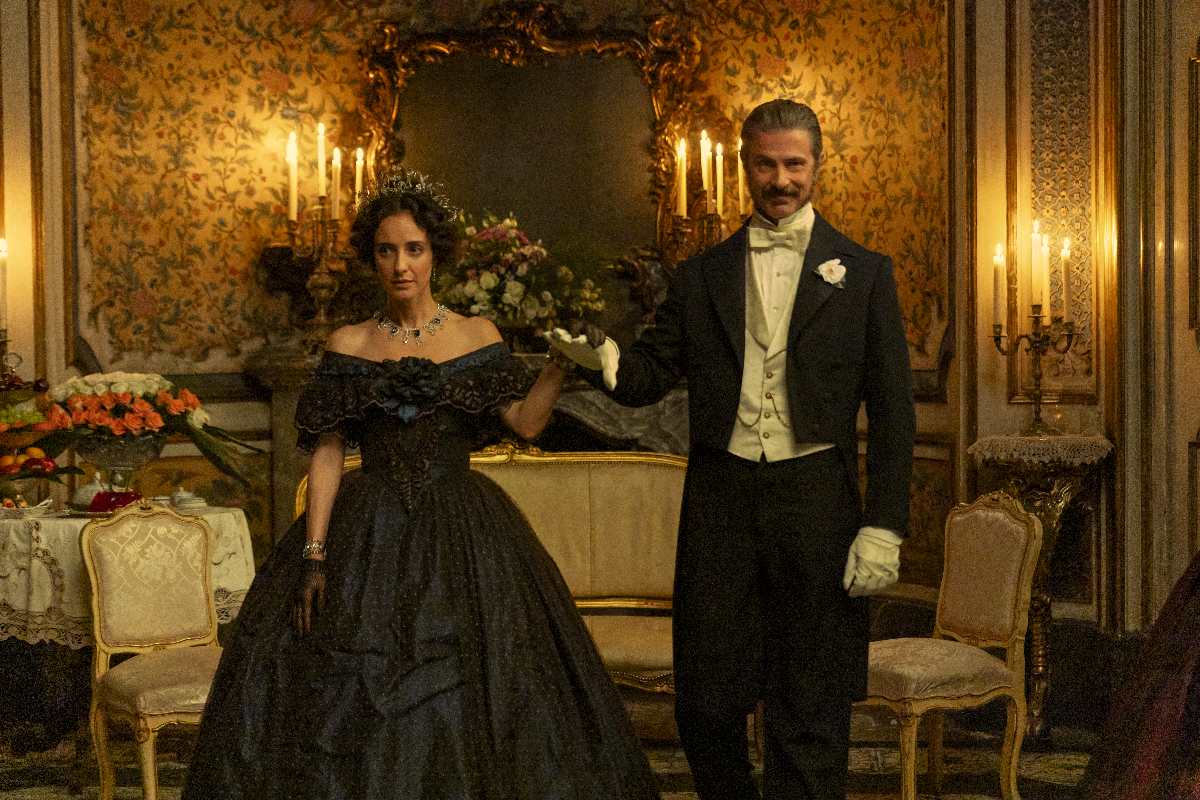
Cathy’s evolution is also mirrored in her costumes, created by Kirsty Cameron (who previously worked on The Power of the Dog). The designer drew inspiration from period pictures and paintings, creating carefully detailed, personalized clothes. She also wanted Cathy’s wardrobe to reflect her growing manipulative attitude. Initially, she builds a version of herself that shows how pure and innocent she is: pastel colors, simple, chaste dresses. But later, from when she moves into the brothel, they become more and more provocative and lavish, although different from the prostitutes’ ones. Finally, in her last transition, she opts for an all-black wardrobe and lots of jewels, reflecting the power she has gained.
Her character goes through so many changes. When she’s a child, she’s being dressed by her mother and being brought up to be a wife, which she never intends to be. She plays along with it, so there’s already an artifice in what she’s wearing.
Kirsty Cameron in an interview with Vogue
This character is central to the narrative thanks to Florence Pugh‘s performance. Her work already granted her an Academy Award nomination for Little Women, but in East of Eden she becomes even more expressive. Pugh’s performance brings life to a more multifaceted character: the novel describes her as a monster, while the show gives her depth and a layered backstory. Her Cathy completes Kazan’s interpretation, as she aimed to give the story a very peculiar female gaze.
East of Eden: Identity and the Freedom to Choose
Kazan makes the timeless story even more relevant by turning morality into everyday philosophy. The constant debate between self-determination and written destiny also challenges the concept of free will. If everyone is shaped by their past, East of Eden asks whether anyone can distance themselves from it. If Cathy’s development shows that female independence doesn’t always lead to real emancipation, the family-saga structure underscores the impossibility of escaping the eternal recurrence of a scheme. Yet, the show seems to suggest everyone can escape their legacy. The “timshel”, which already played a central role in the novel, acquires even more importance as a possibility of redemption. Cathy doesn’t become a good character, though she’s not even a flat allegory of evil. As Cal’s decisions show, he’s not doomed to be like his mother; he can break the circle.
Moreover, East of Eden underlines how destiny affects choices, but so does social conditioning. Lee shapes his character like Americans expect him to be. Cathy is expected to be a wife and mother, and betraying that expectation transforms her into a monster. Yet it also shows that social judgment is not insurmountable.
As with many parabolas and timeless tales, the show’s strength lies more in posing moral questions than in giving answers. The show is a faithful adaptation not only in retracing the original narrative, but especially in respecting Steinbeck’s spirit. Kazan doesn’t try to modernize the story; instead, she shows how timeless some themes are.
Although the ending offers no consolation, it also offers no clear-cut resolution. Free will implies a major choice: surrender to what others think is your nature, or act to be a better version of it. Depending on that, anyone can be Cathy, or Adam, or Cal, mastering one’s own destiny despite external influences. This suggests that everyone’s responsible for the person they aspire to become.
Tag