 Collections
  Magazine
  Exhibitions
  ITA version












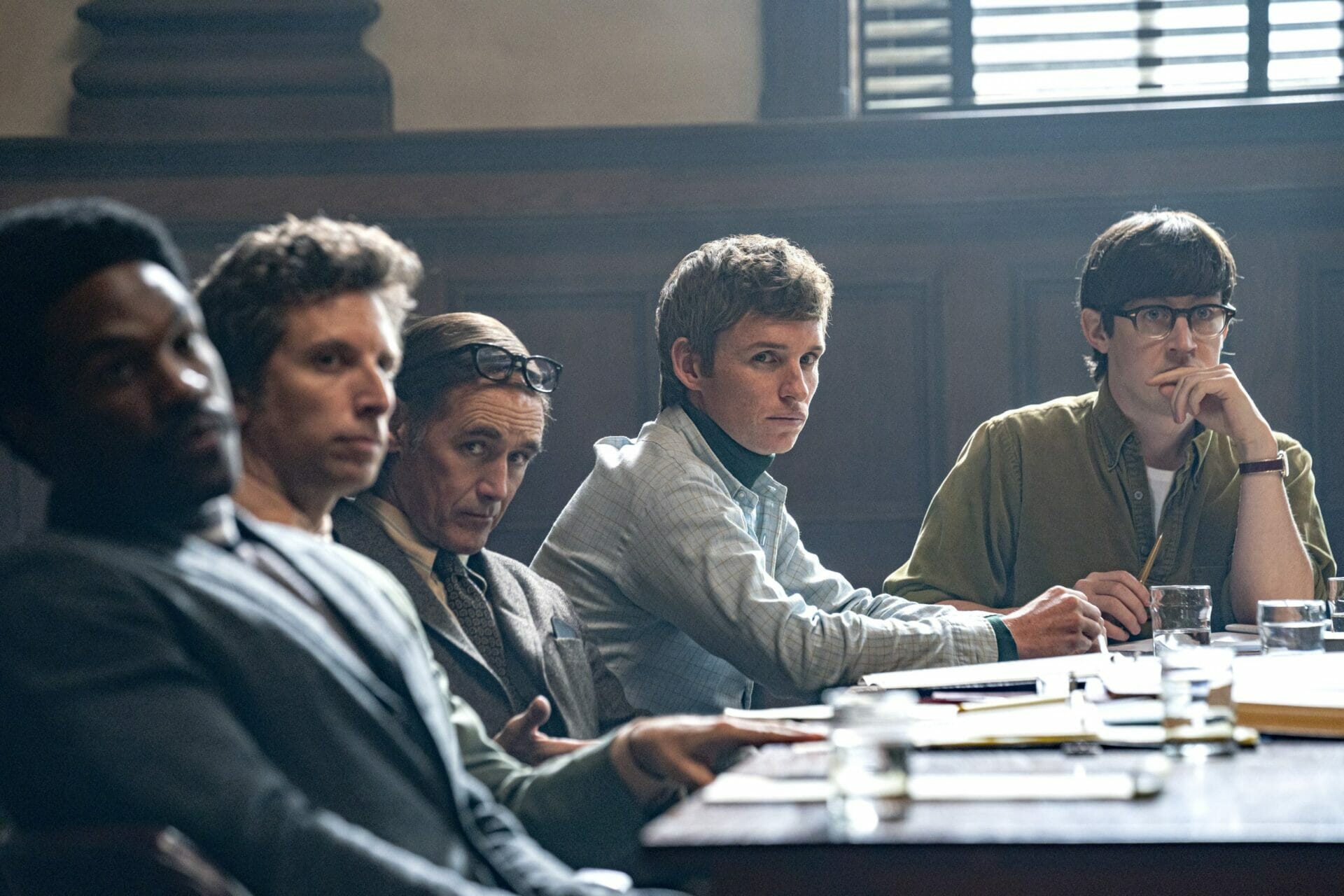
The Trial of the Chicago 7 | A movie about today


Runtime
By
Abbie Hoffman, Jerry Rubin, David Dellinger, Tom Hayden, Rennie Davis, John Froines, and Lee Weiner: these are the men known as the Chicago 7, charged with conspiracy and intent to incite riots at the 1968 Democratic National Convention in Chicago. Hailing from different states across America, of different ages, and representing political groups from the Yippies (Youth International Party) to the Mobe (National Mobilisation Committee to End the War in Vietnam), they were nevertheless united by their ardent opposition to the Vietnam War. Moreover, they had starring roles alongside their lawyer William Kunstler and Black Panther leader Bobby Seale- in one of the most ludicrous, theatrical, and highly publicised trials in American history.
Irresistible material for filmmakers
Aaron Sorkin’s second directorial adventure after his 2017 debut Molly’s Game, The Trial of the Chicago 7 is not the only dramatization of the infamous proceedings. The first one appeared in 1987 with Jeremy Kagan’s Conspiracy: The Trial of the Chicago 8, followed by Brett Morgen’s 2007 Chicago 10 and Pinchas Perry’s 2011 The Chicago 8. Time and again, the nearly six months of transcripts and courtroom antics have proven irresistible material for filmmakers, lending themselves to the screen with a potent mix of the farcical and the deadly serious.
Sorkin especially finds himself at home in the fast-flying, high-pressure exchanges between the defendants and the loathsome Judge Julius Hoffman (unrelated to Abbie Hoffman), informed by his experience writing other legal dramas such as A Few Good Men and The Social Network, and his predilection for the spatial constraints of the theatre.
Stepping outside the courtroom
Yet the film’s actual relevance comes when Sorkin, self-described as a puppy who likes his crate, pushes himself to step outside into the chaos of 1968. Leveraging his trademark precision and borderline mathematical structure, he intercuts courtroom scenes with flashbacks to the moments leading up to the riots of August 28, splicing in archival footage to lend a realistic punch, in the same way as Ben Affleck’s 2012 Argo.

At times, he bends facts and chronology to fit his narrative better. He simplifies the personalities of his ensemble cast (featuring Sacha Baron Cohen, Eddie Redmayne, Joseph Gordon-Levitt, and Michael Keaton) to avoid overwhelming the picture, but he does so with intention. Indeed, he defines the film as a painting, not a photograph, going even further to say, “… this movie is not about 1968, it’s about today.”
A poignant moment in history
That helps explain, then, why the script Sorkin began writing in 2007 only made it to the screen in 2020. The Chicago 7 trial has always been a poignant moment in American history, a collision of the new and the old, of idealism and tradition. But the fulmination of the Black Lives Matter movement, compounded with four years under the Trump administration, has effectively reignited the energy of the 1960s, inspiring films like Ava DuVernay’s Selma and Raoul Peck’s I Am Not Your Negro, and prompting a renaissance for the writings of James Baldwin.
It was more than 50 years ago that Rennie Davis, in addressing Judge Hoffman, said:
You represent all that is old, ugly, bigoted, and repressive in this country, and I will tell you that the spirit of this defense table will devour your sickness in the next generation.
Watching Sorkin’s The Trial of the Chicago 7 in 2020, it’s hard not to feel like that promise is coming true.
Tag